
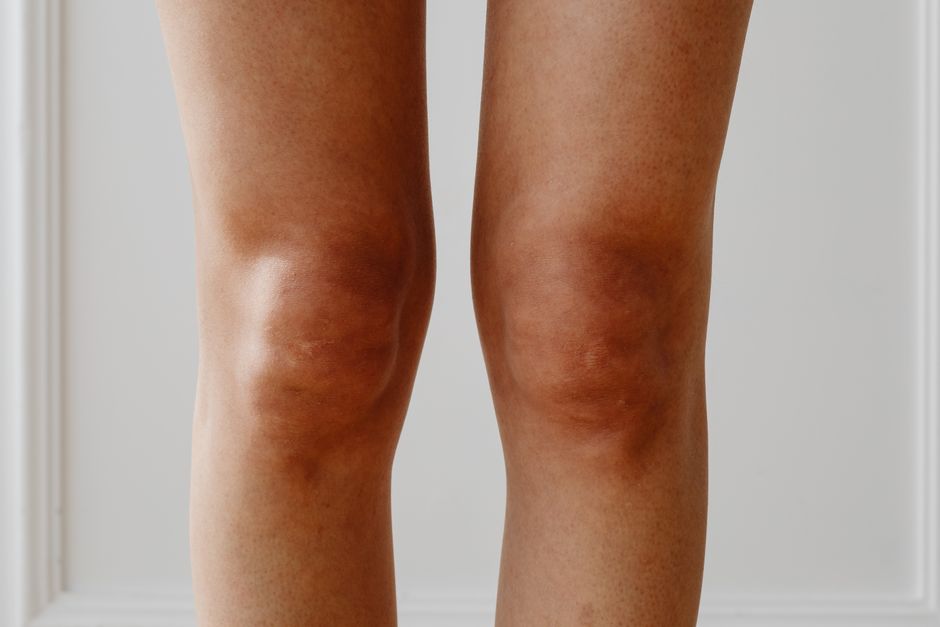
Knock knees in adults is a structural problem, not a posture habit, and that changes what actually works. If your knees touch but your ankles stay apart when you stand with your feet and legs relaxed, the alignment is coming from the angle of your thigh bone, your knee joint, or both. No exercise can change the shape of a bone. But strengthening the muscles around the hip and knee can reduce pain, improve how you walk, and slow the stress that leads to arthritis. For some adults, surgery is the only way to correct the alignment itself. This guide walks through what helps, what does not, and how to know which group you are in.
What Does It Mean To Have Knock Knees As An Adult?
The medical term is genu valgum. It describes a knee that angles inward so the lower leg drifts outward. When you stand with your feet together, the knees touch or nearly touch while a gap remains between the ankles.
Some inward angle is normal. Most adults have a slight valgus alignment at the knee, and in women it tends to be a little more pronounced because of a wider pelvis. The line of force through the knee normally passes slightly to the outside of the joint center.
The question that matters is how much, and whether it is changing. A small angle that has been stable for decades is usually not a problem. A larger angle, or one that has increased over time, puts extra load on the inner compartment of the knee. That is the part of the joint most affected by valgus alignment, and it is where cartilage wear tends to show up first.
Knock knees is also different in adults than in children. In young children, mild knock knees is a normal stage of growth that usually corrects itself by around age 7 to 8 without treatment. In adults, the alignment is set. It does not resolve on its own.
What Causes Knock Knees In Adults?
Most adult cases fall into a few categories. Knowing which one applies to you affects what treatment makes sense.
- Osteoarthritis of the outer knee compartment. As cartilage wears on the outer side, the joint space narrows and the knee drifts further inward. This is one of the most common causes in older adults, and it tends to progress.
- Prior injury or surgery. A fracture near the knee that healed at a slight angle, or certain knee surgeries, can shift alignment.
- Rheumatoid arthritis. Inflammatory arthritis can damage joint surfaces and change alignment over time.
- Metabolic bone disease. Conditions such as rickets or renal osteodystrophy soften or deform bone. These are much less common in adults in the US but are real causes.
- Genetic or developmental factors. Some people simply have a natural valgus alignment that has been present since adolescence.
There is also a mechanical loop worth understanding. Once the knee tilts inward, more load shifts to the inner joint surface. That extra load wears cartilage faster, which can increase the angle further. This is why alignment and arthritis are so tightly linked, and why the direction of the problem matters for treatment.
When Should You See A Doctor About Knock Knees?
See a clinician if the alignment is new, is getting worse, or comes with pain, swelling, or instability. A single leg that has become more angled than the other is a specific reason to get evaluated.
Imaging usually starts with weight-bearing X-rays of both legs. Standing films matter because they show the joint under real load. A full-length standing X-ray lets the clinician measure the mechanical axis — the line from the center of the hip to the center of the ankle — and see exactly how much of the load is passing through the inner or outer side of the knee.
Blood tests may be ordered if inflammatory arthritis or a metabolic bone condition is suspected. These are not routine for everyone.
It is also worth being clear about what a clinician can and cannot do. They can measure the alignment, assess the cartilage, and identify the cause. They cannot make a structural deformity disappear with exercise. If anyone promises that, get a second opinion.




How To Fix Knock Knees In Adults: What Actually Works
There is no exercise that straightens a bone. What exercise can do is change the forces around the joint. Strong hip abductors and external rotators, and a strong quadriceps, help control how the knee tracks during walking and reduce the load that lands on the inner compartment. For many adults with mild alignment and pain, this is the mainstay of treatment.
Physical therapy is usually the first step. A therapist will assess your hip strength, gait, and foot position. Common targets include the gluteus medius, gluteus maximus, and quadriceps. A therapist may also look at your foot mechanics, since flat feet can add to inward rotation of the whole leg.
Weight matters more than most people expect. Every pound of body weight puts several pounds of force through the knee during walking. Losing excess weight reduces that load directly. This is one of the few interventions with strong evidence behind it for knee osteoarthritis pain.
Bracing and shoe inserts are sometimes used. Evidence for their effect on alignment itself is limited. Some people report less pain with a valgus unloading brace or with orthotics, but studies have not consistently shown that these change the underlying angle. They may help symptoms in some people and not others.
Surgery is the only option that changes the alignment. The two main approaches are:
- Osteotomy. The surgeon cuts the bone near the knee and realigns it, then fixes it with plates or screws. This is often used in younger, more active adults with arthritis limited to one side of the knee. It shifts load off the worn side.
- Knee replacement. Partial or total replacement is generally considered for older adults or those with more widespread joint damage. The alignment is corrected as part of the procedure.
Which one fits depends on your age, activity level, how much cartilage is left, and where the damage sits. These are decisions made with an orthopedic surgeon, not from an article.
Can Exercises Fix Knock Knees Without Surgery?
Exercises cannot change the angle of the bone. They can change strength, pain, and function. That distinction is the whole point.
Some studies suggest that hip strengthening reduces knee pain and improves function in people with valgus alignment and knee osteoarthritis. The effect on the alignment itself is not established. So if your goal is a straighter leg, exercise alone will not get you there. If your goal is less pain and better walking, it can help.
A typical program focuses on the hip and thigh. Examples include side-lying leg raises, clamshells, and step-downs, all progressed gradually. A physical therapist can tailor these to your knee and make sure you are not aggravating the joint. Doing more is not better here. Doing the right movements consistently is.
One clarification that surprises people: stretching rarely helps. Knock knees is not a tightness problem in most adults. It is a structural one. Stretching may feel good but will not change the alignment.
Does Knock Knees Always Lead To Arthritis?
No. Alignment is a risk factor, not a guarantee. Many adults have mild knock knees and never develop significant arthritis. Others with the same angle do.
What raises the risk is the combination of a larger angle, ongoing high load through the joint, and time. The inner compartment of a valgus knee takes more stress with every step. Over years, that can wear cartilage faster than it would in a neutrally aligned knee. But the relationship is not one-to-one, and other factors — genetics, weight, injury history, and activity — all play a role.
This is why monitoring matters. If the angle is stable and you have no pain, there may be nothing to do beyond staying active and keeping your weight in a healthy range. If the angle is increasing or pain is starting, that is the point to get evaluated rather than wait.
What Lifestyle Changes Help Most?
The changes that help are the ones that reduce load on the knee and keep the muscles around it strong.
- Keep your weight in a healthy range. This is the single most impactful factor for knee load.
- Stay active with low-impact exercise such as swimming, cycling, or walking on flat ground.
- Strengthen your hips and thighs with guidance from a physical therapist.
- Avoid deep squats and high-impact jumping if they cause pain.
- Address foot mechanics if a clinician identifies them as contributing.
None of this reverses the alignment. All of it can reduce pain and protect function. That is a realistic goal, and it is worth being honest that it is different from “fixing” the angle.
Frequently Asked Questions
Can knock knees be fixed in adults without surgery?
The alignment itself cannot be corrected without surgery, but pain and function can often improve with physical therapy, weight management, and activity changes. Exercise strengthens the muscles around the knee but does not change the bone angle.
Is knock knees in adults serious?
Mild, stable knock knees without pain is usually not serious. A larger or worsening angle raises the risk of inner knee arthritis over time and is worth evaluating with weight-bearing X-rays.
What exercises help knock knees in adults?
Hip and thigh strengthening — such as side-lying leg raises, clamshells, and step-downs — can reduce pain and improve walking. A physical therapist should tailor the program, since these exercises do not change the alignment itself.
Can knock knees get worse with age?
Yes, especially when osteoarthritis is present. As cartilage wears on the outer knee, the angle can increase, which shifts more load to the inner joint and can accelerate the process.
