
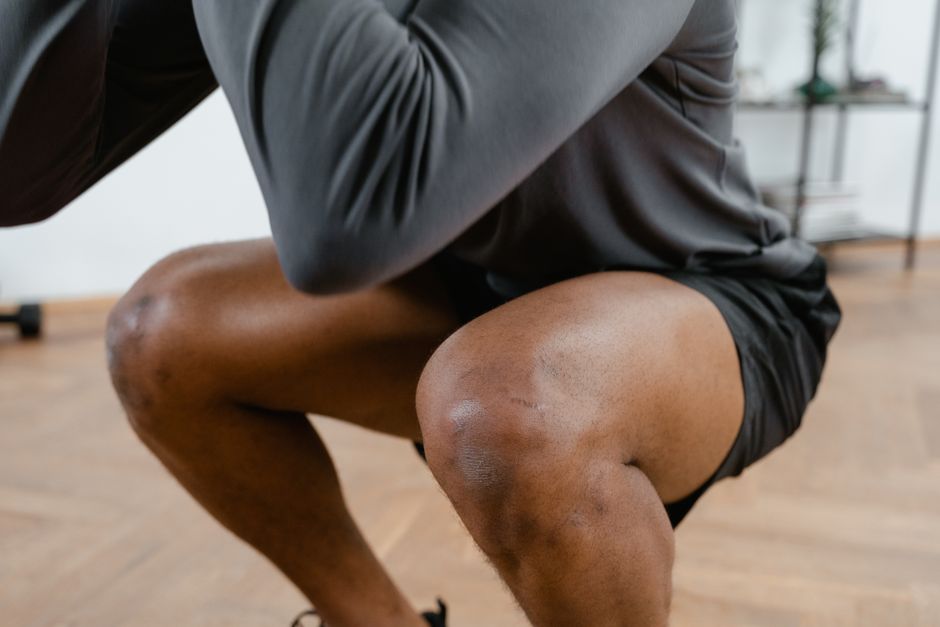
Knee pain from squats is usually a load problem, not a knee problem. Most cases come from doing more volume, depth, or weight than your knees and surrounding muscles are currently conditioned to handle. Fix it by finding the depth and load you can control without pain, then rebuilding strength and technique gradually from there. Pain that comes with swelling, locking, instability, or that persists at rest needs a medical assessment rather than a training tweak.
Why Do Squats Hurt My Knees?
The knee is a hinge that sits between two very mobile joints. The hip above it and the ankle below it both influence how force travels through the knee during a squat. When either one moves poorly, the knee often absorbs the difference.
During a squat, the kneecap (patella) glides along a groove in the thigh bone. The force across that joint increases as the knee bends deeper. That is normal physiology, not damage. Knees are built to tolerate substantial load. The trouble starts when the load rises faster than the tissue can adapt.
Common contributors include:
- Too much load too soon. A sudden jump in weight, reps, or frequency outpaces tissue recovery.
- Ankle stiffness. Limited ankle bending forces the knees and torso to compensate.
- Hip weakness or poor control. The knee drifts inward under load, which changes joint stress.
- Depth beyond current control. Going deeper than you can stabilize increases demand on the patellofemoral joint.
- Rushing the descent. Fast lowering reduces control and raises peak forces.
One point that gets lost: knee position during squats varies a lot between healthy people. Some forward knee travel is normal and not inherently harmful. The old advice to never let knees pass the toes is not supported as a universal rule. What matters is control and load tolerance, not a single joint angle.
How Do I Know If It Is Serious?
Most squat-related knee pain is what clinicians call mechanical pain. It shows up with activity, eases with rest, and does not involve true joint damage. Some signs point to something that needs a professional look.
Seek medical assessment if you notice:
- Swelling that develops quickly after activity
- The knee locking, catching, or giving way
- Pain at rest or pain that wakes you at night
- Pain after a specific twist, fall, or pop
- Redness, warmth, or fever alongside knee pain
These features can suggest injury to ligaments, cartilage, or menisci, or another condition. A physical exam is the reliable way to sort it out. Imaging is sometimes useful but not always necessary, and findings on scans do not always match symptoms.
For pain that is clearly tied to training and settles with rest, self-management is reasonable to try first. If it does not improve over a few weeks of sensible adjustment, get it checked.
How To Fix Knee Pain From Squats For Good
The durable fix is a combination of load management, technique work, and strength building. There is no single cue or stretch that resolves it. The goal is to raise your knees’ tolerance for squatting so the same movement stops provoking pain.
Step 1: Dial back to a pain-free range
Find a squat depth and weight you can perform without pain. That might mean a shallower squat, a lighter load, or both. This is not permanent. It is a starting point you build from. Training through sharp pain tends to prolong the problem rather than toughen the knee.
Step 2: Slow the movement down
Control the descent over a few seconds instead of dropping quickly. Slower, controlled reps reduce peak forces and give you time to keep the knee tracking well. This change alone often reduces symptoms for people who squat fast.
Step 3: Build strength around the knee and hip
Stronger quadriceps, glutes, and hip muscles help the knee handle load. Evidence supports strength training as a core approach for common knee pain. Squat variations, split squats, step-ups, and hip-focused work all count. Progress load gradually rather than in big jumps.
Step 4: Improve ankle mobility if it is limited
If your ankles cannot bend enough, your squat mechanics suffer. Calf stretches and ankle mobility drills can help over time. Some lifters use a small heel elevation to squat more comfortably while they work on ankle range.
Step 5: Manage total volume
Knee pain often tracks with weekly squat volume more than any single session. Spacing squat days out and avoiding sudden spikes in reps or sets gives tissue time to adapt. This is where most people go wrong: they fix technique but keep piling on volume.
Expect improvement over weeks, not days. Tissue adaptation takes time. Consistency with moderate load beats occasional heroic sessions.



Should I Stop Squatting Until It Heals?
Complete rest is rarely necessary and often counterproductive. Knees generally tolerate and benefit from continued movement at a level they can handle. The key is adjusting load rather than stopping entirely.
A reasonable approach is to keep squatting at a reduced depth or weight that stays comfortable, while you build strength and mobility. If a movement reliably provokes pain, modify it rather than push through. Swapping in a leg press, box squat, or split squat can keep you training while the knee calms down.
Prolonged avoidance can make the knee less tolerant of load over time. Gradual exposure, within a comfortable range, is the more reliable path for most mechanical knee pain.
What About Knee Sleeves, Braces, and Supplements?
Knee sleeves can improve comfort and warmth during squats. They do not fix the underlying load or strength issue. Some lifters find them helpful; the evidence that they prevent injury is limited.
Supplements marketed for joint health, such as glucosamine and chondroitin, have been studied extensively. Results across trials have been mixed, and major clinical guidance does not endorse them as a reliable treatment for knee pain. If you are considering any supplement, talk to a clinician or pharmacist first, especially if you take other medications.
No product replaces the fundamentals: appropriate load, good control, and progressive strength work.
When Should I See a Professional?
See a doctor or physical therapist if pain persists despite several weeks of sensible training adjustments, if it is getting worse, or if any of the warning signs above appear. A physiotherapist can assess your movement, identify specific weaknesses or restrictions, and build a plan matched to your situation.
For most people with training-related knee pain and no red flags, self-guided adjustment works. Professional input speeds things up when progress stalls or the cause is unclear.
Frequently Asked Questions
Is it bad if my knees go past my toes during squats?
No, that is a normal and safe position for many people. Knee travel past the toes is not inherently harmful; control and load tolerance matter more than a fixed angle.
How long does squat-related knee pain take to go away?
Many people notice improvement within a few weeks of adjusting load and building strength. Timelines vary widely, and pain that does not improve or gets worse should be assessed by a clinician.
Can I squat with knee pain?
Often yes, at a reduced depth or weight that stays comfortable. If a movement reliably provokes sharp pain, modify it and build back gradually rather than pushing through.
Do knee sleeves or braces fix knee pain from squats?
They can improve comfort during lifting but do not address the underlying cause. Strength, load management, and technique are what resolve most training-related knee pain.
