
Crowded teeth are one of the most common reasons adults seek orthodontic care, and many people want to know if there is a way to fix them without traditional braces. The honest answer is that real options exist, but they depend on how severe the crowding is, your age, and whether the underlying cause is purely dental or involves the jaw. Clear aligners, retainers, and some forms of limited tooth movement can address mild to moderate crowding. Severe crowding often still requires orthodontic treatment that includes braces or aligners with attachments, and sometimes extractions or jaw surgery.
What Actually Causes Crowded Teeth?
Crowding happens when there is not enough space in the jaw for all the teeth to sit in proper alignment. The teeth overlap, rotate, or get pushed forward or backward.
The most common cause is a size mismatch. The combined width of your teeth is larger than the available arch length of your jaw. This is largely genetic. It runs in families, and it can appear even when baby teeth came in straight.
Other causes include early loss of baby teeth, which lets neighboring teeth drift into the empty space, and late loss of baby teeth that can block permanent teeth from erupting in the right position. Thumb sucking and prolonged pacifier use past the age when permanent teeth start coming in can also shift the arch shape. In adults, crowding can worsen over time because teeth continue to shift slowly throughout life, and the lower front teeth are often the first to show it.
One point worth clarifying: crowding is not caused by “small jaws” in a simple sense. It is a relationship between tooth size and jaw size. Two people can have the same jaw dimensions and very different crowding depending on how large their teeth are.
Can Clear Aligners Fix Crowded Teeth Without Braces?
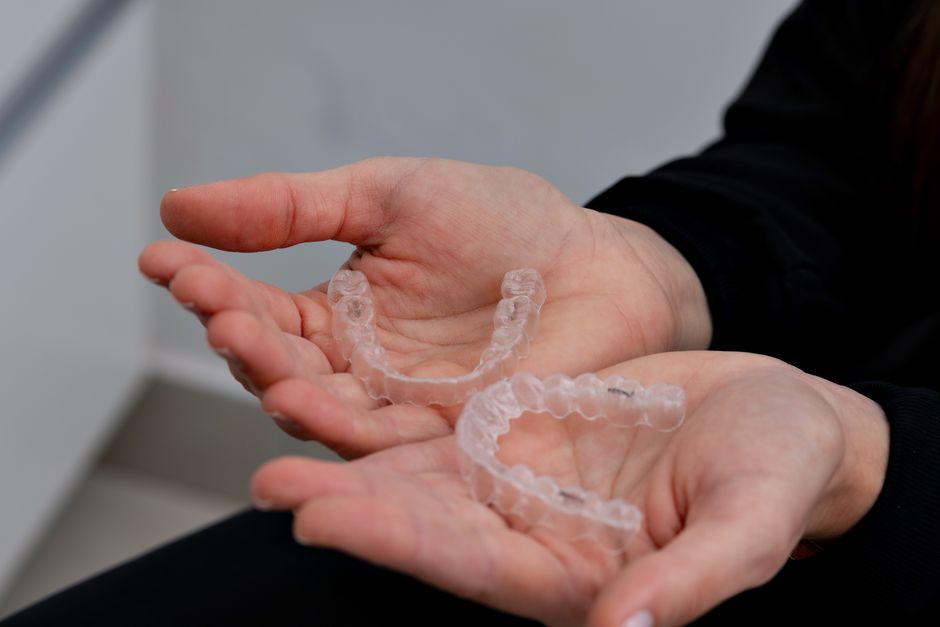
Clear aligners are the most common braces-free option, and for mild to moderate crowding they can work well. Aligners are removable plastic trays custom-made from a digital scan of your teeth. They apply controlled pressure to move teeth in small increments.
Aligners work best when the required movement is straightforward. Mild crowding, minor rotations, and small spacing issues are generally within their range. Moderate crowding may still be treatable, but often requires attachments, which are small tooth-colored bumps bonded to certain teeth to give the aligner more grip.
For severe crowding, aligners alone are usually not enough. Complex movements, large rotations, and significant bite corrections are harder to achieve with removable trays. In these cases, orthodontists typically recommend fixed braces or a combination approach.
Aligner treatment also depends heavily on compliance. Most aligners need to be worn around 20 to 22 hours a day. If they are removed too often, teeth do not move as planned. This is one of the most common reasons aligner treatment fails to deliver the expected result.
Aligners are not a shortcut around orthodontic diagnosis. They still require a proper exam, X-rays in many cases, and a treatment plan. Buying mail-order aligners without an in-person evaluation carries real risk, because underlying bite problems, gum disease, or jaw issues can be missed.
What About Retainers and Minor Tooth Movement?
Retainers are not a treatment for crowding in most cases. They are used to hold teeth in position after treatment. However, there is one exception worth knowing.
If crowding is very mild and limited to a small shift, some dentists use a removable retainer or a fixed retainer wire to hold teeth and prevent further movement. This does not straighten teeth. It stabilizes them.
There is also a procedure called interproximal reduction, sometimes called slenderizing. A small amount of enamel is removed from the sides of teeth to create space. This is often combined with aligners or braces, not used alone. It can help resolve mild crowding, but it does not correct rotations or significant overlap on its own.
Another option some people ask about is expansion. In children and teenagers whose palatal suture has not yet fused, a palatal expander can widen the upper jaw and create space. In adults, the suture is fused, so expansion works differently and is more limited. Adult expansion usually requires surgery-assisted techniques for skeletal change, or it produces only dental tipping rather than true jaw widening.





When Are Braces or More Involved Treatment Still Needed?
Braces remain the most reliable way to correct severe crowding. They give the orthodontist precise control over each tooth in three dimensions. That control matters when teeth need to be rotated significantly, moved vertically, or when the bite itself needs correction.
Sometimes crowding is so severe that space cannot be created without removing teeth. Premolar extractions are a well-established approach in orthodontics when the arch is too small for all the teeth. This is not a failure of treatment. It is a planned part of it.
In some cases, the crowding is not just a tooth problem. It is a jaw problem. If the upper or lower jaw is too narrow or positioned incorrectly, orthodontics alone may not fully correct it. Jaw surgery combined with orthodontics may be recommended. This is uncommon, but it is a real option for certain skeletal cases.
Age also matters. Children and teenagers are still growing, which gives orthodontists more options for guiding jaw development. Adults have finished growing, so treatment focuses on moving teeth within the existing bone. This does not mean adults cannot be treated. It means the approach may differ.
Do Home Remedies or DIY Methods Work?
No. There is no evidence that home remedies straighten crowded teeth. Rubber bands, filing teeth at home, or pushing teeth with fingers do not work and can cause serious harm.
Moving teeth safely requires controlled force applied over time. Too much force can damage the root, the bone, or the gum. Teeth can loosen, die, or be lost. DIY tooth filing removes enamel permanently and increases the risk of decay and sensitivity.
Mail-order aligner services that skip in-person exams have drawn scrutiny from dental professional organizations. Some patients have received aligners that did not fit properly or that addressed the wrong problem. The concern is not that aligners are unsafe. It is that treatment without proper diagnosis can miss issues that matter.
What Should You Do If You Want to Avoid Braces?
Get an orthodontic evaluation. This is the single most useful step. An orthodontist can tell you whether your crowding is mild, moderate, or severe, and whether aligners are a realistic option.
Ask specific questions during the consultation.
- Is my crowding dental only, or is there a jaw component?
- Are aligners appropriate for my case, or would braces give a better result?
- Will any teeth need to be removed to create space?
- How long is treatment expected to take?
- What happens if I do not treat this now?
It also helps to understand that not all crowding needs treatment. Mild crowding that does not affect your bite, your gum health, or your ability to clean your teeth may not require correction. The decision is not just about appearance. It is about function, hygiene, and long-term dental health.
If you do pursue treatment, expect that retainers will be part of the plan. Teeth have a natural tendency to shift back toward their original position. Without retention, even a perfect result can relapse. This is one of the most consistent findings in orthodontics.
How Do the Main Options Compare?
| Option | Best For | Limitations |
|---|---|---|
| Clear aligners | Mild to moderate crowding | Requires high compliance; less effective for severe or complex cases |
| Traditional braces | Mild to severe crowding | Fixed, visible, harder to clean |
| Retainers | Holding teeth in place after treatment | Do not straighten teeth |
| Interproximal reduction | Creating small amounts of space | Usually combined with other treatment; not a standalone fix |
| Palatal expansion | Children and teens with narrow upper jaw | Limited in adults without surgery |
| Extractions plus orthodontics | Severe crowding with insufficient arch space | Involves tooth removal; requires full orthodontic treatment |
What Happens If Crowded Teeth Are Left Untreated?
Not everyone with crowded teeth will develop problems. But crowding can make certain issues more likely.
Overlapping teeth are harder to clean. This raises the risk of plaque buildup, cavities, and gum inflammation in those areas. In some people, crowding contributes to uneven wear on teeth or to bite problems that can cause jaw discomfort over time.
The evidence on how often crowding leads to serious problems is not clear-cut. Many people live with mild crowding for decades without significant issues. The decision to treat should be based on your specific situation, not on a blanket assumption that all crowding must be fixed.
Frequently Asked Questions
Can crowded teeth be fixed without braces?
Yes, for mild to moderate crowding, clear aligners are a common braces-free option. Severe crowding usually still requires braces or a combination of treatments.
How long does it take to fix crowded teeth with aligners?
Treatment time varies widely depending on the case, and no single timeline applies to everyone. Your orthodontist can give you a realistic estimate after evaluating your teeth.
Do I still need a retainer after aligner treatment?
Yes. Retainers are needed after any orthodontic treatment, including aligners, because teeth tend to shift back over time without retention.
Can I fix crowded teeth at home without a dentist?
No. DIY methods like rubber bands or filing teeth can cause permanent damage and do not straighten teeth. A proper evaluation is needed before any treatment.
