
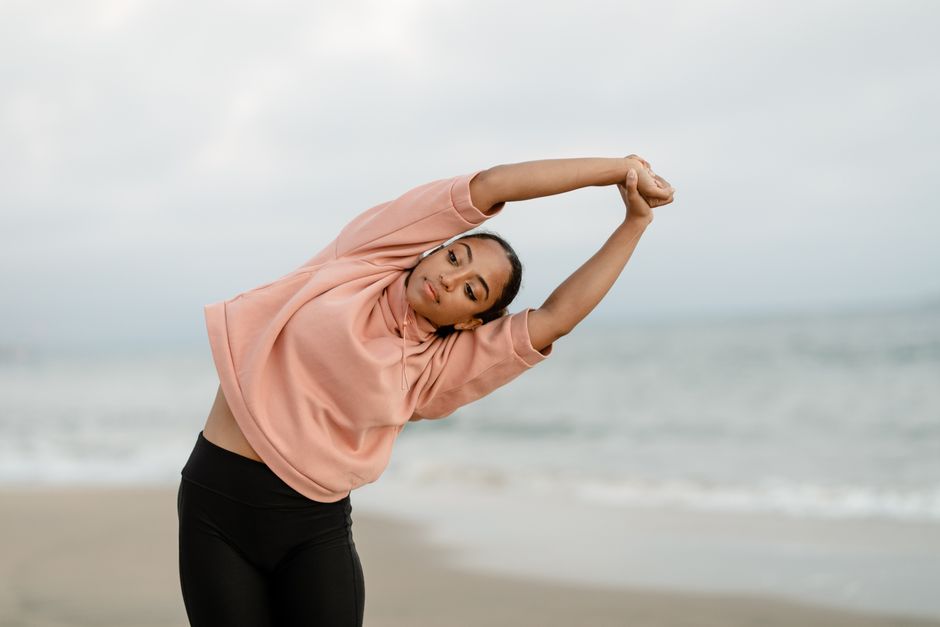
A rotated hip can cause lower back pain, uneven wear in your hip joint, and a noticeable difference in how your legs feel when you stand. It happens when the muscles around your pelvis pull the hip bone out of its neutral position. You can fix a rotated hip with stretches and exercises by releasing tight muscles, strengthening weak ones, and retraining your pelvis to sit level again. Most people see meaningful improvement within four to eight weeks of consistent daily work.
What Does a Rotated Hip Actually Mean?
A rotated hip is not a joint that has popped out of place. The hip joint itself is deeply seated in its socket. What rotates is the pelvis — the large bone structure that your legs attach to. When the pelvis tilts or twists forward, backward, or to one side, your hip joint angles change with it.
This is often called an anterior pelvic tilt when the front of the pelvis drops down and the tailbone lifts up. A posterior pelvic tilt is the opposite — the tailbone tucks under and the lower back flattens. A lateral tilt means one side of the pelvis sits higher than the other.
These positions are not diseases. They are postural habits that develop over time. Sitting for long hours, standing with most of your weight on one leg, and repetitive movement patterns all train your muscles to hold the pelvis off-center. The muscles on one side get short and tight. The muscles on the opposite side get long and weak.
How Do You Know If Your Hip Is Rotated?
Stand in front of a full-length mirror with your feet hip-width apart. Place your hands on your hip bones — the bony points at the front of your pelvis. Look at whether both hands are at the same height. If one side sits higher, you likely have a lateral pelvic tilt.
Now look at your side profile. If your lower back arches dramatically and your belly sticks out forward, you may have an anterior tilt. If your lower back looks flat and your hips tuck under, you may have a posterior tilt.
Another simple test: lie on your back with your legs straight. Have someone look at your ankles. If one foot points outward more than the other, the hip on that side is likely rotated. This happens because the leg follows the position of the pelvis.
These self-checks are useful starting points, but they cannot diagnose you. If you have real pain, numbness, or weakness, see a physical therapist or doctor. Imaging is sometimes needed to rule out structural problems like hip impingement or labral tears.
Can Stretches and Exercises Really Fix a Rotated Hip?
Yes, in most cases. The rotation is a muscle imbalance, not a bone deformity. Muscles respond to training. When you lengthen the tight ones and strengthen the weak ones, the pelvis can return to a neutral position.
Research consistently shows that targeted exercise programs reduce pelvic tilt angles in people with postural imbalances. Studies measuring anterior pelvic tilt before and after exercise programs have found meaningful reductions in tilt angle over several weeks. The key is consistency and correct exercise selection.
What will not fix it is a single session of stretching. The muscles have held this position for years. They need daily, repeated input to change length and strength. Think of it like learning a new posture — your brain and muscles need reps.
It is also worth knowing that some rotation is normal. No human pelvis is perfectly symmetrical. The goal is not perfection. The goal is reducing the tilt enough that you move without pain and your joints wear evenly.




Stretches for a Rotated Hip
Before you stretch, identify which direction your hip rotates. Stretching the wrong muscles can make the problem worse. If you have an anterior tilt, your hip flexors and lower back are tight. If you have a posterior tilt, your hamstrings and glutes are tight.
For an anterior pelvic tilt, the hip flexors are the primary problem. The psoas muscle runs from your lower spine to the front of your thigh. When it is short, it pulls the pelvis forward.
Half-kneeling hip flexor stretch: Kneel on one knee with the other foot flat on the floor in front of you. Squeeze your glute on the kneeling side and gently push your hips forward. You should feel a stretch in the front of the thigh on the kneeling leg. Hold for 30 seconds. Repeat three times per side.
Knee-to-chest stretch: Lie on your back. Pull one knee toward your chest while keeping the other leg straight on the floor. This stretches the lower back and helps release the lumbar spine. Hold for 30 seconds. Repeat three times per side.
For a posterior pelvic tilt, the hamstrings are often the tight muscle group. Tight hamstrings pull the back of the pelvis down.
Supine hamstring stretch: Lie on your back with one leg straight up in the air. Loop a towel or strap around the ball of your foot and gently pull the leg toward you. Keep the knee straight. Hold for 30 seconds. Repeat three times per side.
Figure-four stretch: Lie on your back with both knees bent. Cross one ankle over the opposite knee. Gently pull the bottom thigh toward your chest. You will feel this in the glute and outer hip. Hold for 30 seconds. Repeat three times per side.
Exercises to Strengthen the Supporting Muscles
Stretching alone will not hold the pelvis in place. You need strength in the muscles that pull the pelvis into neutral. The glutes, core, and deep abdominal muscles are the primary stabilizers of the pelvis.
Glute bridge: Lie on your back with your knees bent and feet flat on the floor. Squeeze your glutes and lift your hips until your body forms a straight line from shoulders to knees. Hold for two seconds and lower slowly. Do three sets of 15 repetitions. This strengthens the glutes, which pull the back of the pelvis down.
Dead bug: Lie on your back with your arms pointing straight up and your knees bent at 90 degrees. Slowly lower your right arm and left leg toward the floor while keeping your lower back pressed into the ground. Return to start and switch sides. Do three sets of 10 repetitions per side. This trains your core to stabilize the pelvis while your limbs move.
Side-lying leg raise: Lie on your side with your legs straight. Lift the top leg about 45 degrees without letting your hips roll forward or backward. Lower slowly. Do three sets of 15 repetitions per side. This strengthens the gluteus medius, which controls lateral pelvic tilt.
Bird dog: Start on your hands and knees. Extend your right arm forward and left leg backward at the same time. Keep your pelvis level — do not let it rotate. Hold for two seconds and return. Do three sets of 10 repetitions per side.
These exercises work because they train the muscles to hold the pelvis still while other body parts move. That is exactly what your pelvis needs to do during walking, running, and daily activity.
How Often Should You Do These Exercises?
Daily is ideal for the first few weeks. The stretches can be done every day. The strengthening exercises should be done at least five days per week.
Each session takes about 15 to 20 minutes. That is the commitment level required to change a muscle imbalance that developed over years. Missing a day here and there will not ruin your progress, but consistency matters more than intensity.
You should feel mild discomfort during stretches — a pulling sensation — but never sharp pain. If an exercise causes joint pain or a pinching feeling in the hip, stop and check your form. Pain is a signal that something is wrong, not something to push through.
Most people notice their posture feels different within two weeks. The visual change in the mirror often takes longer. Give yourself at least eight weeks before judging whether the program is working.
Daily Habits That Undo Your Progress
Exercise is only half of the fix. Your daily habits can undo everything you accomplish in your workout session.
Sitting is the biggest contributor to rotated hips. When you sit, your hip flexors shorten. After hours of sitting, they pull your pelvis forward the moment you stand. If you work at a desk, stand up and walk for two minutes every hour. This alone can significantly reduce hip flexor tightness.
Sleeping position also matters. Side sleepers often rotate their top hip forward. Placing a pillow between your knees keeps the pelvis neutral while you sleep. Back sleepers can place a pillow under their knees to reduce lower back arch.
Standing on one leg is another common habit. Many people stand with most of their weight on one leg while waiting or talking. This trains the pelvis to sit tilted. Practice standing with your weight evenly distributed on both feet.
Wearing shoes with elevated heels also contributes. High heels force the pelvis into an anterior tilt. If you wear heels regularly, the exercises above become even more important.
When Stretches and Exercises Are Not Enough
Some rotated hips do not respond to exercise. If you have been consistent for eight to twelve weeks and see no improvement, it is time to see a professional.
A physical therapist can assess your specific muscle imbalances and design a program tailored to your body. They can also identify movement compensations you might not notice yourself. Sometimes the problem is not the hip at all — it is a foot, knee, or spine issue that causes the pelvis to rotate as a compensation.
In rare cases, a structural problem is present. Hip impingement, labral tears, or early arthritis can cause the pelvis to rotate as the body tries to avoid pain. These conditions do not improve with stretching alone and may require medical treatment.
If you have pain that radiates down your leg, numbness, or weakness, do not wait. See a doctor. These symptoms can indicate nerve involvement that requires professional evaluation.
Frequently Asked Questions
How long does it take to fix a rotated hip?
Most people see meaningful improvement within four to eight weeks of daily stretching and strengthening. Full correction can take three to six months depending on how long the rotation has been present.
Can a rotated hip cause back pain?
Yes, a rotated pelvis puts uneven stress on the lower back and can cause muscle strain and joint discomfort. Correcting the rotation often reduces or eliminates this pain.
Should I see a doctor for a rotated hip?
See a doctor if you have sharp pain, numbness, weakness, or if exercises do not help after eight to twelve weeks. A physical therapist can also assess your specific imbalances and create a targeted program.
Is a rotated hip the same as a hip dislocation?
No, a rotated hip is a postural muscle imbalance, not a joint injury. The hip joint stays in its socket — the pelvis tilts around it. Real dislocations require emergency medical care.
