
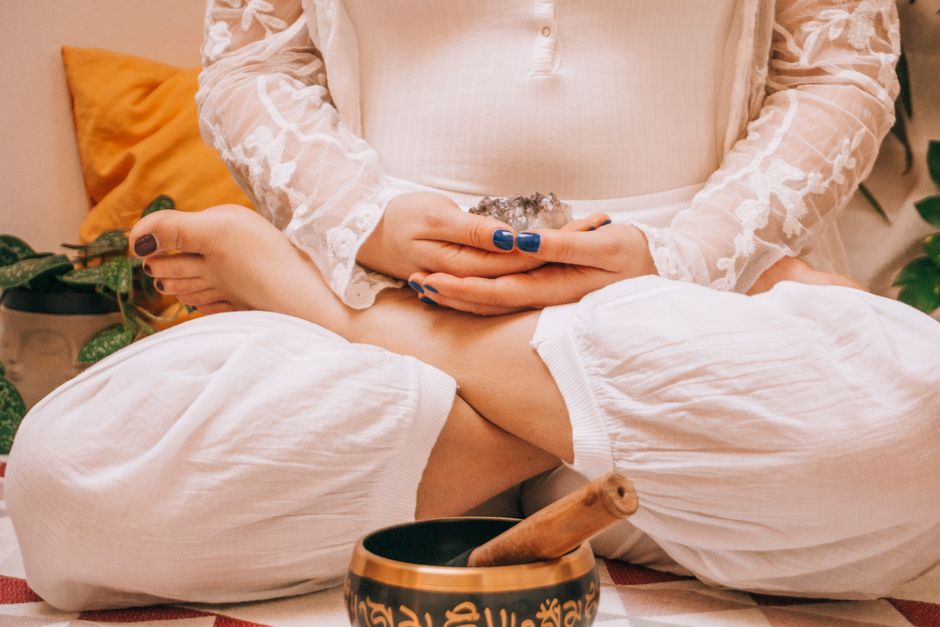
Finding your aura colour is a process of quiet observation, not a test you can pass or fail. The method involves relaxing your eyes, softening your focus, and paying attention to the colours that appear around a person’s body — most commonly around the head and shoulders. You can do this on yourself in a mirror or on a willing friend in good lighting. The key is to trust what you see after a few minutes of patient looking, not what you think you should see.
What Is An Aura, Really?
An aura is described as an energy field that surrounds living things. Some people see it as a coloured halo or a faint glow. Others sense it as a temperature change or a feeling in the air around someone.
There is no scientific evidence that auras exist as measurable physical energy. No instrument has ever detected an aura. That does not stop the practice from being meaningful to many people. For those who practice aura reading, the colours are thought to reflect mood, personality, or health at that moment.
You do not need to believe in a spiritual energy field to try this. Many people find it a useful exercise in focused attention. It trains your eyes and your mind to notice subtle visual details you usually ignore.
What Do You Need To See Your Aura?
You need three things: a plain background, soft lighting, and time. A white or light grey wall works best. Avoid busy patterns or strong colours behind the person you are observing.
Lighting matters more than most people expect. Bright overhead light creates glare that washes out faint colours. Dim light makes it hard to see anything at all. A soft, indirect light source — like a lamp aimed at the wall rather than at the person — gives the best results.
Time is the third requirement. Your eyes need a few minutes to adjust. Most people give up after thirty seconds. Plan to spend at least five minutes on your first attempt.
How To Find Your Aura Colour: Step By Step
Start by standing or sitting about two to three feet away from a plain wall. If you are doing this alone, place a mirror on a stand so you can see your head and shoulders comfortably.
Relax your body first. Take a few slow breaths. Roll your shoulders. Blink normally. Tension in your face or neck makes it harder to keep your gaze soft.
Now look at the edge of your body — the outline of your shoulder or the top of your head. Do not stare directly at one point. Let your eyes go slightly out of focus, the way they do when you are daydreaming.
Hold that soft focus for one to two minutes without looking away. At first you may see a faint outline of light around your body. This is normal. It is often a thin, clear line that looks like a heat shimmer on a hot road.
Keep watching that edge. After a few more minutes, a colour may appear in the space around your body. It often looks like a soft glow or a haze. The colour may shift or change while you watch. Note the first colour that appears and stays steady for more than a few seconds.
Write the colour down. Do not judge it. Just record what you saw.




What Do The Colours Mean?
There is no universal dictionary of aura colours. Different traditions assign different meanings. That said, some interpretations appear consistently across many sources.
Red is often linked to energy, passion, or strong emotion. Orange is associated with creativity and enthusiasm. Yellow is tied to mental activity, optimism, and focus. Green is frequently connected to growth, healing, and calm. Blue is seen as communication, calm, or intuition. Purple or violet is linked to spiritual awareness or deep insight. Pink is often read as love or compassion. White or gold is described as clarity or high spiritual energy.
These meanings are descriptive, not diagnostic. No study has confirmed that a specific aura colour predicts personality or health. Treat the interpretation as a starting point for self-reflection, not as a medical or psychological assessment.
Some practitioners believe your aura colour changes with your mood and circumstances. A calm day might show blue. A stressful day might show red or grey. If you check your aura on different days and see different colours, that is consistent with how most aura readers describe the practice.
Why Do Some People See Nothing At All?
Not seeing a colour on your first try is completely normal. Many people never see auras, even after years of practice. This does not mean you are doing anything wrong.
The visual effect that most people describe as an aura may have a simple physical explanation. When you stare at a bright or contrasting edge for a long time, your eyes produce an afterimage. This is a well-documented visual phenomenon. The colours you see in an afterimage are the opposite of the colours you were looking at — a phenomenon called opponent process theory in vision science.
This means some of what people see as auras may be a normal function of the visual system rather than a perception of an external energy field. That does not make the experience less real to the person seeing it. It just means there may be a scientific explanation for part of the effect.
If you see nothing after several attempts, you have two options. You can accept that aura reading may not be for you. Or you can keep practicing with the understanding that this skill — like many visual skills — improves with time for some people and never develops for others.
Common Mistakes When Trying To See An Aura
Most failed attempts come down to a few fixable errors.
Staring too hard. The harder you stare, the less you see. Your eyes need to be relaxed and slightly unfocused. Think of looking through the person rather than at them.
Giving up too soon. Your visual system needs time to adapt. Three minutes is a reasonable minimum. Five minutes is better for a first attempt.
Using a patterned background. Stripes, wallpaper, or even a textured wall confuses your visual system. You need a flat, plain surface.
Expecting a bright, vivid colour. Most aura colours are subtle. They look like a faint tint in the air, not like a neon sign. If you expect something dramatic, you may miss the subtle version.
Checking your results too often. Looking away to check the wall or your phone resets your focus. Stay with the soft gaze for the full session.
Can You Photograph An Aura?
You will see claims online about aura photography. Some studios offer a service where you place your hands on metal plates and receive a photo showing coloured light around your body.
This technology does not measure an aura. It measures skin temperature and electrical conductivity through sensors in the plates. The colours in the photo are generated by a computer program based on those readings. Two different machines can produce different colours for the same person.
Some people enjoy aura photography as a fun experience or a conversation starter. It is not a scientific measurement. No research has confirmed that the colours in these photos correspond to any external energy field or to your personality.
Should You Trust What You See?
Your perception is your own. If you see a colour around your body or someone else’s, that is a real visual experience. Whether it represents an energy field or a quirk of your visual system, the experience itself is genuine.
What you should not do is make major life decisions based on an aura reading. No evidence links aura colours to health conditions, relationship compatibility, or career success. If someone offers to diagnose a medical or psychological condition from your aura, that is not supported by any scientific evidence.
Use aura reading for what it is: a personal practice of attention and self-reflection. The colours you see can prompt you to think about your mood, your energy levels, and your state of mind. That kind of reflection has value on its own, regardless of what causes the colours to appear.
Frequently Asked Questions
How long does it take to see your aura?
Most people need at least three to five minutes of relaxed, soft-focused looking before any colour appears. Some people see results on the first try, while others need several sessions.
Can anyone learn to see auras?
Some people never see auras no matter how long they practice, and that is normal. The skill improves with practice for some individuals, but there is no guarantee it will work for everyone.
Do aura colours change over time?
Many practitioners believe aura colours shift with mood, stress, and life circumstances. Checking on different days may show different colours, which is consistent with how most aura readers describe the practice.
Is there scientific proof that auras exist?
No instrument has ever detected an aura as a measurable energy field. Some visual effects people call auras may be explained by normal afterimage phenomena in the eye.
