
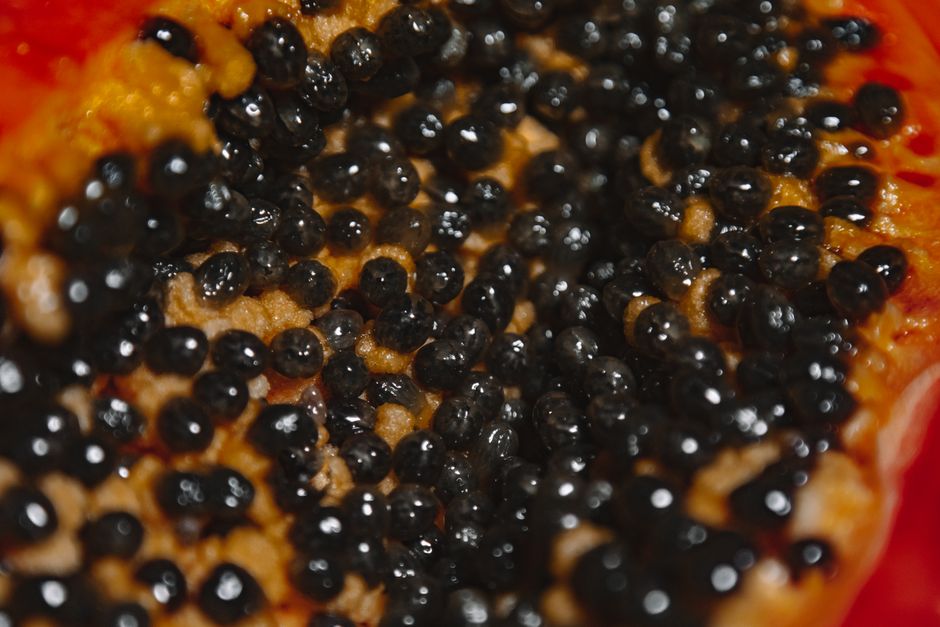
Papaya seeds are edible, and people do blend them into smoothies or chew them raw as a digestive aid. There is no established clinical evidence that eating papaya seeds causes weight loss in humans. The seeds contain compounds with antimicrobial and antioxidant activity, but no human trial has shown they reduce body weight, body fat, or waist size.
If you want to try them, the practical approach is small amounts, dried and ground, mixed into food or drinks. Treat them as a food, not a weight loss treatment. Any real weight change will come from your overall diet and activity, not from the seeds themselves.
What Are Papaya Seeds and Are They Safe to Eat?
Papaya seeds are the small, black, glossy seeds in the center of a ripe papaya. They have a sharp, peppery taste, similar to mustard or cress. People in parts of Asia and Latin America have long used them as a traditional remedy for stomach upset and intestinal parasites.
They are not toxic in the way apple seeds or apricot kernels are. Those seeds contain cyanogenic compounds that release cyanide. Papaya seeds do not. That said, “not toxic” is different from “safe in any amount.”
The seeds contain benzyl isothiocyanate, a compound also found in mustard and wasabi. In laboratory studies, this compound shows activity against certain bacteria and parasites. Laboratory findings are not the same as clinical results in people. Most of the human research on papaya seeds and parasites is small and older, and it does not meet the standard of modern clinical trials.
Papaya seeds also contain small amounts of papain, the same enzyme found in papaya flesh. Papain breaks down protein. In large amounts it can irritate the mouth, throat, and stomach lining.
Practical safety points:
- Start with a very small amount, such as a quarter teaspoon of ground seeds, to see how your stomach reacts.
- Chew them well or grind them. Whole seeds pass through largely undigested.
- Avoid them if you are pregnant. Papaya seeds have traditionally been used to influence menstruation, and no safety data exists for pregnancy.
- Avoid them if you have a known allergy to papaya or related fruits. Cross-reactivity with latex is possible in people with latex allergy.
- Avoid them if you take blood thinners or have a bleeding disorder. There is no strong human evidence of a blood-thinning effect, but papain and related enzymes have shown effects on clotting in lab studies, and the risk is not worth taking without medical advice.
No clinical guidelines exist for a safe upper dose of papaya seeds in adults, and no guidelines exist at all for children, pregnant women, or breastfeeding women.
How to Eat Papaya Seeds for Weight Loss
There is no established method, dose, or timing that produces weight loss from papaya seeds. What follows is how people typically consume them, not a proven weight loss protocol.
Scoop the seeds out of a ripe papaya and rinse off the slippery orange pulp. Spread them on a plate or tray and let them dry for a day or two at room temperature, or dry them in a low oven. Dried seeds are easier to grind and keep longer. Store them in a sealed jar away from light.
Common ways people use them:
- Ground into a powder and stirred into a smoothie, yogurt, or oatmeal
- Sprinkled whole over salads for a peppery crunch
- Blended into juice or a dressing
- Steeped in hot water as a tea, though the heat may break down some of the enzymes
If you want to try them, a common starting point is about a quarter teaspoon of ground seeds once a day. Some traditional preparations use up to a teaspoon. There is no reliable evidence that higher amounts work better, and higher amounts are more likely to cause stomach upset.
Take them with food, not on an empty stomach. That reduces the chance of irritation. If you notice burning in your mouth, nausea, or stomach pain, stop and do not increase the amount.
None of this will cause weight loss on its own. If you eat the same number of calories and move the same amount, adding papaya seeds changes nothing about your weight.
Why Papaya Seeds Do Not Cause Weight Loss
Weight loss happens when you take in fewer calories than your body burns, sustained over time. That is the core mechanism, and it holds regardless of what specific foods you eat.
Papaya seeds do not change that equation in any meaningful way. They contain calories, mostly from fat and protein, and fiber. A typical serving of a teaspoon or less contributes very few calories. That is not enough to matter either way.
Three claims about papaya seeds show up often. Each one falls apart under scrutiny.
Claim one: they speed up metabolism. No human study has measured a change in resting metabolic rate from eating papaya seeds. The idea likely comes from lab studies on isolated compounds, which is a long way from a person eating a teaspoon of seeds.
Claim two: they block fat absorption. No human trial supports this. The compounds in papaya seeds have not been shown to inhibit fat-digesting enzymes in a way that reduces calorie absorption in people.
Claim three: they kill parasites, and parasites cause weight gain. Intestinal parasites can cause weight loss, not weight gain, in most cases. And the evidence that papaya seeds treat parasites in humans is weak and dated.
There is one honest point in favor of papaya seeds for weight management, and it has nothing to do with the seeds themselves. Adding a strong-flavored, low-calorie item to meals can make plain food more interesting. If that helps you eat more vegetables and fewer processed snacks, that is a real benefit. But it comes from the swap, not the seed.





What the Evidence Actually Shows
Papaya seeds have been studied, but not for weight loss in humans. The research falls into a few categories, and it is worth knowing what each one can and cannot tell you.
Laboratory studies have tested papaya seed extracts against bacteria, fungi, and parasites in dishes and in animals. Several show activity. These results are interesting for drug development. They do not tell you what happens when a person eats a teaspoon of seeds.
Small human studies, mostly from several decades ago, looked at papaya seeds for intestinal parasites. Some reported effects. These studies had small numbers of participants, limited controls, and would not meet current research standards. They also did not measure weight.
Some research suggests papaya seed extract has antioxidant activity. Antioxidants are not weight loss agents. Eating more antioxidants does not cause fat loss.
No large human trial has tested papaya seeds for weight loss. No trial has measured body fat, waist circumference, or metabolic markers after papaya seed consumption. That is the honest state of the evidence.
This matters because the internet is full of confident claims. When a food has no human weight loss trials behind it, the confident claims are marketing, not science.
Risks and Side Effects of Eating Papaya Seeds
Papaya seeds can cause digestive upset in some people. The most common complaints are stomach pain, nausea, and a burning sensation in the mouth or throat. These are more likely with larger amounts or with raw, unchewed seeds.
The compound benzyl isothiocyanate is a mild irritant. In high doses in animal studies, it has caused liver and kidney changes. Those doses were far above what a person would eat, but they are a reason not to treat papaya seeds as something to consume in large amounts daily.
Papaya seeds may reduce fertility in male animals. Some animal studies have shown this effect. Whether it happens in humans, and at what dose, is unknown. Men trying to conceive should be cautious.
People with latex allergy may react to papaya and its seeds. Papaya contains chitinases and other proteins that cross-react with latex allergens. If you have a latex allergy, talk to your doctor before trying papaya seeds.
If you take any medication, especially blood thinners, talk to your pharmacist or doctor first. There is no strong human evidence of dangerous interactions, but the absence of evidence is not proof of safety. For a food with no proven weight loss benefit, the risk-benefit math is not in your favor.
A Realistic Approach to Weight Loss
If you want to lose weight, the tools that work are unglamorous and well studied. They also have nothing to do with papaya seeds.
Eating more vegetables, fruits, whole grains, and lean protein while cutting back on added sugar and refined carbohydrates helps most people. So does moving more, in whatever form you will actually keep doing. Sleep and stress matter too. People who sleep poorly tend to eat more and crave more calorie-dense food.
Small, sustainable changes beat dramatic ones you abandon in two weeks. Losing weight slowly is not a failure. It is what the evidence supports for keeping it off.
If you have tried many things and nothing has worked, that is worth a conversation with a doctor. Conditions like hypothyroidism, polycystic ovary syndrome, and type 2 diabetes can affect weight, and so can medications. Those are real factors, not excuses.
Papaya seeds can be part of an interesting, varied diet. They are not a weight loss strategy. No food is.
Frequently Asked Questions
How many papaya seeds should I eat for weight loss?
There is no established dose because no human trial has shown papaya seeds cause weight loss at any amount. A common starting point for general use is about a quarter teaspoon of ground seeds daily, taken with food.
Can papaya seeds help you lose belly fat?
No human study has measured belly fat changes from eating papaya seeds. Claims that they target belly fat are not supported by clinical evidence.
Are papaya seeds safe to eat every day?
Small amounts appear to be tolerated by many people, but no long-term safety studies exist in humans. Larger daily amounts may cause stomach irritation, and animal studies suggest high doses could affect the liver and kidneys.
What happens if you eat papaya seeds on an empty stomach?
They are more likely to cause nausea, stomach pain, or a burning sensation when eaten on an empty stomach. Taking them with food reduces that risk.
