
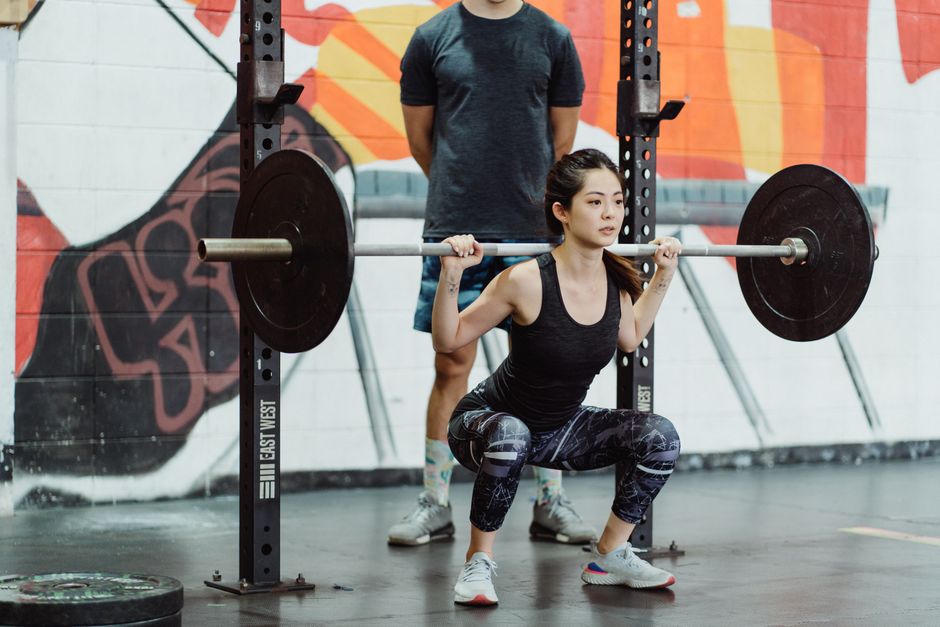
Doing a squat right comes down to one simple idea: keep your spine neutral, push your hips back, and let your knees track over your toes. When you do that, the squat is one of the safest and most effective exercises you can do for your legs, hips, and core. The difference between a good squat and a bad one is not how deep you go—it is how well you control your body through the full range of motion.
What Does a Proper Squat Actually Look Like?
Start with your feet about shoulder-width apart. Your toes can point slightly outward, anywhere from 5 to 15 degrees. This is not just a preference—it matches the natural angle of your hip joints and allows your knees to track in the same direction as your feet.
Take a breath and brace your core as if someone were about to punch you in the stomach. This is not about flexing your abs. It is about creating intra-abdominal pressure that protects your lower back. Without this brace, your spine has to rely on muscles alone to stay stable under load.
Push your hips back and down like you are sitting into a chair that is slightly too far behind you. Your knees should bend at the same time. Keep your chest up and your gaze forward, not down at your feet. Your weight should stay evenly distributed across your whole foot—heel, big toe, and pinky toe all pressing into the floor.
Lower yourself until your thighs are at least parallel to the floor, or as deep as you can go without your lower back rounding. Then drive through your heels to stand back up. Exhale as you rise.
How Deep Should You Squat?
Depth is where most people get confused. The old rule was “thighs parallel to the floor.” That is a reasonable starting point, but it is not a universal standard. Your natural squat depth depends on your hip anatomy, ankle mobility, and flexibility.
Some people can comfortably squat until their hamstrings touch their calves. Others cannot get below parallel without their lower back rounding. Both situations are normal. The problem is not depth itself—it is losing your form to get there.
The key is to stop when your pelvis starts to tuck under. This is called a “butt wink.” When your lower back rounds at the bottom of a squat, your spine loses its neutral position and takes on shear forces it is not designed to handle. For most people, this happens somewhere between parallel and full depth.
Squat to the depth you can control. If that is above parallel, work on mobility. If you can go full depth with a neutral spine, that is excellent for building strength through a longer range of motion. Depth is a goal to work toward, not a requirement to force.
What Are the Most Common Squat Mistakes?
Knees caving inward. This is the most common error. When your knees collapse toward each other on the way up, you lose the stable base your feet are supposed to provide. This puts stress on the knee ligaments and reduces the load your glutes and outer thighs are doing. Fix it by actively pushing your knees outward throughout the movement, as if you were trying to spread the floor apart.
Heels lifting off the floor. If your heels come up, your weight shifts forward onto your toes, and your knees take on extra stress. This usually happens because of tight ankles or because you are leaning too far forward. Work on ankle mobility by doing calf stretches and knee-to-wall drills. In the meantime, squat to a depth where your heels stay planted.
Rounding the lower back. This happens when people try to squat too deep before they have the mobility, or when they let their chest drop forward at the bottom. The fix is to brace your core harder and think about lifting your chest as you descend. If you cannot keep your chest up, you are going too deep.
Not bracing the core. Many people treat the squat as a leg exercise only. It is not. Your core is what transfers force from your upper body to your lower body. Without a braced core, your spine is vulnerable and your squat will be weaker.
Going too fast. A controlled descent takes about 2 to 3 seconds. Dropping into the bottom of a squat and bouncing up may feel effective, but it reduces muscle tension and increases the risk of injury. Control the way down, drive the way up.
How To Do Squats Right for Your Body Type
Your body proportions change how a squat looks, and that is fine. Someone with long thighs and a short torso will naturally lean forward more to keep their balance. Someone with short thighs and a long torso can stay more upright. Neither is wrong.
The key is to find a stance that works for your hip structure. People with wider hips often prefer a wider stance with toes pointed out more. People with narrow hips often prefer a shoulder-width stance. Experiment. If your knees feel pinched or your hips feel jammed, adjust your foot position.
Foot position is not a moral issue. It is a mechanical one. Your squat should feel stable and pain-free. If it does not, change something—foot width, toe angle, or depth—until it does.
What About Squats and Your Knees?
The fear that squats are bad for your knees is one of the most persistent myths in fitness. Research consistently shows that squatting with proper form does not damage healthy knees. In fact, squats strengthen the muscles around the knee, which can protect the joint over time.
The real risk is not the squat itself. It is doing the squat poorly. Knees that cave inward, heels that lift, and uncontrolled depth all place excessive stress on the knee joint. Fix those issues and the squat becomes one of the best exercises for knee health.
If you already have knee pain, talk to a physical therapist before adding squats to your routine. Some knee conditions respond well to squatting. Others do not. A professional assessment is worth more than any article you can read online.
Bodyweight Squats vs. Weighted Squats: Where to Start
Master the bodyweight squat before you add any weight. This is not a suggestion—it is a prerequisite. If you cannot do 15 to 20 bodyweight squats with perfect form, adding weight will only amplify your mistakes.
Once bodyweight squats feel easy, start with a goblet squat. Hold a dumbbell or kettlebell against your chest. This forces you to keep your torso upright and naturally teaches you to brace your core. It is the best next step for most beginners.
After that, you can progress to a barbell back squat or a front squat. Each has different demands. The back squat allows you to lift more weight but requires more mobility in the shoulders and wrists. The front squat keeps your torso more upright but requires more core strength.
There is no “best” squat. There is only the squat that is appropriate for your current strength, mobility, and goals.
How Often Should You Squat?
For most people, squatting 2 to 3 times per week is enough to see progress. The squat is a demanding exercise that stresses your nervous system as much as your muscles. Your body needs time to recover between sessions.
If you are doing heavy squats, give yourself 48 hours between sessions. If you are doing bodyweight squats, you can do them more frequently, but there is little benefit to doing them every single day. Muscles grow during recovery, not during the workout itself.
Pay attention to how your body responds. If your form deteriorates from one session to the next, you are not recovering enough. Add another rest day or reduce the volume.
Frequently Asked Questions
Should my knees go past my toes when squatting?
Yes, it is safe for your knees to travel past your toes. This is a natural movement pattern for many people, especially those with longer thighs. Restricting forward knee movement can actually increase stress on your lower back.
How many squats should I do a day for results?
For most beginners, 3 sets of 10 to 15 bodyweight squats, 2 to 3 times per week, is a solid starting point. Focus on quality of movement rather than chasing a specific number.
Can squats help you lose belly fat?
Squats build muscle in your legs and glutes, which raises your overall calorie burn, but no exercise targets belly fat specifically. Fat loss comes from a calorie deficit across your whole body.
Is it bad to squat every day?
Squatting every day is not inherently harmful, but it is not necessary for most people. Your muscles need recovery time to grow stronger, so 2 to 3 sessions per week is usually enough.
