
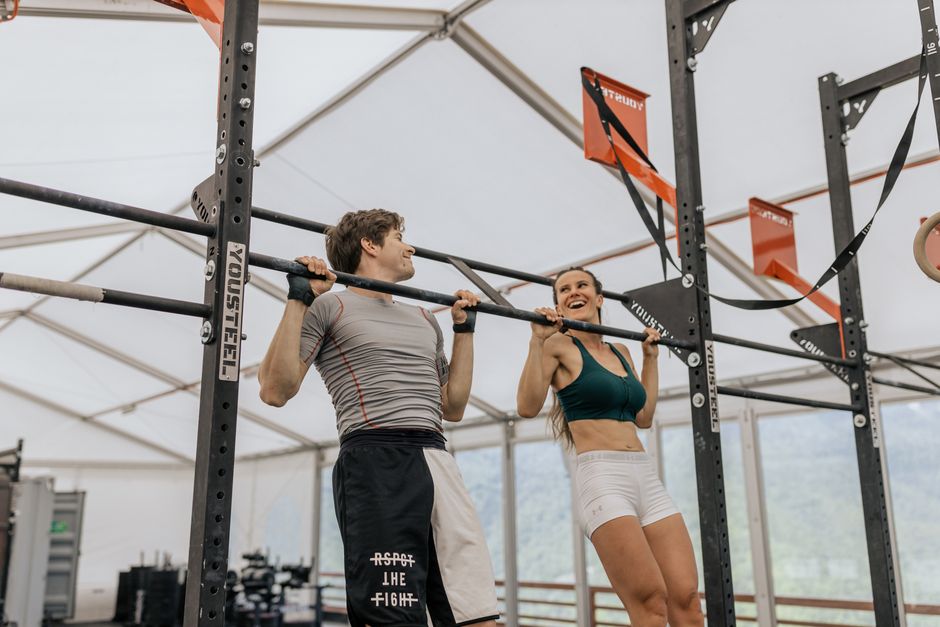
Getting better at pull ups comes down to two things: building the strength to pull your body weight, and practicing the movement often enough that your body adapts. Most people who can’t do more pull ups are not training pull ups enough — they’re doing other back exercises and hoping it transfers. The fastest progress usually comes from a mix of assisted reps, negative reps, and consistent practice a few times a week.
Why Can’t I Do More Pull Ups?
The pull up is a full-bodyweight test of your back, arms, and grip. If you can only do a few, the limiting factor is almost always relative strength — how much force your muscles can produce compared to how much you weigh.
Three things usually hold people back. The first is simply not practicing the movement. Lat pulldowns and rows build back muscle, but they don’t train the exact coordination and grip position of a pull up. The second is excess body weight. Every extra pound has to be pulled up by the same muscles. The third is weak grip, which often gives out before the back and arms do.
There’s a detail most people miss: the pull up starts with the shoulder blades, not the arms. The first part of the movement is a small downward rotation of the shoulder blades before the elbows bend. If you skip that and yank with your arms, you lose power right at the hardest point — the bottom of the rep.
Genetics and limb length also play a role. Longer arms mean a longer range of motion and more work per rep. That’s not a limitation you can change, but it does explain why two people at the same strength level can have very different pull up numbers.
How Often Should I Train Pull Ups to Improve?
Frequency matters more than volume for most people. Training the pull up pattern two to three times per week is a reasonable starting point for most healthy adults, with at least one day between sessions.
Doing pull ups once a week is usually not enough to drive adaptation. Doing them every day often leads to elbow and shoulder irritation before strength improves. The middle ground works best for most people.
Each session doesn’t need to be long. A short, focused practice of 10 to 20 minutes can be more effective than a long workout where pull ups are just one of many exercises. The goal is quality reps, not grinding through fatigue.
One clarification worth making: soreness is not a reliable sign that you trained well, and its absence is not a sign you didn’t. Muscle growth and strength adaptation are driven by progressive overload over weeks, not by how sore you feel the next day.
What Are the Best Exercises to Build Up to More Pull Ups?
The most effective approach is to train the pull up itself in easier versions, rather than avoiding it. Several methods work well, and most people benefit from combining them.
- Negative reps: Start at the top of the bar and lower yourself as slowly as you can. This builds strength in the range where you’re weakest.
- Band-assisted pull ups: A resistance band under your foot or knee reduces how much of your body weight you’re lifting. As you get stronger, use a lighter band.
- Assisted machine pull ups: Many gyms have a machine that counterbalances part of your weight. It’s a useful tool but less specific than free-hanging variations.
- Inverted rows: Done under a low bar or sturdy table, these train the same pulling pattern at a much easier angle.
- Scapular pulls: Hanging from the bar and pulling your shoulder blades down without bending your elbows trains the start of the movement.
For negatives, the goal is a controlled descent. If you drop quickly, you’re not building much. Aim for a slow, steady lower that you can repeat several times.
Bands are helpful but easy to overuse. If you always train with a heavy band, you never practice the harder positions. Reduce the assistance over time rather than staying comfortable.





Does Body Weight Affect How Many Pull Ups I Can Do?
Yes, and this is often the biggest factor people overlook. Pull ups are a strength-to-weight ratio exercise. Losing fat mass without losing muscle makes every rep easier, because you’re moving less weight with the same strength.
This doesn’t mean everyone needs to lose weight to improve. A lean person who can’t do many pull ups simply needs to get stronger. A heavier person may improve faster by reducing body fat than by adding training volume alone.
Gaining muscle helps too, but only if it’s in the right places and doesn’t come with excess fat. Adding five pounds of muscle to your back and arms while adding ten pounds of fat will usually make pull ups harder, not easier.
There’s no single target body weight that guarantees a certain number of pull ups. The relationship is individual, and it depends on how much of your weight is muscle versus fat, plus your limb length and technique.
What Is the Best Grip and Technique for More Pull Ups?
Grip and technique can add reps without any strength gain at all. Small changes in how you hold the bar and position your body often make a noticeable difference.
An overhand grip slightly wider than shoulder width is the standard pull up. A closer grip or an underhand grip (a chin up) usually feels easier for most people because the biceps contribute more. If your goal is simply more reps, a chin up grip is often the easier path.
Technique points that help:
- Start each rep by pulling your shoulder blades down and together before your elbows bend.
- Keep your core braced and your legs relatively still to avoid wasted movement.
- Pull until your chin clears the bar, then lower under control rather than dropping.
- Breathe out on the way up and in on the way down.
- Avoid swinging or kipping unless you’re specifically training that style.
Grip strength itself is often the hidden limiter. If your hands fail before your back does, training your grip — through dead hangs and carries — can add reps even when your pulling muscles are already strong enough.
How Long Does It Take to Improve Pull Up Numbers?
Progress timelines vary widely, and anyone who promises a fixed number of weeks is guessing. Some people add a rep within a few weeks of consistent practice. Others take several months to move from one pull up to three.
What’s more reliable than a timeline is the direction of change. If you’re training the pattern two to three times a week with some form of progressive overload, you should see improvement over weeks to months, not days.
Plateaus are normal. When progress stalls, the usual fixes are adding more recovery, reducing assistance on banded reps, or addressing body composition. Changing the training stimulus — for example, adding weight once you can do several clean reps — also helps.
Be cautious with programs that promise dramatic jumps in a short time. Rapid gains in pull up numbers are usually the result of better technique and neural adaptation, not new muscle, and they tend to plateau quickly.
Common Mistakes That Limit Pull Up Progress
Most stalled progress traces back to a handful of avoidable errors. Fixing these often matters more than adding new exercises.
- Training pull ups too rarely, then expecting fast results.
- Only doing assisted reps and never practicing the unassisted movement.
- Ignoring the shoulder blade initiation at the start of each rep.
- Letting grip strength limit every set without training it separately.
- Adding volume faster than the elbows and shoulders can recover.
- Neglecting body composition when it’s the real bottleneck.
Elbow and shoulder pain is a common reason people stop training pull ups. If pain persists beyond mild soreness, it’s worth getting it checked rather than pushing through. Tendon issues in the elbow are common in people who suddenly increase pulling volume.
Do Supplements or Equipment Help You Do More Pull Ups?
No supplement has been shown to directly increase pull up numbers. Some products marketed for strength or recovery have limited or mixed evidence, and none replace consistent training.
Equipment can help in specific ways. A resistance band set lets you scale assistance. A doorway pull up bar makes frequent practice easier at home. Lifting straps or chalk can help if grip is your limiter, though they reduce how much you train your grip.
Weighted vests and belts are useful once you can do several clean reps, because they let you keep progressing. They are not helpful for someone still working on their first pull up.
The equipment matters far less than the consistency. A basic bar and a plan you actually follow will beat a garage full of gear every time.
Frequently Asked Questions
How many pull ups should I be able to do?
There is no single standard, because the number depends on body weight, limb length, and training history. Many fitness assessments use a range, but a number that’s easy for one person can be very hard for another at the same strength level.
Can I do pull ups every day to improve faster?
Daily pull ups often lead to elbow and shoulder irritation before strength improves. Training the pattern two to three times per week with at least one rest day between sessions is a more sustainable approach for most people.
Are chin ups easier than pull ups?
Chin ups — with an underhand grip — usually feel easier because the biceps contribute more to the movement. If your goal is simply more reps, a chin up grip is often the more accessible option.
What if I can’t do a single pull up yet?
Start with negatives, band-assisted reps, and inverted rows to build the pulling strength and coordination the movement requires. Practicing these consistently is more effective than avoiding the bar until you feel ready.
