
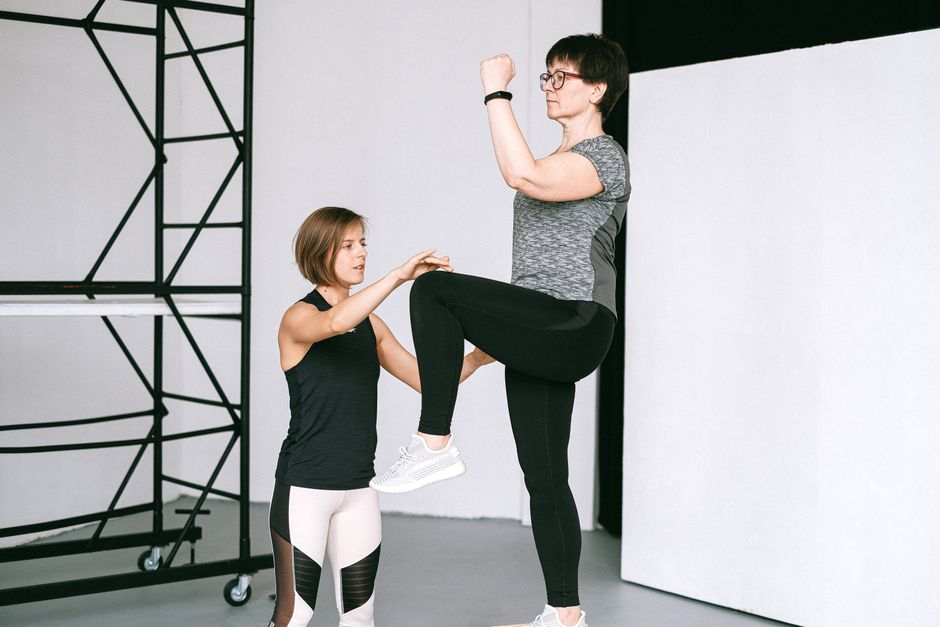
Knee jumps are a plyometric exercise where you jump and land on both knees, then push back up to your feet. The move shows up in martial arts training, dance, and social media fitness clips, but it carries real injury risk because you land directly on a hard joint with your full body weight. If you attempt it, the priorities are a controlled descent, landing on a padded surface, and keeping reps low.
What Is a Knee Jump and How Does It Work?
A knee jump is a two-part movement. You start standing, drop into a kneeling position, and then — instead of catching yourself with your hands — you land on the front of both knees. From there you swing your arms and generate enough force to pop back up to standing without using your hands.
That second part is the hard part. Standing up from a kneeling position without hands requires a fast, forceful extension of the hips, knees, and ankles. It is essentially a jump launched from a kneeling start.
The movement belongs to a group of exercises called plyometrics. Plyometric training uses rapid stretch-and-contract cycles of muscle to build power. Standard plyometrics include box jumps, squat jumps, and depth jumps. All of them load the joints on landing. Knee jumps load the knee joint more directly than most, because the kneecap and the tissues around it absorb the impact first.
This is where a lot of online demonstrations get careless. A knee jump is not a beginner movement, and it is not a conditioning exercise you tack onto the end of a workout when you are already tired. Fatigue and hard landings are a bad combination.
How To Do Knee Jumps Form Reps And Safe Landing
Good form starts before you leave the ground. The landing is the part that determines whether you get through the set without pain.
Set up on a padded mat or padded floor. Bare knees on a hard gym floor is not a good idea. Wear long pants or knee pads if you have them.
Here is the basic sequence:
- Stand with feet about hip-width apart.
- Lower into a kneeling position under control. Do not slam down.
- Land on the meaty part just below the kneecap, not directly on the kneecap itself.
- Keep your torso upright and your core braced as you land.
- Swing both arms back, then forward, to build momentum.
- Drive through your hips and legs to stand up without touching the floor with your hands.
- Land on your feet with knees slightly bent, then reset.
On reps: there is no official rep scheme for this exercise because it is not part of standard strength or conditioning guidelines. Most coaches who use it keep volume very low — often a handful of reps per set, and few sets. That is a practical convention, not an evidence-based prescription. If you feel sharp pain in the knee, stop.
On landing mechanics: aim to land softly, with the impact spread across a wide area rather than concentrated on one point. Absorb the landing by letting your hips and knees bend slightly as you settle. A stiff, locked landing sends more force straight into the joint.
Is It Safe To Land Directly On Your Knees?
Landing directly on your knees is not a low-risk movement. The kneecap sits in front of the knee joint, and the tissue between the kneecap and the skin — the prepatellar bursa — is thin. Repeated direct impact to that area can cause irritation and swelling of the bursa, a condition called prepatellar bursitis.
There is also the question of what is underneath. The knee is a hinge joint with cartilage, ligaments, and menisci. A hard, repeated impact loads all of these structures. Whether any single landing causes damage depends on the surface, your body weight, your landing technique, and how many reps you do.
The evidence here is limited. There is no large body of research confirming that knee jumps are safe for healthy adults, and no research confirming a safe rep range. Some martial arts and dance traditions have used kneeling jumps for years, and some athletes tolerate them. That is not the same as saying they are safe for everyone.
People with existing knee pain, a history of knee injury, patellar tendon problems, or bursitis should treat this movement as off-limits unless a clinician who knows their history says otherwise.





Who Should Avoid Knee Jumps?
Knee jumps are a high-impact movement, and high-impact loading is not appropriate for everyone. If any of the following apply, this is not the exercise to reach for:
- Current or recent knee pain, swelling, or stiffness
- A history of patellar tendon injury, bursitis, or meniscus problems
- Knees that feel unstable or give way
- Recent knee surgery
- Being new to jumping or plyometric training
- Joint conditions such as osteoarthritis
Age alone is not a disqualifier. What matters is joint health, training background, and how the knee responds. A 50-year-old with healthy knees and a background in jumping may handle it. A 30-year-old with a cranky kneecap may not.
Pregnancy is a separate consideration. The hormonal and physical changes of pregnancy affect joint stability and balance, and there are no clinical guidelines for knee jumps during pregnancy. This is not a movement to start while pregnant without clearance from a clinician.
Safer Alternatives That Build Similar Power
If the goal is lower-body power, you do not need to land on your knees to get it. Several exercises train the same qualities with far less direct joint impact.
- Squat jumps — jump from a squat and land softly on both feet.
- Box jumps — jump onto a stable box, step down to reduce landing force.
- Broad jumps — jump forward for distance, land with bent knees.
- Kneeling to standing (no jump) — stand up from kneeling without a jump. This trains the same hip and leg drive with no impact.
- Step-ups — a lower-impact way to build leg strength and control.
The kneeling-to-standing version is worth highlighting. It works the same muscles and movement pattern as the jump-up portion of a knee jump, but it removes the landing entirely. For most people, that is the smarter starting point.
How To Progress Safely If You Want To Try Them
If you decide to try knee jumps, build up slowly. Start with the no-jump version — kneeling to standing — until you can do it smoothly and without knee discomfort. Then add a small hop, still landing on your feet, before you ever land on your knees.
When you do add the knee landing, keep the surface padded, keep reps low, and stop at the first sign of pain. Do not train this movement when your legs are already fatigued.
Give your knees time between sessions. High-impact movements need recovery, and repeating them day after day does not give tissue time to adapt. If your knees feel sore the next day, that is information worth paying attention to.
One clarification worth making: soreness after a new exercise is common and not always a sign of harm. But knee soreness that lingers, swells, or comes with pain when you bend or straighten the leg is different. That warrants a break from the movement and, if it persists, a conversation with a clinician.
What the Evidence Does and Does Not Show
Here is the honest position. Knee jumps are a real exercise used in some sports and performance settings. They are also a high-impact movement with a plausible mechanism for knee irritation and injury.
What is well established: direct, repeated impact to the front of the knee can irritate the bursa and load the joint structures. That is basic anatomy and is not in dispute.
What is not established: a safe rep range, a safe frequency, or evidence that knee jumps are safe for the general population. No large human trials have confirmed these things. Anyone claiming a specific “safe” number of reps is going beyond what the evidence supports.
For most people chasing lower-body power, the alternatives above do the job with less risk. Knee jumps are not a required exercise. If you have healthy knees and a specific reason to train them, proceed with caution and a padded surface. If you are unsure, that uncertainty is a reason to pick a different movement.
Frequently Asked Questions
Are knee jumps bad for your knees?
Landing directly on your knees repeatedly can irritate the bursa in front of the kneecap and load the joint structures. There is no established safe rep range, so the risk depends on your knee health, the surface, and how often you do them.
How many knee jumps should I do?
No clinical guidelines set a safe rep range for this exercise. Coaches who use it typically keep volume very low, but that is convention rather than evidence.
Can you do knee jumps on a hard floor?
Hard floors increase the impact force on your knees and are not advisable for this movement. A padded mat or padded surface reduces the load.
What can I do instead of knee jumps?
Squat jumps, box jumps, and kneeling-to-standing without a jump train similar leg power with less direct knee impact. The no-jump kneeling-to-standing version is the safest starting point.
