
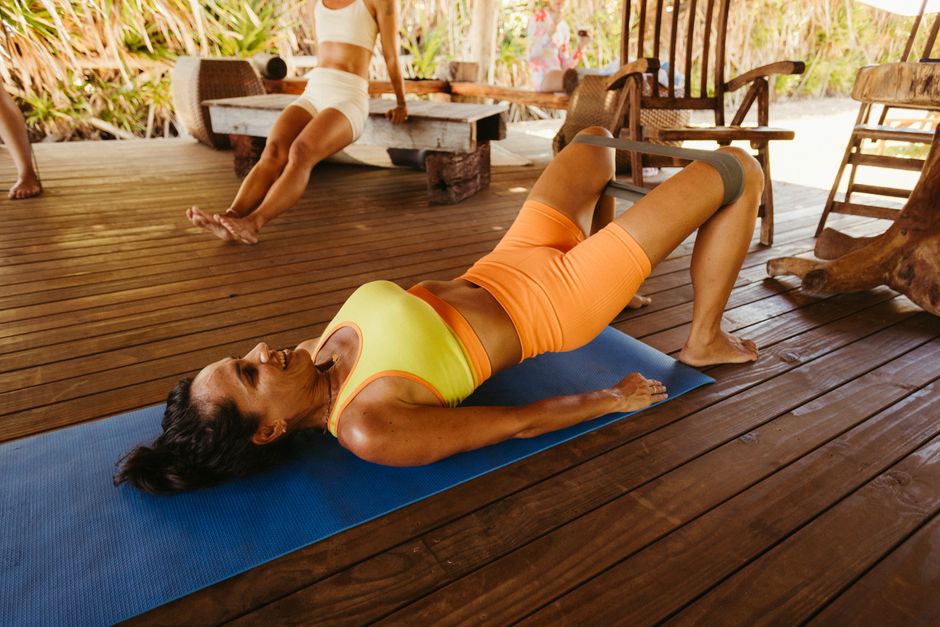
Glute bridges are one of the simplest exercises you can do at home with no equipment. To do one, lie on your back with knees bent and feet flat on the floor, then squeeze your glutes and lift your hips until your body forms a straight line from shoulders to knees. Hold for a moment, then lower slowly. That basic movement is the foundation for every variation that follows.
The exercise is popular for good reason. It is easy to learn, easy on the lower back for most people, and it directly targets the muscles that support your hips and spine. But “easy to learn” is not the same as “hard to get right.” Small positioning errors can shift the work away from your glutes and into your lower back or hamstrings — which is often why people feel bridges in the wrong place.
How To Do Glute Bridges Step By Step
Start on your back on a firm but comfortable surface. A yoga mat on the floor works well. Avoid soft beds or deep couches, because they make it hard to push through your feet and keep your hips level.
Follow these steps in order:
- Lie down. Bend your knees and place your feet flat on the floor, about hip-width apart. Your heels should sit roughly a hand’s length from your buttocks.
- Set your arms. Rest them along your sides, palms down. This gives you a stable base and helps you avoid pushing off the floor with your hands.
- Find neutral spine. Let your lower back rest in its natural curve. Do not press it hard into the floor or arch it up.
- Brace gently. Take a breath in, then exhale as you draw your belly button slightly toward your spine. This is a light brace, not a hard crunch.
- Push through your heels. Press your feet into the floor and squeeze your glutes to lift your hips.
- Stop at the top. Lift until your hips, knees, and shoulders form a straight line. Do not arch your back to go higher.
- Hold briefly. Pause at the top and squeeze your glutes. Two to three seconds is plenty.
- Lower with control. Roll your spine down slowly until your hips touch the floor. Do not drop.
That is one repetition. A common starting point is two to three sets of 8 to 12 reps, but the right number depends on your current strength. The quality of each rep matters far more than the count.
What Muscles Do Glute Bridges Actually Work?
The gluteus maximus is the primary muscle doing the work. It is the largest muscle in your body and the main driver of hip extension — the motion of pushing your hips forward or lifting them up.
The gluteus medius and minimus, on the outer side of your hip, help stabilize your pelvis so it does not tilt or drop during the lift. Your hamstrings assist, and your deep abdominal muscles help hold your trunk steady.
Here is a detail many people miss. The glute bridge is a hip extension exercise, not a back extension exercise. If you feel it mostly in your lower back, your glutes are not doing their share of the work. That usually points to one of the positioning problems below.
Common Mistakes That Shift the Work Away From Your Glutes
Most people who feel glute bridges in their back or hamstrings are making one of a few fixable errors. Fixing them often changes the exercise completely.
- Pushing through your toes. This recruits your hamstrings and calves. Keep your weight in your heels.
- Overarching at the top. Lifting past the straight-line position arches your lower back and takes tension off your glutes. Stop when your hips are level with your knees and shoulders.
- Feet too far away. If your heels are far from your body, your hamstrings take over. Bring your feet closer.
- Not squeezing at the top. The glute squeeze is the point. Without it, you are just moving your hips up and down.
- Rushing. Fast reps use momentum instead of muscle. Slow down, especially on the way down.
If you are unsure whether your form is right, film yourself from the side. You are looking for a straight line from shoulder to knee at the top, with no arch in the lower back.





Glute Bridge vs. Hip Thrust: What Is the Difference?
These two exercises look similar but are not the same. The difference comes down to where your upper back is positioned.
| Feature | Glute Bridge | Hip Thrust |
|---|---|---|
| Shoulders | On the floor | On a bench or elevated surface |
| Range of motion | Smaller | Larger |
| Equipment | None | Bench or sturdy chair |
| Typical use | Home, beginner, warm-up | Gym, loading with weight |
The hip thrust allows a greater range of motion because your torso is elevated, and it is easier to add weight across your hips. Research comparing the two has generally found that both activate the glutes, with the hip thrust producing somewhat higher activation in some studies. That said, the glute bridge remains an effective and accessible option, and for many people it is the better starting point.
How to Make Glute Bridges Harder or Easier
Once 12 to 15 clean reps feel easy, you can progress. The simplest way is to change how many seconds you hold at the top, or to move to a single-leg version.
Easier options:
- Reduce your range of motion — lift only partway if the full lift strains your back.
- Do fewer reps with longer rests between sets.
- Place your hands lightly on the floor beside you for support.
Harder options:
- Hold the top position for several seconds on each rep.
- Lift one foot off the floor and perform single-leg bridges.
- Place a weight across your hips once bodyweight feels easy.
- Elevate your feet on a low step to increase the range.
Single-leg bridges are noticeably harder and demand more stability. They are not a beginner move. Build up with two-leg bridges first.
Who Should Be Careful With Glute Bridges?
Glute bridges are generally well tolerated, but they are not right for everyone at every stage. If you have a history of lower back injury, hip surgery, or a diagnosed spinal condition, talk to a clinician or physical therapist before adding them.
Stop the exercise if you feel sharp pain, numbness, or tingling that travels down a leg. Muscle fatigue and a burning sensation in the glutes are normal. Nerve symptoms are not.
During pregnancy, the position can become uncomfortable or unsafe for some people as the belly grows, and guidance varies. There are no universal clinical guidelines covering glute bridges during pregnancy, so check with your own healthcare provider rather than following general advice. The same applies after childbirth and after abdominal surgery.
If you have knee pain, keep your knees bent at a comfortable angle and avoid letting them collapse inward. A small pillow or folded towel under your knees may help.
How Often Should You Do Them?
Two to three sessions per week is a reasonable general target for most people starting out. Muscles need recovery time between sessions, so daily work is not necessary and may not help.
Consistency matters more than volume. A few focused sets done twice a week will do more for your hip strength than an occasional long session. If you are also doing squats, lunges, or deadlifts, you are already working these muscles, so you may not need much extra bridge work.
One thing worth being honest about: no exercise changes your body shape on its own. Glute bridges strengthen the glute muscles, and stronger muscles can look firmer, but visible change depends on many factors including overall training, nutrition, and genetics. Claims that a single exercise “builds” a specific shape are not supported by evidence.
Frequently Asked Questions
How many glute bridges should I do a day?
There is no single correct number, but two to three sets of 8 to 12 reps, two to three times per week, is a common starting point. Increase reps or difficulty only when the current sets feel easy with good form.
Why do I feel glute bridges in my lower back instead of my glutes?
You are likely arching your lower back at the top or pushing through your toes. Stop the lift when your hips, knees, and shoulders form a straight line, and press through your heels while squeezing your glutes.
Are glute bridges good for lower back pain?
They are often used in rehabilitation programs because they strengthen the glutes and hips, which can support the lower back. However, they are not a treatment for all back pain, and anyone with an existing back injury should get individual guidance from a clinician.
Do glute bridges build muscle without weights?
Yes, bodyweight bridges can build strength, especially for beginners, because the glutes are working against your own body weight. Progress slows once the movement becomes easy, which is when adding single-leg variations or weight helps.
