
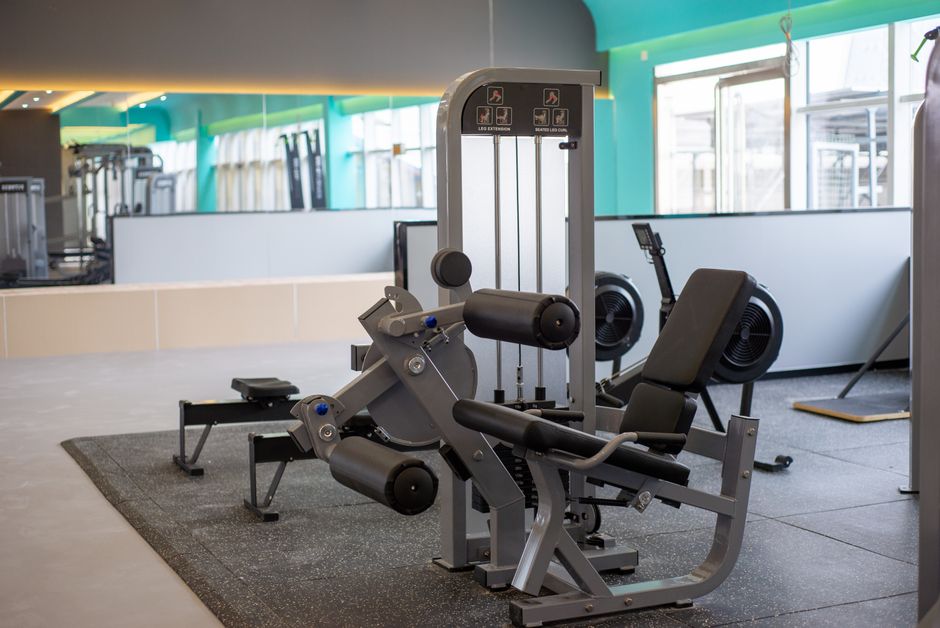
Back extensions are a straightforward exercise: you lie face down on a back extension bench or Roman chair, anchor your ankles, and raise your upper body against gravity. The movement trains the muscles along the back of your spine, your glutes, and your hamstrings. Done with control and a neutral spine, it is one of the more useful exercises for strengthening the lower back. Done with too much range or too much speed, it is one of the easier ways to irritate it. This guide walks through the setup, the movement, and the mistakes that matter.
What Muscles Do Back Extensions Work?
The primary target is a group of muscles that run along your spine called the erector spinae. These muscles help you stand upright, arch backward, and resist forward bending. Back extensions load them directly.
The glutes and hamstrings do meaningful work too. They help extend your hips as your torso comes up. Some people feel the movement mostly in their lower back and some feel it mostly in their glutes and hamstrings. That difference usually comes down to how much you bend at the hips versus how much you bend through the spine.
It helps to understand what the erector spinae actually do. They are not the muscles that hold your spine rigid. They produce and control movement. A back extension trains them to work under load, which is part of why the exercise is used in lower back rehabilitation and general strength programs.
Back extensions are not a core exercise in the way a plank is. They work the muscles that extend the spine, not the muscles that resist rotation or brace the trunk. If your goal is a stronger midsection, this is one piece of a larger picture rather than the whole thing.
How To Do Back Extensions? Step By Step
Set up on a 45-degree back extension bench or a flat Roman chair. Your hip bones should sit just at or slightly above the top edge of the pad. This lets you bend at the hips, which is where the movement should largely happen.
Hook your ankles securely under the footpads. Cross your arms over your chest, or place your fingertips lightly behind your ears. Do not pull on your head or neck.
Start with your body in a straight line from your heels to your head. Your spine should be neutral, meaning a natural slight curve in the lower back, not rounded and not arched hard.
Now lower your torso by hinging at the hips. Keep your spine in that same neutral position as you go down. Stop when you feel a stretch in the back of your thighs or when your torso is roughly perpendicular to the floor, whichever comes first.
Raise your torso back up by squeezing your glutes and hamstrings and extending your hips. Come up until your body forms that straight line again. Do not keep going past it into a hard arch.
Move slowly on both directions. A controlled tempo of about two seconds down and two seconds up is a reasonable starting point. Exhale as you rise.
Start with your bodyweight only. Many people never need to add load. If you do add weight later, hold a plate against your chest and keep the same range of motion.
What Range Of Motion Is Safe?
Stopping at neutral is the safer choice for most people. That means you come up until your body is straight, then stop. Hyperextending, or arching past straight, puts more load on the small joints at the back of your spine and is not necessary to train the muscles.
There is a common misconception that you need to arch far back to “work the whole muscle.” Muscle fibers are trained through a full range of motion, but the range that matters here is hip extension, not spinal hyperextension. Going past neutral mostly adds stress to structures that do not need it.
The bottom position deserves the same care. Lowering too far can round your lower back, especially if your hip flexors are tight. Stop before your spine starts to curl.
If you have a history of low back pain, disc problems, or a spinal condition, get clearance from a clinician before starting. Back extensions are used in some rehabilitation programs, but the right range and setup depend on your specific situation. That is a conversation for a professional who can assess you, not a general article.





What Are The Most Common Mistakes?
Going too fast is the mistake that shows up most. Speed turns a controlled strength exercise into a bouncing motion, and the muscles stop doing the work. Slow down and let the muscles drive the movement.
Setting the pad too low is another common error. If the pad sits below your hip bones, you end up bending through your lower spine instead of your hips. Raise the pad so your hip crease lines up with its top edge.
Arching past neutral at the top is the third big one. It feels like more work, but it is mostly added strain. Stop when you are straight.
Pulling on your head or neck with your hands is a smaller but real issue. Keep your hands light behind your ears or crossed on your chest.
- Rushing the reps
- Pad set too low
- Arching past a straight line at the top
- Rounding the lower back at the bottom
- Adding weight before bodyweight reps are clean
How Often Should You Do Back Extensions?
Two to three sessions per week is a reasonable general frequency for strength work on the same muscle group. Training a muscle more often than that without adequate recovery tends to limit progress rather than speed it up.
Start with one or two sets of 10 to 15 controlled reps. That rep range is a common starting point for bodyweight back extensions, though there is no single correct number. The right amount is the amount you can do with clean form and without lingering soreness that lasts more than a couple of days.
If you are using back extensions to help manage existing low back pain, frequency and dosage should come from your clinician or physical therapist. General fitness guidance does not account for an individual injury.
Back extensions pair well with exercises that train the front of your body and your ability to resist movement, such as planks and dead bugs. A program built only on spinal extension is unbalanced. Most strength programs combine extension, flexion, and anti-movement work.
Back Extension Bench vs. Floor Version
The bench version gives you a fixed setup and a clear range of motion. The floor version, often called a prone back extension or Superman, requires no equipment. Both train the same muscles, but they load them differently.
| Version | Setup | Load | Best For |
|---|---|---|---|
| Back extension bench | 45-degree or flat bench, ankles anchored | Bodyweight or added plate | People with access to a gym or bench |
| Floor prone extension | Lie face down on the floor | Bodyweight only | Home training, beginners |
On the floor version, lie face down with arms at your sides or extended overhead. Lift your chest and thighs slightly off the floor, hold briefly, and lower. The range is small. Do not force a big arch. This version is gentler and easier to learn, which makes it a sensible starting point before moving to a bench.
Neither version is inherently better. The bench allows more load and a larger range at the hips. The floor version is more accessible and easier to control.
When Should You Avoid Back Extensions?
Skip back extensions, at least until you have spoken to a clinician, if you have an acute back injury, a recent spinal fracture, or pain that gets sharply worse during the movement. Pain that travels down a leg, numbness, or weakness are reasons to stop and get assessed.
Some people with certain spinal conditions are advised against spinal extension altogether. Others are prescribed it in a controlled form. The difference depends on the diagnosis, which is why a general article cannot tell you which group you are in.
If you feel the movement only in your lower back and never in your glutes or hamstrings, check your setup. The pad may be too low, or you may be bending through your spine instead of your hips. Fixing the setup usually changes where you feel it.
Frequently Asked Questions
Are back extensions bad for your lower back?
No, when performed with a neutral spine and a controlled range, they are a standard strengthening exercise for the lower back muscles. The risk comes from arching past neutral, going too fast, or using a setup that forces movement through the spine instead of the hips.
How many back extensions should I do?
Start with one or two sets of 10 to 15 controlled bodyweight reps, two to three times per week. That is a general starting point, not a prescription, and the right amount depends on your fitness and any back history.
Do back extensions work your glutes?
Yes, the glutes and hamstrings help extend your hips during the movement. How much you feel them depends on your setup and on how much you hinge at the hips rather than bending through your spine.
Can I do back extensions at home without a bench?
Yes, the floor version, often called a Superman, trains the same muscles with no equipment. Lie face down, lift your chest and thighs slightly, hold briefly, and lower without forcing a large arch.
