
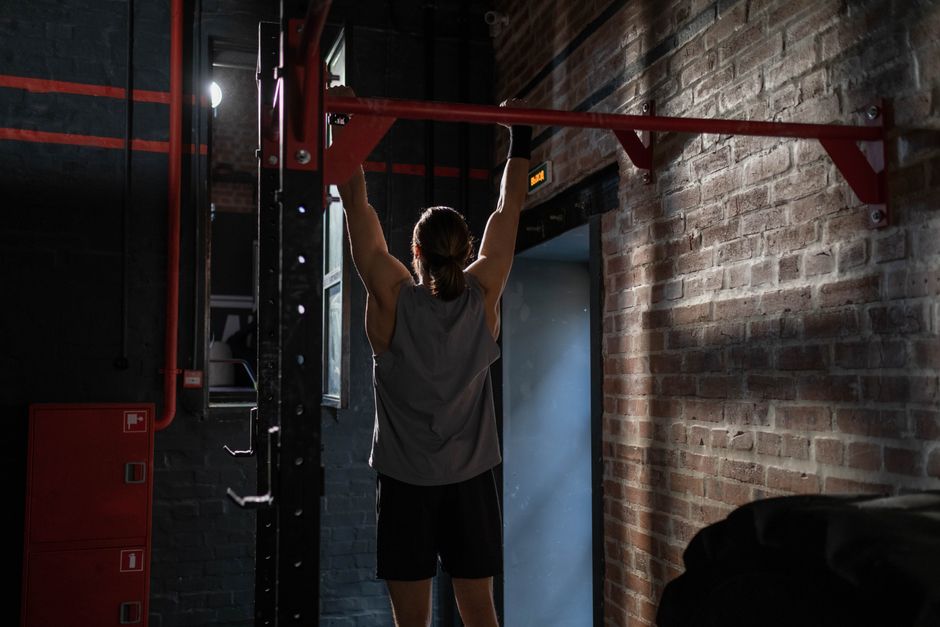
A kipping pull up is a pull up that uses a rhythmic hip and torso swing to help drive your chin over the bar. You start from a hanging position, swing your hips forward and then back, and use that momentum to pull. The kip does not replace strength — it adds momentum to a movement you can already control. If you cannot yet do a strict pull up, a kipping pull up is not the right next step.
What Is a Kipping Pull Up and How Is It Different From a Strict Pull Up?
A strict pull up is done with no swing. Your body stays close to a straight line, and your arms and back do all the work. A kipping pull up adds a deliberate swing to the hips and legs. That swing stores and releases energy, which lowers how much raw pulling strength you need to get your chin over the bar.
The two movements train different things. Strict pull ups build strength and control. Kipping pull ups build timing, coordination, and the ability to move fast under fatigue. That is why kipping shows up in high-repetition workout formats. It lets people complete more reps in less time than strict reps would allow.
Here is the part many people miss. A kip is not a shortcut around strength. It is a skill layered on top of strength. If your shoulders and back cannot control a strict pull up, adding a swing does not fix that. It just moves the weak point somewhere else, usually into the shoulder joint itself.
How To Do A Kipping Pull Up Steps And Common Fixes
Break the movement into phases. Each phase has a job. Skipping a phase is the source of most problems.
- The hang and hollow position. Start at the bottom of the bar with arms straight. Pull your ribs down and squeeze your legs together. This is your base.
- The forward swing (arch). Push your hips forward and let your chest open. Your body forms a slight backward curve. This loads the spring.
- The back swing (hollow). Snap your hips back and pull your ribs toward your pelvis. Your body forms a slight forward curve. This is where the energy releases.
- The pull. As your hips drive back, pull your elbows down toward your ribs. Time the pull to the back swing, not before it.
- The push away. At the top, push down on the bar to help your body travel up and over. This sets up the next rep.
The rhythm is swing, pull, push, repeat. The swing drives the pull. The pull does not drive the swing.
Common fixes:
- Chicken winging (one elbow bends before the other). This usually means one side is stronger or your timing is off. Slow the swing down and practice the pull phase on its own.
- No hip drive. If your legs stay still, you are doing a strict pull with extra steps. Practice the arch and hollow shapes separately before adding the pull.
- Pulling too early. If you pull before your hips snap back, you fight your own momentum. Wait for the back swing.
- Gripping too wide. A very wide grip makes the pull harder and stresses the shoulder. A grip just outside shoulder width is a common starting point.
- Losing the hollow at the bottom. If your back arches hard at the bottom, you lose tension. Keep the ribs down.
What Muscles and Joints Does a Kipping Pull Up Use?
The main pulling muscles are the latissimus dorsi (the broad muscles of the back), the biceps, and the muscles around the shoulder blade. The core muscles control the swing. The hip flexors and glutes drive the arch and hollow.
The shoulder is the joint under the most load. During a kip, the shoulder moves through a large range while also bearing your body weight and the force of the swing. That combination is what makes kipping more demanding on the shoulder than a strict pull up.
The grip is also working hard. Your hands stay fixed on the bar while your body swings below. That creates friction and pressure on the skin of the palms. Rips and blisters are common, especially early on.





Is Kipping Harder on Your Shoulders Than Strict Pull Ups?
Yes, in most cases. The swing adds speed and force at the shoulder. That does not automatically mean injury — but it does mean the shoulder needs to be ready for that load.
The evidence here is limited and mostly comes from sports medicine observations rather than large controlled trials. What clinicians generally describe is that shoulder injuries in kipping movements tend to involve the rotator cuff and the structures around the shoulder blade. These often show up when people kip before they have enough strength and control to manage the swing.
Some clinicians recommend building a base of strict pull ups before adding kipping. There is no universal number that applies to everyone, and no clinical guideline sets a required strict pull up count. What most coaches and clinicians agree on is the principle: control first, speed second.
If you feel a sharp pain in the shoulder during a kip, stop. Sharp pain is different from muscle fatigue. It is a signal to get assessed rather than push through.
Who Should Avoid Kipping Pull Ups?
People with an existing shoulder injury should get cleared before kipping. This includes rotator cuff problems, shoulder instability, and labrum issues. Adding a swing to a joint that is already injured is not a good idea.
People who cannot yet do a strict pull up should build that strength first. Kipping is not a substitute for the strength to control your own body weight.
People with wrist, elbow, or hand problems may also struggle. The grip demands are real, and the swing adds load through the arms.
If you are new to pulling movements in general, start with assisted pull ups, banded pull ups, or negative reps. These build the strength that kipping assumes you already have.
What Is the Difference Between Kipping and Butterfly Pull Ups?
A kipping pull up uses a front-to-back swing. Your body moves forward and back like a pendulum. A butterfly pull up uses a circular motion. Your legs and hips travel in a loop rather than a straight line.
The butterfly is faster and allows more reps per minute. It is also harder to learn and puts different demands on the shoulder. Many people learn the kipping pull up first and add the butterfly later, if at all.
The butterfly is not more advanced in the sense of being “better.” It is a different skill with a different rhythm. Some people never need it.
How Do You Build Up to a Kipping Pull Up Safely?
Build the pieces before you put them together.
- Strict strength. Work on strict pull ups or assisted versions until you can control the movement.
- Hollow and arch holds. Practice the two body shapes on the bar or the floor. These teach your core what the swing needs.
- Shoulder stability work. Exercises that train the rotator cuff and shoulder blade help prepare the joint for load.
- Grip care. Build hand toughness gradually. Use chalk if your gym allows it. Trim calluses before they tear.
- Timing drills. Practice the swing without pulling first. Add the pull once the swing feels smooth.
Progress is not linear. Some days the timing clicks. Other days it does not. That is normal for a skill-based movement.
One non-obvious point: the kip is a skill, and skills improve with sleep and repetition spacing. Practicing kipping every single day often works worse than practicing it a few times a week with rest between. The nervous system needs recovery to lock in timing.
Frequently Asked Questions
Can you do a kipping pull up without a strict pull up?
You can physically swing and get your chin over the bar, but doing so without strict strength raises injury risk. Most coaches and clinicians recommend building strict pull up strength first.
Why do my hands rip during kipping pull ups?
The swing creates friction and pressure on the palms while your hands stay fixed on the bar. Trimming calluses, using chalk, and building up gradually can reduce the chance of tears.
Are kipping pull ups cheating?
No. They are a different movement with a different purpose. Kipping is a skill used in high-repetition formats, while strict pull ups build raw strength.
How long does it take to learn a kipping pull up?
There is no set timeline. It depends on your existing strength, shoulder control, and how often you practice. Some people learn it in weeks; others take months.
