
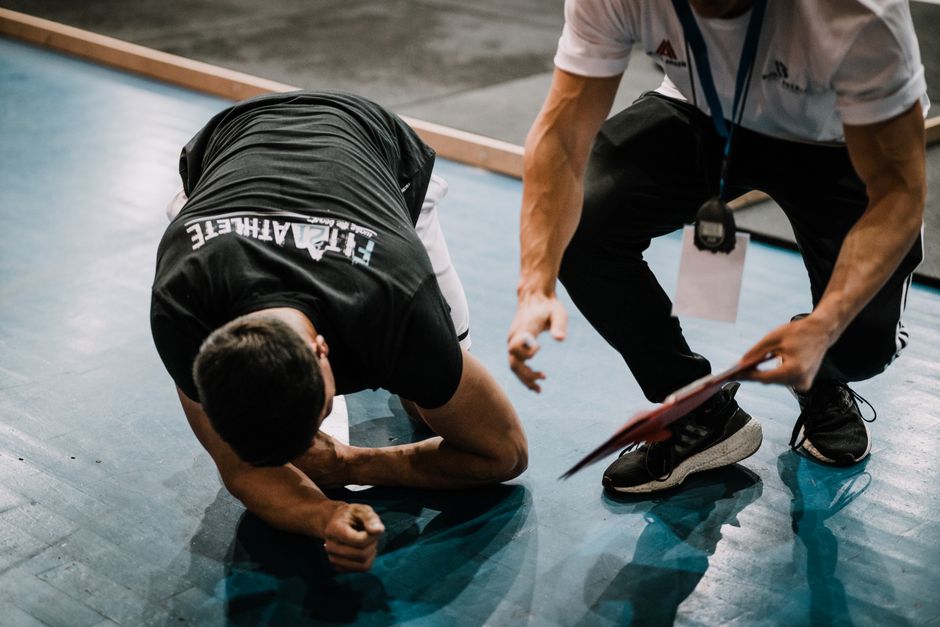
A burpee is a full-body exercise that combines a squat, a plank, a push-up, and a jump into one continuous movement. To do a burpee workout, start with a few clean repetitions at a slow pace, focus on form before speed, and build up gradually over several weeks. Most people can learn the basic pattern in one session, but doing a full workout safely takes practice and a sensible progression.
The move is popular because it raises your heart rate fast and works your legs, chest, shoulders, and core at the same time. It is also demanding. Poor form is common, and that is where injuries and frustration come from. This guide breaks down the movement, the workout structure, and the honest limits of what burpees can and cannot do.
What Is a Burpee and What Muscles Does It Work?
A burpee is a four-part sequence performed as one flowing movement. You squat down, place your hands on the floor, kick or step your feet back into a plank, perform a push-up, bring your feet back under you, and jump up with your arms overhead. Every rep returns you to standing.
The exercise recruits a large amount of muscle in a short time. The main muscles involved include:
- Quadriceps and glutes — drive the squat and the jump
- Chest, shoulders, and triceps — power the push-up portion
- Core muscles — stabilize the plank position and protect the lower back
- Hamstrings and calves — assist the jump and the landing
Because so much muscle is working at once, burpees push your heart and lungs hard. That is why they show up in military fitness tests, boot camps, and conditioning circuits. The high demand is also why they are not a beginner’s first exercise. If you cannot yet hold a plank with good form or perform a push-up, build those first.
How Do You Perform a Burpee With Proper Form?
Good form starts with the setup and ends with a controlled landing. Move slowly at first. Speed comes later, and only after the pattern is clean.
Follow these steps for a standard burpee:
- Stand tall with feet about hip- to shoulder-width apart.
- Squat down and place both hands on the floor in front of your feet, shoulder-width apart.
- Jump or step your feet back into a plank. Your body should form a straight line from head to heels.
- Lower into a push-up until your chest is close to the floor, keeping your elbows at roughly a 45-degree angle from your body.
- Push back up to the plank position.
- Jump or step your feet back toward your hands.
- Stand and jump upward, reaching your arms overhead.
- Land softly with bent knees, then move straight into the next rep.
The most common form errors are letting the hips sag in the plank, rounding the lower back when the feet come back in, and landing stiff-legged from the jump. Each of these puts stress on the lower back or knees. If you feel your hips drop, slow down or drop the push-up until you can hold a rigid plank.
One clarification worth knowing: the push-up is optional in many training programs. A burpee without the push-up is still a burpee, and it is a reasonable starting point. Removing the push-up lets you focus on the squat, plank, and jump before adding upper-body work.
How To Do A Burpee Workout: Structuring Your Session
A burpee workout should match your current fitness, not a number you saw online. The structure matters more than the total count. A short set done with clean form beats a long set done sloppy.
Here is a simple framework that works for most people new to burpees:
- Warm up first. Spend five to ten minutes raising your heart rate and moving your joints through their range. Bodyweight squats, arm circles, and light marching in place are enough.
- Start with short sets. Do a small number of reps, rest, and repeat. Short sets with full recovery keep form intact.
- Rest between sets. Rest long enough that your breathing settles and your form holds on the next set.
- Stop when form breaks. The moment your hips sag or your landings get heavy, end the set. Fatigue-driven reps teach bad habits.
- Cool down. Walk it out and stretch your calves, hips, and chest.
For a first workout, three to five sets of a few reps each is plenty. Add reps or sets in later sessions only when the previous workout felt controlled. There is no universal rep target that fits everyone, and programs that promise a specific number in a set number of days are marketing, not science.
If you want a conditioning effect, keep rest periods shorter as you get fitter. If you want to build strength and clean technique, keep rest longer. The same exercise serves both goals depending on how you pace it.
What Are the Best Burpee Variations for Different Fitness Levels?
Burpees scale up and down more than most people realize. Choosing the right version lets you train the pattern without wrecking your form or your joints.
For beginners: Use the step-back burpee. Instead of jumping your feet back and in, step one foot at a time. Skip the push-up and skip the jump at the top. This version teaches the sequence and builds confidence.
For intermediate exercisers: Add the push-up and the jump, but keep the pace moderate. This is the standard burpee most people picture.
For advanced trainees: Options include the burpee with a tuck jump, the burpee with a broad jump forward, and the burpee combined with a dumbbell deadlift or a pull-up. These add power and complexity. They also raise injury risk, so they belong after solid base fitness.
People with knee, shoulder, or lower back concerns should talk to a clinician or a qualified trainer before adding high-impact variations. Burpees involve repeated loading of the wrists, shoulders, knees, and lower back. That does not make them unsafe for everyone, but it does mean the movement deserves respect.
How Many Burpees Should You Do and How Often?
There is no official recommended number of burpees, and anyone who gives you one is guessing. The right amount depends on your fitness, your goals, and how your body recovers. What is well established is that high-intensity exercise should be built up gradually.
A sensible approach is to treat burpees as one part of a broader routine, not the whole thing. Two to three sessions per week that include burpees, alongside strength work and easier cardio, is a reasonable pattern for many adults. Give yourself at least one full rest day between hard burpee sessions at first.
Watch for signs you are overdoing it: persistent joint pain, poor sleep, unusual fatigue, or workouts that keep getting harder instead of easier. These are reasons to back off, not push through.
If your goal is fat loss, be clear-eyed. Burpees burn calories, but no single exercise drives meaningful weight loss on its own. Total diet and overall activity matter far more than any one movement. Burpees are a useful tool in a larger plan, not a shortcut.
What Are the Risks and Who Should Modify or Avoid Burpees?
Burpees are high-impact and full-body, which means they load several joints at once. Most healthy adults can do them with good form and sensible progression. Some people should modify or skip them.
Consider a modified version or a different exercise if you:
- Have current knee, shoulder, wrist, or lower back pain
- Are recovering from a recent injury or surgery
- Have a heart condition or have been told to limit vigorous activity
- Are pregnant — check with your clinician about what intensity is appropriate for you
- Are new to exercise and cannot yet hold a plank or do a push-up
No clinical guidelines set a specific burpee prescription for pregnant women or people with heart conditions. The general principle is to follow your clinician’s advice on exercise intensity rather than a generic workout plan.
The most preventable risk is the jump landing. Land with soft knees and absorb the impact rather than hitting the floor stiff-legged. The second is the plank. If your hips sag, your lower back takes the load. Fix the plank before you chase speed.
Frequently Asked Questions
How many burpees should a beginner do?
Start with a small number of reps spread across a few short sets, such as three to five sets of a few reps each, and stop when form breaks. There is no official beginner target, so progress based on how controlled each set feels.
Do burpees build muscle or burn fat?
Burpees build some muscular endurance and cardiovascular fitness, but they are not a primary muscle-building exercise. They burn calories, but fat loss depends mostly on overall diet and total activity, not one movement.
Can you do burpees every day?
Daily high-impact burpees are not recommended for most people because the joints need recovery. Two to three sessions per week, with rest days between, is a more sustainable pattern for many adults.
What is a good burpee alternative for bad knees?
A step-back burpee without the jump, or a squat-to-plank movement with no push-up, removes much of the impact. A clinician or qualified trainer can help you choose a version that fits your situation.
