
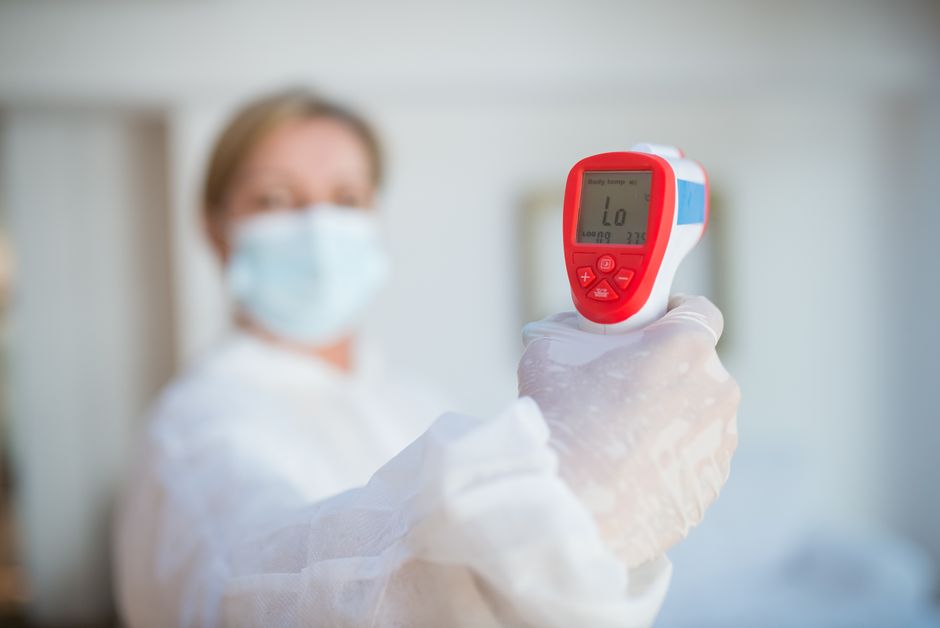
Infrared light is invisible to the human eye, which is exactly why detecting it takes a workaround. Your eyes can only sense a narrow band of the light spectrum, roughly 380 to 700 nanometers, and infrared sits just beyond the red end of that range. To detect infrared light and visualize it, you need a tool that translates it into something your eyes can see — a digital camera sensor, a smartphone camera, a thermal imager, or an infrared viewer. Each one works differently, and each has limits worth understanding before you buy anything.
What Actually Makes Infrared Light Invisible?
Light is electromagnetic radiation, and what we call “visible” is just the slice our photoreceptors happen to respond to. The retina contains two main types of light-sensing cells. Rods handle dim-light vision. Cones handle color and detail. Neither responds to wavelengths much beyond about 700 nanometers.
Infrared begins around 700 nanometers and stretches to roughly 1 millimeter. Within that range, scientists divide it into near-infrared (closest to visible red), short-wave, mid-wave, and long-wave infrared. The distinction matters because different tools detect different parts of the spectrum.
Long-wave infrared is essentially heat radiation. Any object above absolute zero emits it. That is why thermal cameras can “see” a warm body in total darkness — they are not detecting reflected light at all. They are detecting emitted heat.
Near-infrared is different. It behaves more like visible light. It reflects off surfaces, passes through some materials, and can be focused with glass lenses. This is the type most consumer cameras can pick up, often without any modification.
How To Detect Infrared Light And Visualize It With a Camera
Most digital camera sensors are sensitive to near-infrared light. Manufacturers add a filter to block it because it would otherwise distort normal color photos. That filter is called an infrared cut filter or hot mirror.
Some cameras leak a small amount of infrared through anyway. This is why you can sometimes point a TV remote at a phone camera, press a button, and see a faint purple-white glow on the screen. The remote’s LED emits near-infrared light that the camera sensor partially detects.
This trick works with many older smartphones and some newer ones. It is inconsistent. Apple and other manufacturers have improved infrared blocking over the years, so newer phones may show nothing. It is not a reliable test on its own.
For consistent results, a camera with the infrared cut filter removed — often called a “full-spectrum” or “IR-converted” camera — will capture near-infrared clearly. These are used in scientific imaging, forensic photography, and some agricultural monitoring. The trade-off is that a converted camera can no longer take normal color photos without an external filter.
What About Phone Cameras Specifically?
Front-facing cameras on many phones have weaker infrared filters than rear cameras. Some people find the front camera shows the remote’s glow more clearly. This is anecdotal and varies by model. There is no universal rule.
If you want to test whether your phone camera detects infrared, point a working remote at the lens, press a button, and watch the screen. If you see a light, your camera is picking up some infrared. If you see nothing, it does not prove the camera is blind to all infrared — it may just mean the filter is strong at that particular wavelength.
Thermal Imaging: Seeing Heat Instead of Light
Thermal cameras do not detect near-infrared reflected light. They detect long-wave infrared emitted as heat. This is a fundamentally different technology.
A thermal imager produces an image based on temperature differences. Warm objects appear bright. Cool objects appear dark. The images are usually displayed in false color — reds and yellows for hot, blues and purples for cold — but those colors are added by software. The camera itself sees only heat.
Thermal cameras have real limitations. They cannot see through glass, because glass blocks long-wave infrared. They struggle in reflective environments. And they are significantly more expensive than near-infrared tools.
Consumer thermal cameras have become more affordable in recent years, with some smartphone attachments costing a few hundred dollars. They are used in home energy audits, electrical inspection, wildlife observation, and firefighting. They are not a substitute for a near-infrared camera if your goal is to see reflected infrared light.



Infrared Viewers and Night Vision Devices
Night vision devices work differently from thermal cameras. They amplify available light — including near-infrared — using an image intensifier tube. Some models include an infrared illuminator that shines near-infrared light on a scene, which the device then amplifies.
This is why night vision goggles can see in near-total darkness. The illuminator provides the infrared, and the intensifier makes it visible. Without the illuminator, the device still works if there is some ambient light, even starlight.
These devices are legal in most US states for personal use, but some states restrict them for hunting. Regulations vary. If you plan to use night vision for hunting, check your state’s wildlife agency rules first.
Infrared viewers used in industrial settings — for inspecting electrical panels or finding heat leaks — are often thermal imagers, not night vision. The terminology gets mixed up in marketing. Read the specifications carefully.
Infrared Spectroscopy: When You Need Precise Measurements
For scientific or industrial purposes, detecting infrared often means measuring its interaction with matter. Infrared spectroscopy works by shining infrared light through or onto a sample and measuring which wavelengths are absorbed.
Different chemical bonds absorb infrared at characteristic wavelengths. This makes infrared spectroscopy a powerful tool for identifying substances. It is used in pharmaceutical quality control, environmental monitoring, and forensic analysis.
These instruments are not consumer devices. They require calibration, specialized software, and trained operators. If you need this level of detection, you are looking at laboratory equipment, not a phone attachment.
What Infrared Detection Cannot Do
Infrared tools cannot see through walls. This is a common myth. Thermal cameras can detect surface temperature differences that might suggest what is behind a wall — a stud, a pipe, a draft — but they do not produce X-ray-like images.
Infrared cannot reliably identify people through clothing in the way some marketing implies. Thermal cameras detect heat signatures, but clothing, insulation, and environmental conditions all affect the reading. A heavy coat in cold weather can mask a heat signature almost entirely.
Near-infrared cameras cannot see in complete darkness without an infrared light source. They need either reflected near-infrared or an illuminator. Only thermal cameras work in total darkness, because they detect emitted heat rather than reflected light.
No consumer device can detect all infrared wavelengths. Each tool covers a specific band. A phone camera sees a sliver of near-infrared. A thermal imager sees long-wave infrared. Neither sees the full spectrum.
Practical Ways To Visualize Infrared at Home
The simplest method is the remote control test. Point any working remote at your phone camera and press a button. If you see a light on the screen, your camera detects some near-infrared. This costs nothing and takes seconds.
If you want to go further, you can buy an inexpensive infrared filter that blocks visible light and passes near-infrared. Screw it onto a camera lens, and you can capture infrared photos in daylight. Trees and foliage reflect near-infrared strongly, so they often appear bright white or pink in these images. Skin can look smoother because near-infrared penetrates slightly deeper than visible light.
For thermal imaging, smartphone attachments are the most accessible entry point. They are not cheap, but they are far less expensive than dedicated thermal cameras were a decade ago. They work best for spotting heat leaks, overloaded circuits, and temperature differences on surfaces.
None of these methods require special training. But understanding what each tool actually detects — and what it does not — will save you from disappointment and from believing claims that do not hold up.
Frequently Asked Questions
Can I see infrared light with my naked eye?
No. The human retina does not respond to wavelengths beyond roughly 700 nanometers, which is where infrared begins. Some people report seeing a faint red glow from very bright infrared sources, but this is usually the visible red edge of the emission, not true infrared.
Why does my phone camera show the TV remote light?
Most digital camera sensors are sensitive to near-infrared light, but manufacturers add a filter to block it. Some cameras leak a small amount through. When you point a remote at the camera, the sensor picks up the infrared and displays it as a faint glow on the screen.
Do thermal cameras and night vision work the same way?
No. Thermal cameras detect emitted heat in the long-wave infrared range and work in total darkness. Night vision devices amplify available light, including near-infrared, and usually need some light source or an infrared illuminator to function.
Can infrared cameras see through walls?
No. Thermal cameras can detect surface temperature differences that might suggest what is behind a wall, but they do not produce see-through images. The idea that infrared can see through walls is a myth.
