
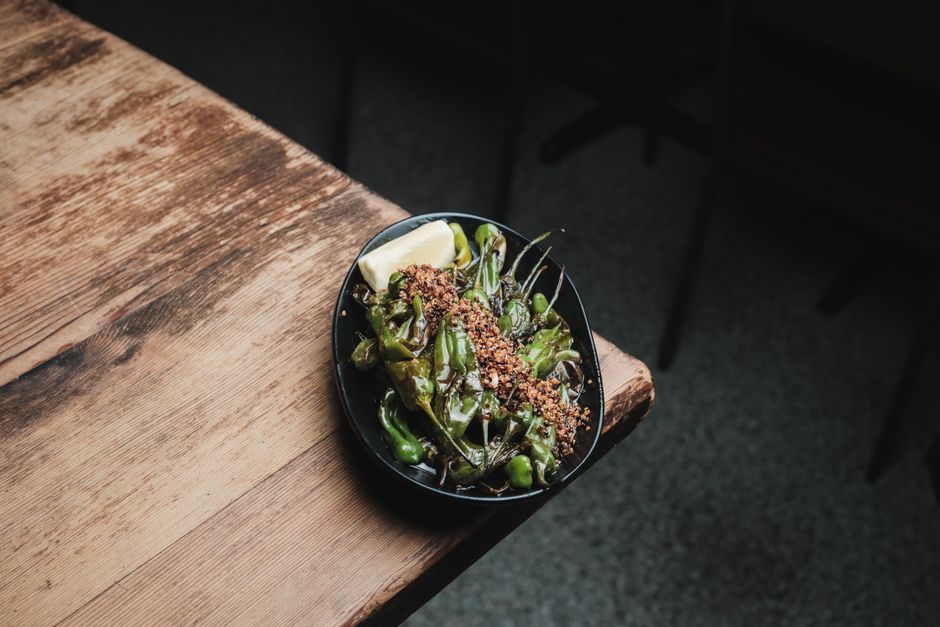
Shishito peppers are small, thin-skinned Japanese peppers that are almost always cooked whole. The standard way to cut them for cooking is to leave them intact and simply pierce each pepper once or twice with a paring knife so steam can escape and they do not burst in a hot pan. If you want them in strips or rings, trim the stem, slice lengthwise or crosswise, and scrape out the seeds and pale inner ribs with your fingers or a small spoon.
That is the short answer. The longer answer involves knowing when to leave them whole, when to cut them, and what to do about the seeds, the stem, and the heat level. This guide covers all of it.
How To Cut Shishito Peppers For Cooking
For the most common cooking methods — blistering in a skillet, grilling, or roasting — you do not cut shishito peppers at all. You pierce them.
Here is the whole process:
- Rinse the peppers and pat them dry. Wet peppers steam instead of blister, and hot oil spits when water hits it.
- Leave the stem on. It acts as a handle for eating and holds the pepper together.
- Take a paring knife and make one small slit, about a quarter inch, near the stem end or through the side of the pepper.
- Repeat for each pepper. One slit is usually enough. Two is fine if the pepper is on the larger side.
That single slit matters more than it sounds. A whole shishito is a sealed pouch. When the skin heats fast, the moisture inside turns to steam and pressure builds. Without a vent, the pepper can pop in the pan and send hot oil across your stovetop. The slit gives that steam somewhere to go.
If you are cooking a large batch, pierce them all before you turn on the heat. Doing it one at a time over a hot pan is how people get splattered.
Do You Need To Remove The Seeds And Stem?
No, not for whole-pepper cooking. Shishito seeds are small, soft, and mild, and they cook along with the pepper without any problem. The stem is left on deliberately — it is edible-adjacent in the sense that you hold it, not eat it, and it makes the pepper easy to pick up.
You only remove seeds and stem when you are cutting the peppers into pieces. In that case, cut off the stem end, slice the pepper open, and wipe or scrape out the seeds and the pale white ribs inside. The ribs hold most of whatever heat the pepper has, so leaving them in keeps more of a kick.
One practical note: shishito seeds are not a choking hazard the way large seeds can be, but if you are serving these to young children, cutting the peppers into pieces and removing the seeds is the more cautious approach. Whole peppers with stems are easy for a small child to grab and hard to chew safely.
How To Cut Shishito Peppers Into Rings Or Strips
When a recipe calls for sliced shishitos — for a stir-fry, a salad, a topping, or a sauce — the method is straightforward.
For rings, cut off the stem, then slice the pepper crosswise into rounds about a quarter inch thick. Push the seeds out with your thumb as you go, or give the slices a quick shake in a colander.
For strips, cut off the stem, slice the pepper in half lengthwise, scrape out the seeds and ribs, then cut each half into thin strips. This is the cut you want for anything where the pepper needs to cook fast and evenly.
For a rough chop, halve the pepper lengthwise, remove the seeds, and run your knife through it a few times. There is no wrong size here — shishitos are thin-walled and cook quickly no matter how you cut them.
Use a sharp knife and a stable cutting board. Shishito skins are slippery, especially after rinsing, and a dull blade is more likely to slide off the pepper than to cut it.
Why Most Shishito Recipes Keep Them Whole
The whole-pepper approach is not just tradition. It is the cooking method that produces the texture people actually want.
Shishitos are prized for blistered, charred skin and a soft, tender interior. Cut them into small pieces and they release their moisture fast, collapse, and end up limp rather than blistered. Left whole, they hold their shape while the skin chars, and the inside steams gently.
There is also the eating experience. Picking up a whole blistered shishito by the stem, dipping it in sauce, and eating it in one or two bites is the point. Sliced peppers lose that.
So the general rule is this: whole for blistering, grilling, and roasting; cut for stir-fries, salads, sauces, and anything where the pepper is an ingredient rather than the dish.
Are Shishito Peppers Hot?
Usually not. Shishito peppers are generally mild, with a heat level closer to a bell pepper than to a jalapeño. But there is a catch that surprises people.
Roughly one in ten shishito peppers is noticeably spicy. This is not a controlled trait — individual peppers on the same plant can vary, and there is no reliable way to tell a hot one from a mild one by looking at it. The variation appears to be influenced by growing conditions and plant stress, though the exact triggers are not fully settled.
This is why shishitos are sometimes called “Russian roulette peppers.” It is also why the seeds and inner ribs matter if heat is a concern — those tissues contain the compounds responsible for capsaicinoid heat, so removing them reduces the burn in any individual pepper.
If you are cooking for people who avoid spicy food, there is no way to guarantee a mild batch. Cutting the peppers open and removing the seeds and ribs lowers the odds of a surprise, but it does not eliminate it.
Common Mistakes When Cutting Shishito Peppers
Most problems with shishitos come down to a few avoidable errors.
- Cooking them wet. Water on the surface causes steaming and oil splatter. Dry them thoroughly after rinsing.
- Skipping the slit. Whole, unpierced peppers can burst in a hot pan. Always vent them.
- Overcrowding the pan. Peppers piled on top of each other steam instead of blister. Work in a single layer, in batches if needed.
- Cutting them too small for blistering. Small pieces release moisture and go soft. Keep them whole for this method.
- Leaving the seeds in when heat matters. If you want a milder dish, remove the seeds and ribs.
None of these are dangerous, but they change the result. A wet, crowded pan gives you soft green peppers instead of blistered ones with charred spots.
Do You Have To Cut Shishito Peppers At All?
You can cook shishitos completely whole with no cut at all, and some people do. The risk is that a sealed pepper can burst under high heat, which is messy and can cause burns from hot oil.
The single slit is a small step that removes most of that risk. It takes a few seconds per pepper and does not change how the pepper cooks or how it looks on the plate.
If you are roasting at a lower temperature rather than blistering in a screaming-hot pan, the risk of bursting is lower, but the slit still helps. There is no downside to doing it.
How To Store Cut Shishito Peppers
Whole shishitos keep well in the refrigerator, loosely wrapped or in a perforated bag, for about a week to ten days. They hold up better than many peppers because of their thick-ish walls relative to their size.
Once cut, they decline faster. Sliced or chopped shishitos should go into a sealed container in the refrigerator and are best used within two to three days. After that they soften and lose their snap.
Do not wash them before storing. Moisture speeds spoilage. Rinse and dry them right before you cook.
Frequently Asked Questions
Do you have to cut shishito peppers before cooking?
No, you do not have to cut them, but you should pierce each pepper once with a knife so steam can escape. Whole, unpierced peppers can burst in a hot pan and splatter oil.
Should I remove the seeds from shishito peppers?
Only if you are cutting the peppers into pieces or want to reduce the heat. For whole-pepper cooking, the seeds are soft and mild and can stay in.
Are shishito peppers spicy?
Most are mild, but roughly one in ten is noticeably hot, and you cannot tell which by looking. Removing the seeds and inner ribs lowers the heat in any individual pepper.
Can you eat shishito peppers raw?
Yes, they can be eaten raw, though they are most commonly cooked. Raw shishitos are firm and grassy, and slicing them thin works better than eating them whole.
