
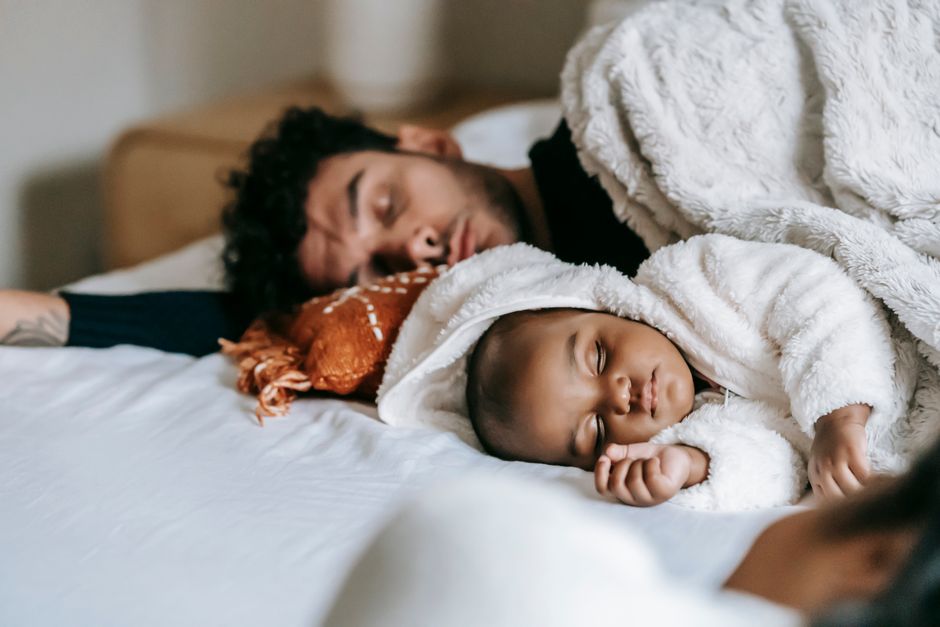
Co-sleeping means sharing a sleep surface or sleep space with your baby. The Safe Sleep Seven is a set of seven conditions developed by breastfeeding and sleep researchers to describe when bed-sharing is considered lower risk. It is not a guarantee of safety, and it does not replace the safe sleep guidance from pediatric authorities, which recommends that infants sleep on a separate surface in the same room for the first year of life.
What Is The Safe Sleep Seven?
The Safe Sleep Seven is a checklist of seven conditions. The idea is that all seven should be met together, not picked from selectively. It was developed by researchers including James McKenna and colleagues who study mother-infant sleep, and it is widely discussed in breastfeeding and attachment-parenting circles.
The seven conditions are:
- No smoking. Nobody in the household smokes, and the mother did not smoke during pregnancy.
- So sober. No alcohol, and no drugs or medications that cause drowsiness or affect alertness.
- Breastfeeding. The baby is breastfed, which is associated with different sleep-wake patterns in both mother and infant.
- Healthy baby. The baby was born full-term, at a normal weight, and has no health problems.
- Healthy mother. The mother is not ill and has no condition that affects her awareness or ability to respond.
- On the back. The baby is placed to sleep on their back, not on the stomach or side.
- Safe surface. A firm, flat mattress with no gaps, no soft bedding, no pillows near the baby, and no risk of the baby falling or becoming trapped.
This list is a framework, not a formal clinical guideline. No major pediatric body endorses bed-sharing as a routine practice. The distinction matters: the Safe Sleep Seven describes conditions under which bed-sharing risk is thought to be lower, not conditions under which it becomes risk-free.
Is Bed-Sharing Ever Considered Safe?
Bed-sharing carries a real and well-documented risk of infant death, particularly for babies under four months old. The evidence on this is strong and consistent. Studies have repeatedly found an association between bed-sharing and sudden infant death syndrome (SIDS), and the risk is highest for the youngest infants.
That said, the picture is not one flat number. Research indicates the risk is not the same in every family. Bed-sharing appears more dangerous when parents smoke, when a parent has used alcohol or sedating drugs, when the baby was born premature or low birth weight, and when the sleep surface is soft or cluttered. Some researchers argue that in the absence of these factors, the added risk is smaller, though not zero.
The American Academy of Pediatrics recommends that infants sleep in the same room as parents but on a separate surface, such as a bassinet or crib, for at least the first six months and ideally the first year. This is the position with the strongest backing in pediatric medicine. The Safe Sleep Seven is a harm-reduction framework for families who bed-share anyway. It is not an alternative recommendation.
Here is a point that often gets lost: room-sharing (baby in the same room, separate surface) is not the same as bed-sharing (baby in the same bed). Room-sharing is recommended. Bed-sharing is not. The two get confused constantly.
How To Co Sleep Safely The Safe Sleep Seven In Practice
If a family has decided to bed-share despite the guidance against it, the Safe Sleep Seven focuses on removing the factors that make it most dangerous. Each condition targets a specific mechanism.
The sleep surface
Use a firm, flat mattress. Soft mattresses, memory foam, waterbeds, and sagging surfaces can create pockets where a baby’s face can sink and breathing can be blocked. Remove pillows, heavy blankets, and loose bedding from around the baby. Do not bed-share on a couch or armchair under any circumstances; these surfaces are linked to a markedly higher risk of infant death because a baby can become wedged in cushions or between the parent and the furniture.
Position and entrapment
Place the baby on their back. Check for gaps between the mattress and the wall, headboard, or bed frame where a baby could become trapped. If the bed is against a wall, check that there is no gap. Do not let the baby sleep between two adults if either could roll onto them; some guidance suggests the baby should sleep beside the breastfeeding parent rather than between parents.
Parent factors
No smoking, no alcohol, and no sedating medications. This applies to every adult in the bed. Fatigue alone is a real factor; an exhausted parent is less responsive. Very obese parents may face higher risk of overlaying a baby, and some guidance advises against bed-sharing in this situation.
Baby factors
Premature babies and babies born at low birth weight are at higher risk and should not bed-share. Babies under four months are the most vulnerable group, and the risk of bed-sharing is highest in this period.
What Are The Biggest Co-Sleeping Risks?
The main risks are suffocation, entrapment, and overlay. These are mechanical dangers, and they are the reason the sleep surface and the people in the bed matter so much.
Suffocation can happen when soft bedding, a pillow, or a parent’s body blocks a baby’s airway. Entrapment happens when a baby gets stuck between the mattress and a wall or frame. Overlay happens when a parent rolls onto the baby, which is more likely with alcohol, sedating drugs, or extreme fatigue.
There is also a subtler risk that gets less attention: the association between bed-sharing and SIDS is not fully explained by overlay or suffocation. Some researchers believe shared sleep changes arousal patterns and temperature regulation in ways that may matter for some infants. The mechanism is not completely understood, which is one reason the evidence is taken seriously even when no obvious accident occurred.
Soft bedding is a major contributor. A study published in the journal Pediatrics found that many infant sleep-related deaths involved soft bedding, and that these deaths often happened in circumstances that were not obviously unsafe to parents. The takeaway is that a bed that feels comfortable to an adult is not automatically safe for a baby.
What Does The Evidence Actually Show?
The evidence consistently shows an association between bed-sharing and increased SIDS risk, strongest for infants under four months. This is not a controversial finding; it is replicated across many studies and countries.
What is debated is how much the risk depends on context. Some researchers argue that when you separate out smoking, alcohol, prematurity, and soft bedding, the residual risk for a full-term breastfed baby of a nonsmoking mother is small. Others argue that even a small added risk is not acceptable when a safe alternative (room-sharing on a separate surface) exists.
Both positions have thoughtful proponents. The honest summary is that bed-sharing is not risk-free under any conditions, and the Safe Sleep Seven reduces but does not eliminate risk. No study has shown that following all seven conditions makes bed-sharing as safe as sleeping on a separate surface.
One clarification worth making: the Safe Sleep Seven was not designed as a clinical guideline that pediatricians should recommend. It was designed to describe the conditions under which the families who do bed-share can lower the danger. That is a meaningful difference.
What About Bed-Sharing And Breastfeeding?
Breastfeeding is one of the seven conditions, and the link is real. Breastfed babies wake more often and feed more frequently at night, and many breastfeeding mothers find bed-sharing makes night feeds easier and less disruptive to sleep.
Some research suggests that breastfeeding and bed-sharing are associated with each other, and that breastfeeding itself is associated with a lower risk of SIDS. This has led some to argue that the benefits of breastfeeding and the protective effect of shared sleep may partly offset the added risk in low-risk families.
That argument is plausible but not settled. The evidence does not show that breastfeeding cancels out the risk of bed-sharing. It shows that breastfeeding is associated with lower SIDS risk on its own, and that the two practices often go together. Treating one as offsetting the other is an interpretation, not a proven equivalence.
When Should You Not Bed-Share?
Some situations are clearly outside the Safe Sleep Seven, and bed-sharing should be avoided. These include:
- Any smoker in the household
- Recent alcohol use or use of sedating medications by any adult in the bed
- A baby born premature or at low birth weight
- A baby under four months old, the highest-risk period
- Soft mattresses, waterbeds, or couches and armchairs
- Loose bedding, pillows, or blankets near the baby
- A parent who is extremely fatigued or unwell
If any of these apply, the safer choice is a separate sleep surface in the same room. That arrangement keeps the baby close for feeding and monitoring while removing the mechanical risks of shared sleep.
Parents who are exhausted and worried about falling asleep while feeding should feed in a position that makes it hard to fall asleep, or feed sitting up in a chair rather than on a couch or bed. Falling asleep with a baby on a couch is one of the most dangerous scenarios documented in infant death reviews.
Frequently Asked Questions
What are the Safe Sleep Seven?
The Safe Sleep Seven are seven conditions for lower-risk bed-sharing: no smoking, sober parents, breastfeeding, a healthy full-term baby, a healthy mother, baby on the back, and a safe firm surface. All seven are meant to be met together, and they reduce but do not remove risk.
Is co-sleeping safe for a newborn?
No, bed-sharing is not considered safe for newborns, who are in the highest-risk period for sleep-related death. The recommendation is a separate surface in the same room for at least the first six months.
Can I bed-share if I breastfeed?
Breastfeeding is one of the Safe Sleep Seven conditions, but it does not make bed-sharing risk-free. The evidence shows breastfeeding is linked to lower SIDS risk on its own, not that it cancels the added risk of shared sleep.
What is the difference between co-sleeping and room-sharing?
Room-sharing means the baby sleeps on a separate surface in the same room, which is recommended. Co-sleeping or bed-sharing means the baby sleeps in the same bed, which is not recommended by pediatric authorities.
