
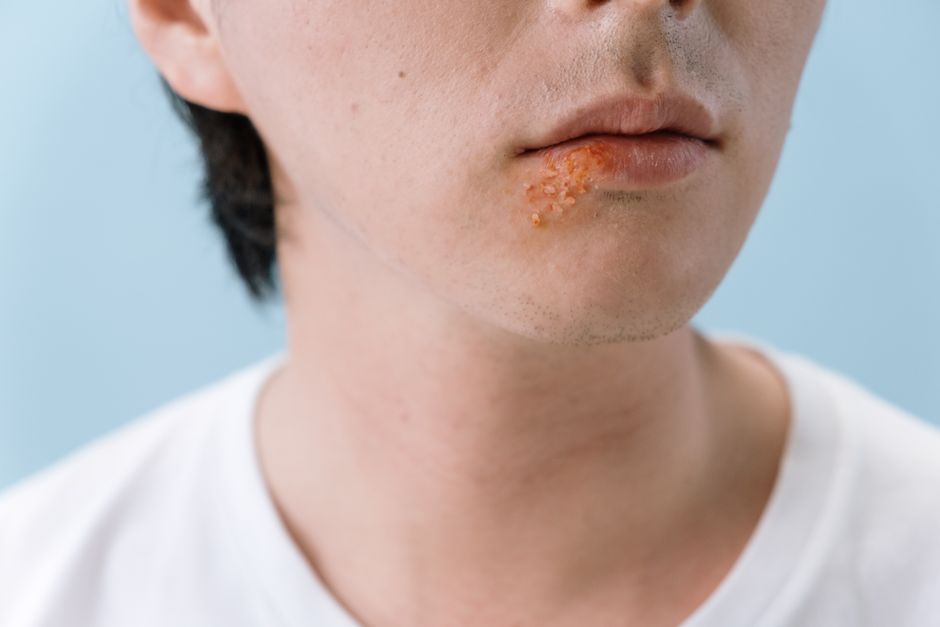
Cold sores heal on their own, usually within 7 to 10 days, and no product removes them faster than that. What you can do is shorten the outbreak if you start an antiviral medicine in the first day or two, and avoid the things that make it worse — picking at the blister, sun exposure, and stress on the skin. The sore will crust over and fade regardless. Treatment mainly changes how bad it gets and how long it lasts.
What Actually Causes A Cold Sore?
Cold sores come from herpes simplex virus type 1, usually called HSV-1. Most people who carry it were infected in childhood, often through a kiss from a relative or shared utensils.
The virus does not leave the body. After the first infection, it travels up a nerve and settles in a cluster of nerve cells called a ganglion, where it stays dormant. Something triggers it to reactivate — a fever, illness, sunburn, physical or emotional stress, hormonal shifts, or a weakened immune system. The virus travels back down the nerve to the skin and a sore forms.
This is why cold sores keep coming back in roughly the same spot. The virus is waking up in the same nerve each time. Common sites are the outer edge of the lip, the corner of the mouth, and sometimes the nose or chin.
Many people carry HSV-1 without ever getting a visible sore. The World Health Organization estimates that a large share of the global population under 50 carries the virus, and most have no symptoms. Carrying it is not the same as having frequent outbreaks.
What Are The Warning Signs Before A Sore Appears?
Most people feel a cold sore coming before they can see it. This early phase is called the prodrome, and it usually starts a few hours to a day before the blister shows up.
Watch for:
- Tingling, itching, or a faint burning feeling on the lip
- A small patch of skin that feels tight or slightly numb
- Mild tenderness in the area
This is the most useful window you have. Starting antiviral treatment during the tingling stage gives the medicine the best chance to reduce how severe the outbreak becomes. Once a full blister has formed, treatment can still help but has less effect on the course.
How To Clear Up Cold Sores Fast And What To Avoid?
There is no way to erase a cold sore overnight. The realistic goal is to reduce severity and length, and to keep it from spreading or getting infected. Here is what the evidence supports.
Start antiviral medicine early
Prescription antivirals are the only treatments with solid evidence for shortening outbreaks. The main options are acyclovir, valacyclovir, and famciclovir, taken as pills, plus topical acyclovir cream. Oral medicines generally work better than creams for outbreaks.
Timing matters more than the specific drug. Starting within the first day — ideally at the tingling stage — is when these medicines help most. If you get frequent outbreaks, some clinicians prescribe a supply to keep on hand so you can start immediately. Others recommend daily suppressive therapy for people with very frequent recurrences. Both approaches are common clinical practice supported by trial evidence, but whether either fits you is a decision for your clinician.
Over-the-counter options: what they can and cannot do
Docosanol cream is available without a prescription and has some evidence for modestly shortening healing time when applied at the first sign. The effect is small. Topical anesthetics like benzocaine or lidocaine can ease pain but do nothing to the virus. Lip balms protect cracked skin but do not treat the sore.
Be skeptical of products marketed as cold sore “cures.” No over-the-counter product eliminates HSV-1 from the body, and none has been shown to stop an outbreak once it is underway.
Basic care that helps
- Keep the area clean with mild soap and water, then pat dry
- Apply a cool compress to reduce pain and swelling
- Use a lip balm with sun protection once the sore has crusted
- Wash your hands after touching the sore
- Do not share towels, utensils, or lip products while a sore is present
What to avoid
Do not pick or squeeze the blister. This spreads the fluid — which contains virus — to nearby skin and raises the risk of a bacterial infection. It can also leave a scar.
Avoid intense sun on the lips. Ultraviolet light is a well-documented trigger for reactivation. If sun exposure sets off your outbreaks, daily lip protection with an SPF product is a reasonable step.
Skip harsh home remedies. Applying alcohol, hydrogen peroxide, or essential oils directly to a sore irritates the skin and can slow healing. There is no clinical evidence these shorten an outbreak.
Avoid close contact while the sore is visible. Kissing and oral contact can pass the virus to others, and it can be passed even when no sore is present — a point many people do not realize. Viral shedding happens without symptoms. Avoiding contact during an active sore lowers risk but does not eliminate it.
How Long Does A Cold Sore Last?
A typical outbreak runs its course in about 7 to 10 days, sometimes up to two weeks. The stages are predictable.
- Day 1–2: Tingling or burning before anything is visible
- Day 2–3: A small fluid-filled blister appears, often in a cluster
- Day 4: The blister breaks and weeps clear fluid, then forms a crust
- Day 5–8: The crust cracks, may bleed slightly, and begins to heal
- Day 9–12: The crust falls off and the skin underneath heals
This timeline is general. First infections tend to be more severe and last longer, and people with weakened immune systems may heal more slowly.
When Should You See A Doctor?
Most cold sores do not need medical care. Some situations do.
See a clinician if a sore lasts more than two weeks, if sores are large or spreading, or if you get them very often. Frequent outbreaks may justify prescription treatment or a discussion about daily suppressive therapy.
Seek care promptly if you have a weakened immune system, are undergoing cancer treatment, or have had an organ transplant — outbreaks can be more severe in these groups.
Get urgent medical attention for a cold sore near or in the eye. HSV infection of the eye is a serious condition that can affect vision and needs treatment right away. Also seek care if you have a high fever, widespread blisters, or signs of a bacterial infection such as spreading redness, warmth, or pus.
Newborns are a special case. A cold sore or any herpes infection in a baby under a few weeks old is a medical emergency. Keep anyone with an active sore away from a newborn, and call a doctor immediately if you suspect exposure.
Can You Prevent Cold Sores From Coming Back?
You cannot remove HSV-1 from the body, so prevention means reducing reactivation and transmission.
Identify your triggers. Many people notice a pattern — sun exposure, lack of sleep, illness, or emotional stress. Managing what you can is reasonable, though the evidence for trigger avoidance specifically reducing outbreak frequency is limited and largely based on observation rather than trials.
For people with frequent outbreaks, daily antiviral suppressive therapy is the best-supported prevention strategy. It reduces recurrence frequency, and trials have shown it works. It does not eliminate the virus or fully remove the chance of passing it on. Talk with a clinician about whether it fits your situation.
To reduce passing the virus to others, avoid kissing and sharing utensils, drinks, or lip products during an active sore, and wash hands after contact with the area.
Frequently Asked Questions
How can I get rid of a cold sore in 24 hours?
You cannot get rid of a cold sore in 24 hours — the blister needs time to heal. Starting a prescription antiviral at the first tingle can reduce severity and may shorten the outbreak, but it will not make it disappear overnight.
Does toothpaste dry out a cold sore?
No, and it can irritate the skin and slow healing. There is no clinical evidence that toothpaste treats a cold sore, and applying it is not recommended.
Are cold sores contagious when there is no blister?
Yes. HSV-1 can be shed and passed to others even when no sore is visible, which is why many people are infected without knowing how. Avoiding contact during an active sore lowers risk but does not remove it entirely.
What triggers cold sores to come back?
Common triggers include sun exposure, fever or illness, physical or emotional stress, and hormonal changes. The virus reactivates from nerve cells and travels back to the skin, usually in the same spot.
