
Scoliosis is a sideways curve of the spine. You check for it by looking at the back and shoulders from behind, watching how the person bends forward, and comparing both sides of the body for asymmetry. A visible difference does not confirm scoliosis on its own, but it is the signal that a proper exam and an X-ray are needed.
Most cases are not caused by anything a parent or person did wrong. The most common type has no known cause, which is why screening is about spotting the shape of the spine early rather than finding a disease to blame.
What Does Scoliosis Actually Look Like?
A spine with scoliosis bends sideways in a C or S shape. When viewed from the front or back, the curve can pull one shoulder higher, shift the waist, or make one side of the rib cage sit differently than the other.
The key detail is rotation. The vertebrae do not just tip sideways — they twist. That twist is what pushes the ribs on one side backward, creating a ridge or hump in the back. This is why the forward bend test, described below, reveals curves that a standing look can miss.
Small curves can be nearly invisible. Larger curves change posture and, in some cases, how clothing fits. Most people with mild scoliosis feel no pain and have no symptoms beyond the shape of their back.
How Do You Check a Child at Home?
You can do a basic visual check at home in a few minutes. It is not a diagnosis — it is a way to notice whether a professional evaluation makes sense.
Have your child stand with their back to you, feet together, arms relaxed at their sides. Look for these signs:
- One shoulder sitting higher than the other
- One shoulder blade more prominent or sticking out further
- Uneven waist — a gap on one side between the arm and the body but not the other
- Hips that look tilted rather than level
- The head not centered over the body
- Ribs that look more prominent on one side when bending forward
Then do the forward bend test. Ask your child to stand with feet together, knees straight, and bend forward at the waist as if reaching for their toes, with arms hanging down. Look at their back from behind, at eye level with their spine. In a straight spine, both sides of the back rise evenly. In scoliosis, one side — usually the rib area — rises higher, forming a visible hump.
This test is called the Adams forward bend test, and it is the core of most clinical screening. It is more reliable than looking at a standing posture alone because it makes the rotational component of a curve visible.
If you see a clear difference, book an appointment with a doctor. Do not try to measure the curve yourself or decide whether it is “bad enough.”
How Is Scoliosis Checked in Adults?
The same visual signs apply to adults, but the context differs. Adult scoliosis falls into two broad groups: curves that were present in adolescence and never fully assessed, and curves that develop later in life, often related to spinal degeneration, arthritis, or prior surgery.
Adults are more likely to notice back pain, stiffness, or a sense of leaning to one side. Pain alone is not a sign of scoliosis — most adults with back pain do not have it. But a combination of visible asymmetry and persistent pain is a reasonable reason to get checked.
In adults, the forward bend test is still useful, though age and flexibility can affect what you see. A doctor will typically take a standing X-ray to measure the curve and look at the health of the spinal joints and discs.
When Should You See a Doctor?
See a doctor if you notice visible asymmetry in the back or shoulders, a rib hump on the forward bend test, or a change in posture that persists. For children, this matters most during growth spurts, when curves can progress quickly.
Growth is the single biggest factor in how a curve behaves. A mild curve in a child who is still growing can worsen, while a similar curve in someone who has finished growing is more likely to stay stable. That is why timing matters and why a doctor may recommend monitoring rather than immediate treatment.
Seek care promptly if a child has back pain that is severe, wakes them at night, or comes with fever, weakness, numbness, or changes in bowel or bladder function. These are not typical scoliosis symptoms and point to other causes that need urgent evaluation.
What Happens at a Medical Exam?
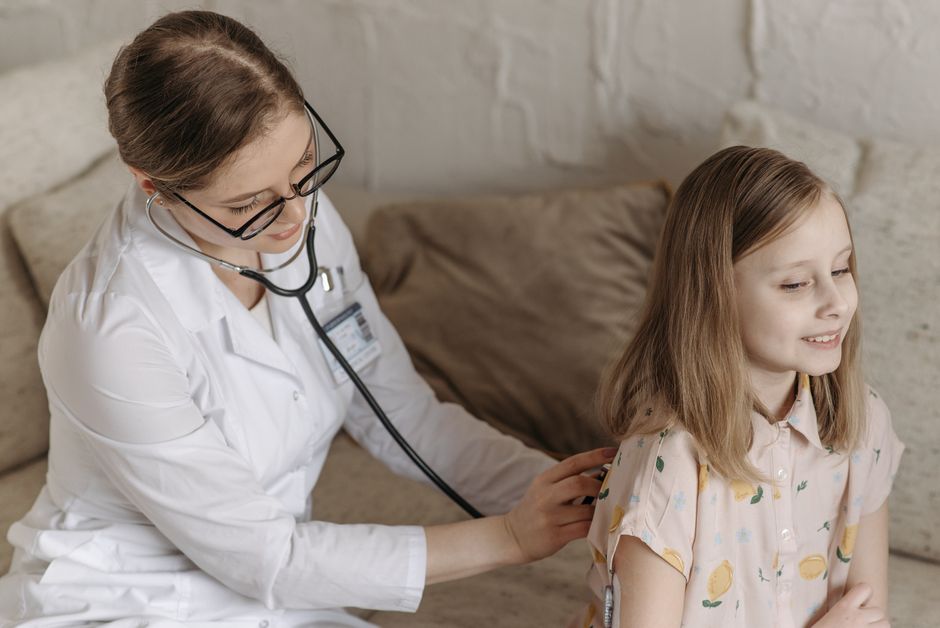
A doctor will take a history, look at the back from several angles, and often repeat the forward bend test. They may check leg length, look at how the person walks, and test strength and reflexes.
If a curve is suspected, the standard next step is a standing X-ray of the spine. The X-ray lets the doctor measure the curve in degrees, called the Cobb angle. This number guides decisions about monitoring, bracing, or referral to a specialist.
Curves are generally grouped by size. Small curves are often watched over time. Moderate curves may prompt a discussion about bracing in growing children. Larger curves may lead to a referral to an orthopedic specialist. The exact thresholds a clinician uses depend on the person’s age, growth status, and symptoms — ask your doctor to explain the number and what it means for you or your child.
What the Forward Bend Test Can and Cannot Tell You
The forward bend test is a screening tool, not a diagnosis. It is good at flagging possible curves. It cannot measure how large a curve is, and it does not distinguish between types of scoliosis.
It also produces false alarms. Uneven posture, muscle tightness, leg length differences, and simply standing differently can create asymmetry that looks like scoliosis but is not. A study finding of a rib hump does not confirm the condition — it confirms that a doctor should look.
This is why home checks should lead to a professional evaluation, not a conclusion. The X-ray measurement is what separates a real curve from an uneven stance.
Is School Screening Still Recommended?
Screening programs vary widely by country and region, and recommendations have shifted over time. Some health bodies support screening in schools for early detection, while others question whether the benefits outweigh the costs and false positives. The evidence is genuinely mixed.
If your child’s school offers screening, it is a reasonable safety net, not a guarantee. If it does not, a home check during growth years is a sensible habit. Neither replaces a doctor’s exam if you notice something.
What Home Checks Cannot Do
No home check can measure a curve, predict whether it will worsen, or tell you whether treatment is needed. Those questions require imaging and a clinician’s judgment.
Be cautious with online “scoliosis tests” that promise a diagnosis from a photo or a few questions. The shape of a back on a photo does not reliably reflect the spine underneath. The forward bend test plus a doctor’s exam remains the standard approach.
What a home check does well is simple: it helps you notice something early and decide whether to act. That is its only job, and it is a useful one.
Frequently Asked Questions
Can I check for scoliosis at home?
You can do a visual check and the forward bend test at home, which can reveal asymmetry that warrants a doctor’s visit. Only an X-ray can confirm and measure a curve.
At what age should kids be checked for scoliosis?
Checks are most useful during growth spurts, typically in late childhood and early adolescence. There is no single correct age, so periodic checks during growth years are reasonable.
Does a rib hump always mean scoliosis?
No. A rib hump on the forward bend test suggests a possible curve, but muscle tightness, posture, and leg length differences can also create asymmetry. A doctor’s exam and X-ray are needed to confirm.
Can adults develop scoliosis?
Adults can develop curves later in life, often related to spinal degeneration or arthritis, and some carry childhood curves that were never assessed. Any new asymmetry or persistent back pain should be evaluated by a doctor.
