
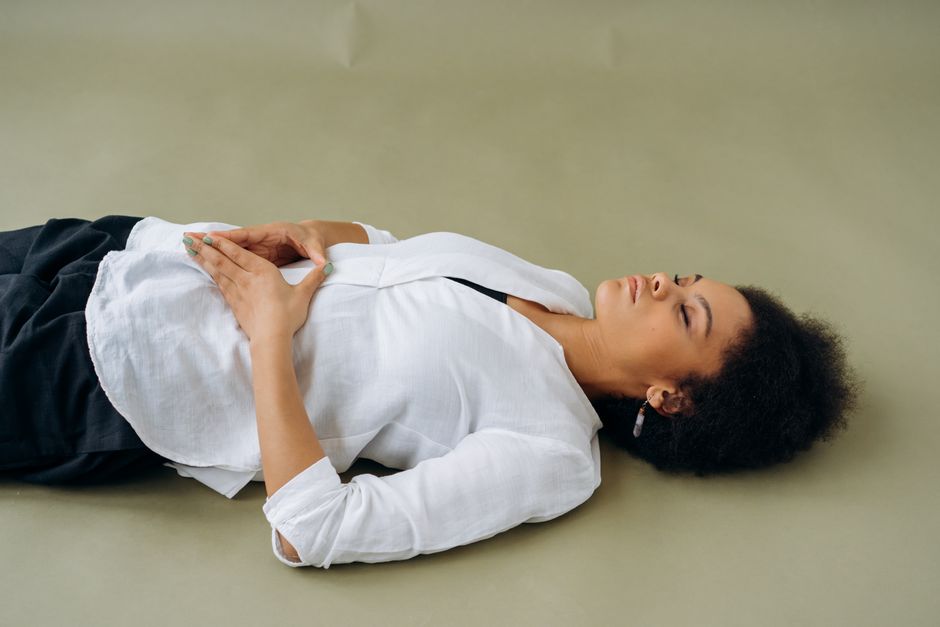
Stress triggers a real physical response in your body, and you can interrupt it within minutes using nothing more than your breath, your senses, and a quiet space. The fastest method is slow, extended exhaling — breathing out longer than you breathe in. This activates the parasympathetic nervous system, which is the branch of your nervous system responsible for calming you down. You can do it right now, sitting wherever you are.
How To Calm Down From Stress Quickly At Home
Your body has two stress pathways, and they move at different speeds. The fast one is the sympathetic nervous system — it releases adrenaline within seconds and speeds up your heart. The slower one is the HPA axis, which releases cortisol over minutes to hours. This matters because it tells you what kind of intervention works when.
You cannot talk yourself out of an adrenaline surge. But you can change the signals your body is sending back to your brain.
The single most reliable tool is your exhale. When you breathe in, your heart rate speeds up slightly. When you breathe out, it slows down. This is called respiratory sinus arrhythmia, and it is a normal, measurable pattern in healthy hearts. By making your exhale longer than your inhale, you shift the balance toward the calming branch of your nervous system.
Try this: breathe in through your nose for a count of four. Breathe out through your mouth for a count of six to eight. Repeat for one to two minutes. That is it. No app, no equipment, no special position.
A common mistake is breathing too deeply. Over-breathing — taking huge gulps of air — can actually increase dizziness and make anxiety worse. Keep the breath gentle and quiet. If someone sitting next to you can hear you breathing, you are trying too hard.
Why Does Splashing Cold Water On Your Face Help?
Cold water on your face triggers what scientists call the dive reflex. It is an automatic response your body has when your face meets cold water — your heart rate drops, and blood flow shifts toward your vital organs. This reflex exists in all mammals and is one of the few ways to directly slow your heart rate without medication.
Fill a bowl with cold tap water. Add ice if you have it. Hold your breath and put your face in for about 15 to 30 seconds. If a bowl feels like too much, a cold pack or a wet cloth held over your cheeks and eyes works similarly.
This is not a relaxation trick. It is a physiological override. That is why it can work when nothing else does.
One caution: if you have a heart condition or a history of fainting, talk to your doctor before trying cold-water face immersion. The dive reflex affects heart rhythm, and for some people that is not a safe thing to trigger deliberately.
Can You Calm Down By Changing What You See And Hear?
Yes — and this works because your senses feed directly into the parts of your brain that regulate arousal. You do not need to think your way to calm. You can sense your way there.
Sound. Slow, rhythmic sound at roughly the tempo of a resting heart rate — around 60 to 80 beats per minute — tends to be calming for most people. This is not a magic frequency. It is simply that slow rhythms cue safety, and fast rhythms cue alertness. Some research suggests that listening to slow tempo music can lower heart rate and blood pressure, though study results vary and the effect is modest.
Sight. Narrow your visual field. When you are stressed, your eyes tend to dart around, scanning for threats. Softening your gaze — looking at one still object, or even closing your eyes — reduces that scanning behavior. Some people find that looking at something vast, like the sky or a distant horizon, helps more than looking at something close.
Touch. Weight and warmth are calming for many people. A heavy blanket, a warm shower, or even pressing your palms together firmly can help. The evidence for weighted blankets specifically is mixed — some small studies suggest benefit for anxiety, but the research is not strong enough to call it proven.
Smell. Certain scents, particularly lavender, have been studied for their effect on anxiety. The evidence is modest and inconsistent. Some trials show small benefits; others show none. If a scent helps you personally, use it. Just do not expect it to do the work on its own.





What About Movement — Does It Help Or Make It Worse?
Movement helps, but the type matters. Intense exercise during a stress spike can sometimes amplify the feeling, because it adds more physical arousal on top of what is already there. Gentle movement tends to work better in the moment.
- Shaking out your hands and arms for 30 seconds
- Rolling your shoulders slowly, five times each direction
- Walking around your home at an easy pace for a few minutes
- Stretching your neck gently side to side
- Tensing your muscles for five seconds, then releasing — working through your body from feet to face
That last one is called progressive muscle relaxation. It has been studied for decades and is generally considered helpful for anxiety, though effects vary between people. The idea is simple: you cannot easily relax a muscle you have not first noticed. Tensing it makes the release more obvious.
If you have a few more minutes, a slow walk outside is one of the better options. Rhythmic movement combined with a change of scenery addresses both the physical and mental sides of stress at once.
Does Writing Or Naming What You Feel Actually Work?
Putting feelings into words does appear to reduce their intensity. Brain imaging research has found that when people label their emotions — even just silently — activity in the amygdala, a brain region involved in threat detection, tends to decrease. This is sometimes called “name it to tame it,” and the underlying finding has been replicated in several studies.
You do not need a journal. You can say it out loud or in your head: “I am stressed about the deadline.” “I am angry about what she said.” Naming the specific emotion works better than a vague label like “I feel bad.”
If you want to write, try a few minutes of unfiltered writing — no editing, no structure. Some research suggests that expressive writing about emotional experiences can improve how people feel over time, though the effects are not uniform and depend on how it is done.
What does not help is rumination — replaying the same worry over and over without moving forward. If you notice yourself circling, that is your cue to switch to a physical method instead.
What Should You Do If Nothing Is Working?
If you have tried breathing, cold water, movement, and naming the feeling, and you are still at a high level of distress, that is information. It does not mean you failed. It may mean the stress is bigger than a quick technique can address.
At that point, the goal shifts from calming down to getting through. Call someone. Being with another person — even on the phone — activates social calming pathways that are hard to replicate alone. If you are in crisis, the 988 Suicide and Crisis Lifeline is available by call or text in the US.
If you find yourself needing these techniques most days, or if stress is interfering with sleep, work, or relationships, that is worth discussing with a doctor or mental health professional. Quick calming techniques are useful tools. They are not treatment for an anxiety disorder, and they are not a substitute for care.
One more thing worth knowing: the techniques that work best for you may not be the ones that work best for someone else. There is no single method with strong evidence behind it for everyone. Breathing exercises, cold exposure, and progressive muscle relaxation all have reasonable support, but individual response varies. Treat this as a set of options to test, not a formula.
Frequently Asked Questions
What is the fastest way to calm down from stress at home?
Slow breathing with a longer exhale than inhale is the fastest reliable method — try in for four counts, out for six to eight. Cold water on your face is a strong backup because it triggers a reflex that slows your heart rate.
Does splashing cold water on your face really calm you down?
Yes, for many people. Cold water on the face triggers the dive reflex, which slows heart rate and shifts blood flow — this is a documented physiological response, not a placebo. People with heart conditions should check with a doctor first.
How long does it take for breathing exercises to work?
Most people notice a shift within one to two minutes of slow breathing. If nothing changes after a few minutes, switch to a physical method like cold water or gentle movement instead of continuing the same technique.
Can you calm down without meditation or an app?
Yes. Breathing, cold exposure, gentle movement, and naming your emotions out loud all work without any app or training. Meditation has good evidence for stress over time, but it is not required for in-the-moment relief.
