
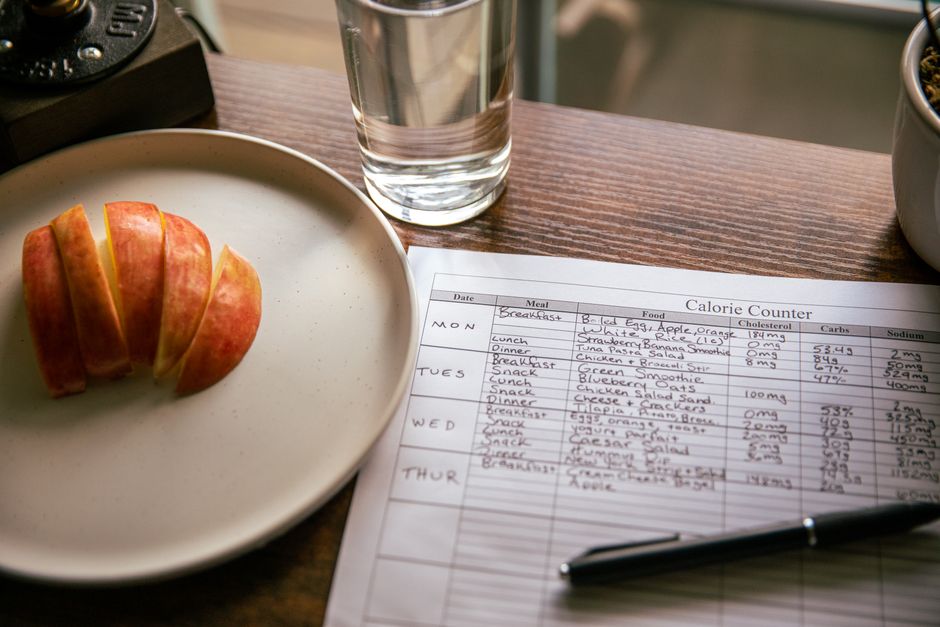
Counting calories is a straightforward math problem: you track what you eat, add up the numbers, and compare that total to what your body burns each day. The process works the same whether you want to lose, gain, or maintain your weight. You need three pieces of information: your daily calorie needs, the calorie content of your food, and a reliable way to record it all.
What Does “Calorie” Actually Mean?
A calorie is a unit of energy. In nutrition, when we say “calorie,” we almost always mean a kilocalorie — the amount of energy needed to raise the temperature of one kilogram of water by one degree Celsius. Food labels use this larger unit, so 200 “calories” on a package means 200 kilocalories.
Your body uses calories for everything: breathing, pumping blood, digesting food, and physical movement. The energy balance equation is simple — if you eat more than you burn, you store the excess. If you eat less, your body draws on stored energy. One pound of body fat contains roughly 3,500 calories of stored energy, which is why a daily deficit of about 500 calories typically produces about one pound of weight loss per week.
How To Calculate Your Daily Calorie Needs
Your total daily energy expenditure (TDEE) is the number of calories you burn in a day. It has two main parts: your resting metabolic rate and your activity level.
Your resting metabolic rate (RMR) is the energy your body uses at complete rest. It accounts for about 60-75% of your daily burn. Several formulas estimate RMR, but the Mifflin-St Jeor equation is the most commonly used in clinical settings:
- Men: (10 × weight in kg) + (6.25 × height in cm) − (5 × age in years) + 5
- Women: (10 × weight in kg) + (6.25 × height in cm) − (5 × age in years) − 161
To convert pounds to kilograms, divide by 2.2. To convert inches to centimeters, multiply by 2.54.
Once you have your RMR, multiply it by an activity factor to estimate TDEE:
- Sedentary (little or no exercise): RMR × 1.2
- Lightly active (exercise 1-3 days per week): RMR × 1.375
- Moderately active (exercise 3-5 days per week): RMR × 1.55
- Very active (exercise 6-7 days per week): RMR × 1.725
- Extra active (physical job plus intense training): RMR × 1.9
These estimates are useful starting points, but they are estimates. Your actual burn depends on muscle mass, genetics, hormones, and other factors. The most accurate way to calibrate is to track your intake for two weeks, monitor your weight trend, and adjust by 100-200 calories as needed.
How To Read Food Labels for Calories
Food labels list calories per serving. The serving size appears at the top of the label, and all the numbers below it apply to that specific amount. If a package contains two servings and you eat the whole package, you consume double the calories listed.
Pay attention to these label details:
- Serving size — often smaller than people expect. A bag of chips labeled 150 calories per serving may contain three servings.
- Calories from fat — this number is informational; total calories are what matter for weight management.
- Percent daily values — based on a 2,000-calorie diet. They show nutrient density, not calorie content.
Labels are allowed a 20% margin of error in calorie counts. This means a food labeled 200 calories could actually contain between 160 and 240 calories. For most people, this variation averages out across a day of eating. For people tracking very precisely, it explains why the scale sometimes doesn’t match the math.





How To Count Calories in Food Without Labels
Whole foods — fruits, vegetables, meat, eggs, grains — don’t come with nutrition labels. For these, you need reference data. The USDA FoodData Central database provides calorie and nutrient information for thousands of foods. Many phone apps pull from this database, making tracking easier.
When you cook at home, weigh ingredients before cooking. Cooking changes water content but not calories. A 4-ounce raw chicken breast and a 4-ounce cooked chicken breast have the same calories because the meat itself hasn’t gained or lost energy — it has only lost water. Weighing raw ingredients is more accurate because cooking methods vary in how much moisture they remove.
For restaurant meals, most chains publish nutrition information online. Independent restaurants rarely do. When the information isn’t available, estimate using similar dishes from comparable restaurants. If you eat out regularly, this estimation error compounds — plan for that by tracking consistently and adjusting based on your weight trend.
How To Use a Calorie Tracking App
Calorie tracking apps simplify the process considerably. Most apps allow you to scan barcodes, search a food database, and save frequently eaten meals. The apps calculate your daily total automatically.
Choose an app with a large food database and the ability to log custom foods. This matters because you will eat foods that aren’t in the database, and you need to enter them accurately. Some apps also track macronutrients — protein, carbohydrates, and fat — which can be useful if you have goals beyond calories.
Apps are only as accurate as the data you enter. Weigh your food when possible. Log everything, including drinks, cooking oils, and small snacks. People consistently underestimate portion sizes by 20-40% when they eyeball instead of weigh. A food scale costs about $15 and is the single best investment for accurate tracking.
How To Calculate Calories for Weight Loss
To lose weight, you need a calorie deficit. A deficit of 500 calories per day produces about one pound of weight loss per week. A deficit of 1,000 calories per day produces about two pounds per week. Most health organizations recommend losing no more than 1-2 pounds per week for sustainable results.
Your maintenance calories — the number you calculated with the Mifflin-St Jeor equation — are your starting point. Subtract 500 from that number for weight loss. Do not go below 1,200 calories per day for women or 1,500 calories per day for men without medical supervision. Very low-calorie diets can cause nutrient deficiencies, muscle loss, and metabolic adaptations that make continued weight loss harder.
Weight loss is not linear. Water retention, hormonal changes, and digestive contents cause day-to-day fluctuations of 2-4 pounds. Track your weight trend over weeks, not days. If your weight hasn’t moved in three weeks, reduce your intake by 100-200 calories or increase your activity.
How To Calculate Calories for Weight Gain
Weight gain requires a calorie surplus. Add 300-500 calories per day to your maintenance number for gradual weight gain. This typically produces about 0.5-1 pound per week.
The quality of those extra calories matters. A surplus of junk food adds fat more readily than muscle. Choose calorie-dense, nutrient-rich foods like nuts, nut butters, olive oil, whole milk, and lean meats. Protein intake of about 0.7-1 gram per pound of body weight supports muscle growth when combined with resistance training.
People who struggle to gain weight often find that liquid calories are easier to consume than solid food. A smoothie with milk, peanut butter, banana, and protein powder can add 500-700 calories without feeling like a huge meal.
Common Calorie Counting Mistakes
Even careful trackers make errors. The most common ones include:
- Forgetting cooking oils — a tablespoon of olive oil has about 120 calories. Two tablespoons in a pan add 240 calories you might not log.
- Ignoring drinks — soda, juice, sweetened coffee drinks, and alcohol add significant calories. A daily 200-calorie latte is 73,000 calories per year.
- Underestimating portions — a “handful” of nuts is often two servings. A “bowl” of cereal can be triple the listed serving size.
- Not logging taste tests — the bites you take while cooking count. So do the last few bites off your child’s plate.
- Trusting fitness tracker calorie burns — wearable devices overestimate energy expenditure by 20-40% in many cases. Do not eat back all the calories your watch says you burned.
These errors don’t make calorie counting useless. They just mean your tracking is an estimate. The scale tells you the truth. If you’re tracking consistently but not seeing results, your estimates are off somewhere — tighten your measuring and weighing.
Frequently Asked Questions
How many calories should I eat per day?
Your daily calorie target depends on your age, sex, weight, height, and activity level. Use the Mifflin-St Jeor equation to estimate your resting metabolic rate, multiply by an activity factor, and adjust based on your goals.
Is calorie counting accurate?
Calorie counting is accurate enough to work for most people, but food labels have a 20% margin of error and people typically underestimate portions. Track consistently and use your weight trend to calibrate your numbers.
Do I need to count calories forever?
No. Many people track for a few months to learn portion sizes and calorie content, then maintain without logging. The skills you build — reading labels, estimating portions, understanding your body’s needs — stay with you.
Can I count calories without weighing food?
Yes, but it will be less accurate. Measuring cups and spoons are better than eyeballing, and a food scale is the most accurate method. If you choose not to weigh, be consistent and expect slower progress.
