
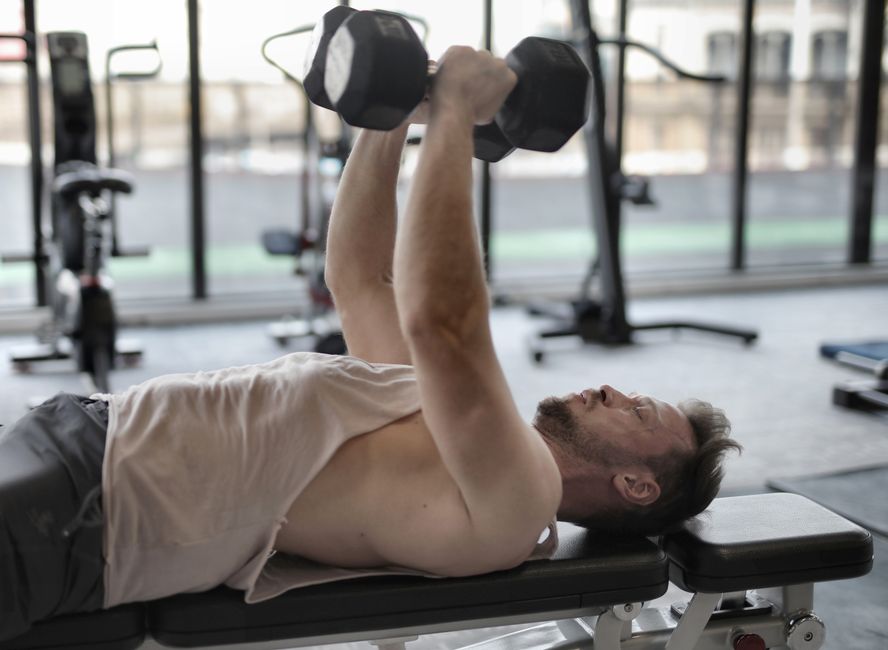
Building body strength comes down to three things: challenging your muscles with resistance, eating enough protein and calories to support repair, and recovering between sessions. Strength is a trainable adaptation, not a fixed trait you either have or don’t. Most people can make meaningful gains within a few weeks of starting, and beginners often progress fastest.
What Actually Happens When You Build Strength?
Strength training works by stressing muscle fibers, then letting the body repair them. The mechanical tension from lifting or pushing against resistance causes tiny structural disruptions in the muscle. Your body responds by rebuilding those fibers slightly thicker and stronger.
Two systems adapt. The nervous system gets better at recruiting muscle fibers and coordinating them — this is why beginners often get stronger before their muscles visibly grow. Then, over weeks and months, the muscle tissue itself adds contractile proteins and grows in size.
This is why strength and muscle size are related but not identical. A person can lift noticeably more weight without looking much bigger, especially early on. The nervous system is doing a lot of the early work.
How Often Should You Train to Build Strength?
Two to three sessions per week per muscle group is a well-established starting point. Research consistently shows that training a muscle group roughly twice a week produces solid strength gains for most people, and more frequent training can work if volume and recovery are managed.
Beginners often do well with three full-body sessions per week. More experienced lifters usually split their training so different muscle groups get attention on different days.
What matters more than the exact split is progressive overload — gradually asking your muscles to do more over time. That can mean adding weight, adding reps, or adding sets. Without some form of increasing demand, the body has no reason to keep adapting.
Rest between sessions matters. A muscle group generally needs about 48 hours before it’s ready to be trained hard again. Training the same muscles every single day rarely helps and often backfires.
Which Exercises Build the Most Strength?
Compound movements that use multiple joints and large muscle groups give you the most strength per unit of effort. These include squats, deadlifts, presses, rows, and pull-ups or their variations.
Isolation exercises — like bicep curls or leg extensions — have their place, but they work smaller amounts of muscle. They’re useful for addressing specific weak points, not as the foundation of a strength program.
You don’t need a gym to build strength. Bodyweight progressions work: push-up variations, pull-ups, split squats, and single-leg movements all provide real resistance. The principle is the same — you need to keep making the movement harder as you get stronger.
A simple structure many people follow:
- One pushing movement (press, push-up)
- One pulling movement (row, pull-up)
- One squat pattern (back squat, goblet squat, split squat)
- One hip hinge (deadlift, Romanian deadlift, hip thrust)
- One core or carry movement
That covers the major patterns. Add variety over time, but don’t overcomplicate the basics.
How Much Weight and How Many Reps?
For strength specifically, heavier loads with lower reps are generally effective. A common approach is training with a weight you can lift for roughly 3 to 6 reps, leaving one or two reps in reserve at the end of a set.
For muscle size, moderate loads in the 6 to 12 rep range work well. For muscular endurance, higher reps with lighter weight. All three ranges build some strength — the differences are a matter of emphasis, not absolutes.
The more important variable is effort. A set taken close to failure — where you genuinely couldn’t complete another rep or two — drives adaptation regardless of the exact rep count. Stopping a set when you have five or six reps left in the tank does much less.
That said, training to absolute failure on every set isn’t necessary and can slow recovery. Leaving a rep or two in reserve on most sets is a reasonable, sustainable approach for most people.
How Much Protein Do You Need to Build Strength?
Protein needs go up when you’re training for strength. General population guidelines sit around 0.8 grams per kilogram of body weight per day, but people doing regular resistance training generally need more.
Research and sports nutrition guidance commonly point to roughly 1.4 to 2.0 grams per kilogram of body weight per day for people actively building muscle and strength. For a 150-pound (68 kg) person, that’s roughly 95 to 136 grams per day. Spreading protein across meals — rather than eating most of it in one sitting — appears to support muscle protein synthesis better.
Calories matter too. Building muscle requires energy. Eating at or slightly above your maintenance calorie level supports growth. Trying to build strength while eating very little makes the process much harder, though it’s not impossible for beginners with higher body fat.
Whole food sources like meat, fish, eggs, dairy, and legumes cover most needs. Protein powder is convenient but not required.
How Long Before You See Results?
Strength gains often show up within two to four weeks for beginners, largely from nervous system improvements. Visible muscle changes typically take longer — most people notice meaningful size differences after about eight to twelve weeks of consistent training.
These timelines vary widely. Genetics, starting point, sleep, nutrition, and training consistency all shift the picture. Someone in their 20s with good recovery habits may progress faster than someone in their 50s juggling poor sleep. That’s not a hard rule — older adults can and do build significant strength with proper training.
The variable most within your control is consistency. Two solid sessions every week for months beats sporadic intense efforts.
What Slows Strength Progress Down?
Sleep is the most underrated factor. Muscle repair and hormone regulation happen largely during sleep. Consistently sleeping poorly blunts recovery and reduces how much you can gain.
Overtraining is another common problem. Doing too much volume, too often, without adequate rest leads to fatigue, stalled progress, and sometimes injury. More is not always better.
Skipping progressive overload is the quiet killer. If you do the same weight and reps for months, your body adapts and then stops. The stimulus has to keep increasing to keep driving change.
Nutrition gaps matter too — not enough protein, not enough calories, or not enough overall food quality. You can’t build tissue from nothing.
Do You Need Supplements to Build Strength?
No supplement is required to build strength. Food and training do the heavy lifting.
A few supplements have reasonable evidence behind them. Creatine monohydrate is among the most studied sports supplements and has consistent evidence for supporting strength and muscle gains when combined with resistance training. Protein powder is simply convenient food. Caffeine can improve training performance acutely.
Most other products marketed for strength — testosterone boosters, branched-chain amino acids, and various “muscle builders” — have weak or absent evidence in healthy trained people. The marketing often outruns the science considerably.
If you take any supplement, check with a healthcare provider first, especially if you take medication or have a medical condition.
Can You Build Strength at Any Age?
Yes. Resistance training produces strength gains in adults well into their 80s and beyond. This is one of the more consistent findings in exercise research — muscle responds to training across the lifespan.
Older adults may need to start lighter and progress more gradually, and recovery can take longer. But the adaptation still happens. In fact, strength training is one of the more effective interventions for maintaining physical function and reducing fall risk as people age.
If you have joint problems, heart conditions, or other health concerns, talk to a doctor before starting a new program. That’s not a reason to avoid training — it’s a reason to train intelligently.
Frequently Asked Questions
How long does it take to build noticeable body strength?
Most beginners notice strength improvements within two to four weeks, mostly from nervous system adaptation. Visible muscle changes usually take about eight to twelve weeks of consistent training.
Can you build strength without going to a gym?
Yes, bodyweight exercises like push-ups, pull-ups, and split squats build real strength if you keep increasing difficulty. Progressive overload matters more than equipment.
How much protein do you need daily to build strength?
Guidance commonly suggests about 1.4 to 2.0 grams of protein per kilogram of body weight per day for people doing regular resistance training. That’s roughly 95 to 136 grams daily for a 150-pound person.
Is it better to lift heavy or lift light for strength?
Heavier loads with lower reps — around 3 to 6 reps — tend to build strength most directly. Lighter weights with higher reps still build strength, just with a different emphasis.
