
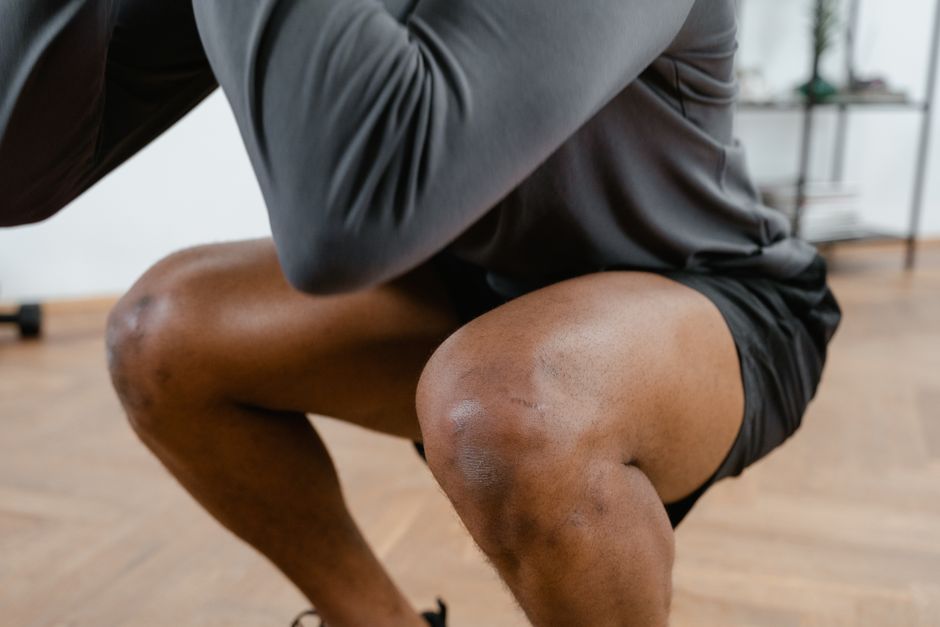
Building knee muscles comes down to three things: strengthening the quadriceps, hamstrings, and glutes with controlled resistance exercise, progressing the load over time, and giving the tissue enough recovery between sessions. A practical weekly plan uses two to three strength sessions, one or two low-impact cardio days, and daily gentle mobility. Most people see meaningful strength gains in six to twelve weeks when they train consistently and increase difficulty gradually.
What Muscles Actually Support the Knee?
The knee is a hinge joint held together by ligaments and moved by muscles that mostly live above it. The muscles that matter most for knee stability sit in the thigh and hip.
The quadriceps is the large muscle group on the front of the thigh. It straightens the knee and absorbs force when you walk downstairs, sit down, or land a jump. It is the single most important muscle group for knee function.
The hamstrings run down the back of the thigh. They bend the knee and help control the lower leg during movement. The glutes in the hip control how the thigh rotates and stabilizes the whole leg. Weak hips often show up as knee pain because the knee ends up taking load it was not designed to handle alone.
The calves matter too. They absorb force at the ankle and help you push off, which changes how much load travels up to the knee.
One point that surprises people: the knee joint itself has almost no muscle crossing it. The muscles that protect it are trained by moving the hip and ankle as much as the knee. That is why a good knee program always includes hip and calf work, not just leg extensions.
How Do You Build Knee Muscle Safely?
Muscle grows when it is challenged with resistance it is not used to, then allowed to recover. For the knee, the key is controlled movement through a comfortable range, with load that increases slowly over weeks.
Three principles do most of the work:
- Progressive overload. Add a little resistance, a few more reps, or slightly more range every week or two. Muscles adapt to demands, not to repetition alone.
- Controlled tempo. Lowering slowly under control builds strength and protects the joint. Rushing reps shifts load away from muscle.
- Consistent recovery. Muscle repairs between sessions. Training the same muscles hard every day works against you.
Pain is the useful guide here. Mild discomfort during exercise that settles within a day is generally acceptable. Sharp pain, swelling that lasts more than a day, or pain that worsens over several sessions means the load is too high and should be reduced.
If you have existing knee arthritis, a past injury, or had knee surgery, check with a clinician or physical therapist before starting a loaded program. General exercise guidance does not replace individual assessment.
Which Exercises Build Knee Muscles Most Effectively?
Compound exercises that load the whole leg build knee muscles more efficiently than isolation moves alone. The best exercise is the one you can do with good control and progress over time.
Foundational exercises:
- Sit-to-stand (bodyweight squat to a chair). Trains the quads and glutes through a natural range. A reliable starting point for most people.
- Step-ups. A low step, controlled pace. Builds quad and glute strength and mimics stairs.
- Split squats or lunges. One leg at a time, which exposes and corrects side-to-side weakness.
- Romanian deadlift or hip hinge. Targets hamstrings and glutes with minimal knee bending.
- Leg curls or hamstring bridges. Direct hamstring work that balances the quads.
- Calf raises. Simple, effective, and easy to load progressively.
When knee pain limits you: start with higher-seat sit-to-stands, short-range step-ups, and isometric holds such as a wall sit at a comfortable depth. These load the muscle with less joint compression. Some clinicians use these as entry points; the evidence for isometrics specifically reducing pain is mixed, but they are a reasonable way to begin loading when full-range work is uncomfortable.
Free weights and machines both work. Machines offer more control and are useful early on. Free weights demand more balance and hip stability, which adds value once the basics feel solid.
How Often Should You Train Knee Muscles Each Week?
Two to three strength sessions per week is the standard starting point for building muscle. Research on resistance training consistently shows that training a muscle group roughly twice weekly supports steady gains, and that the total weekly volume matters more than any single session.
More is not automatically better. Beginners often do well with two sessions and a rest day between them. People with training experience can handle three. Hard sessions on back-to-back days give muscle less time to repair.
Low-impact cardio on other days supports blood flow and joint health without interfering with recovery. Walking, cycling, and swimming are common choices. Daily gentle mobility — not stretching to the point of pain — keeps range of motion from tightening up.
What Does a Weekly Knee Strength Plan Look Like?
A workable week alternates strength days with lighter movement days and includes at least one full rest day. The plan below suits a beginner to intermediate trainee with no acute knee injury.
| Day | Focus | Example Session |
|---|---|---|
| Monday | Strength A | Sit-to-stand 3 sets of 8–12; step-ups 3 sets of 8 per leg; calf raises 3 sets of 12–15 |
| Tuesday | Low-impact cardio | 20–30 minutes walking or cycling at a comfortable pace |
| Wednesday | Strength B | Split squats 3 sets of 8 per leg; hip hinge or Romanian deadlift 3 sets of 8–10; hamstring bridge 3 sets of 10–12 |
| Thursday | Mobility and light activity | Gentle range-of-motion work, easy walk |
| Friday | Strength A or B | Repeat a session, adding a small amount of resistance or one or two reps |
| Saturday | Active recovery | Walking, swimming, or light cycling |
| Sunday | Rest | Full rest or very light movement |
Rest between sets is typically one to two minutes. Start with resistance you can control for the lower end of the rep range, then add difficulty only when the last few reps feel manageable with good form. Progress every week or two, not every session.
The exact numbers are a template, not a prescription. Someone recovering from knee pain may start with two sets at a shallow range. Someone already strong may need more load than bodyweight provides.
How Long Until You Notice a Difference?
Strength gains begin within the first few weeks, mostly from the nervous system learning to recruit muscle more effectively. Visible muscle growth typically takes longer — often around eight to twelve weeks of consistent training, and it varies widely between people.
Functional improvements, like climbing stairs more easily or standing up from a low chair without pushing off, often show up before visible changes. Those are worth tracking. Strength is the goal, not appearance.
Consistency matters more than intensity. Three moderate sessions every week for three months will do more than two very hard weeks followed by a month off. Missing a session is not a setback. Missing several weeks in a row resets progress.
What Mistakes Slow Knee Muscle Growth?
The most common mistake is doing the same routine at the same difficulty for months. Muscle adapts to a challenge and then stops responding. If the exercise feels easy, it is time to make it harder.
Other frequent problems:
- Ignoring the hamstrings and glutes. Quad-only training leaves the back of the leg and hip underdeveloped, which affects knee control.
- Pushing through sharp pain. Discomfort that worsens session after session is a signal to reduce load, not to work harder.
- Training the same muscles hard every day. Recovery is part of the program.
- Skipping the warm-up. A few minutes of easy movement and light sets prepares the joint and muscle for load.
- Chasing soreness. Soreness is not a measure of progress. Strength gains happen without it.
Knee muscle building is not complicated. Load the leg, control the movement, progress slowly, and rest. The plan matters less than doing it week after week.
Frequently Asked Questions
How many days a week should I train knee muscles?
Two to three strength sessions per week is the standard starting point for building muscle. Beginners often do well with two sessions and a rest day between them.
Can I build knee muscle without weights?
Yes. Bodyweight exercises like sit-to-stands, step-ups, and split squats build strength when you progress the difficulty over time. Once those feel easy, adding resistance helps continue the gains.
Is it safe to exercise with knee pain?
Mild discomfort that settles within a day is generally acceptable during strengthening. Sharp pain, swelling that lasts more than a day, or pain that worsens over several sessions means you should reduce load and check with a clinician.
How long does it take to strengthen knee muscles?
Strength gains begin within the first few weeks, mostly from improved muscle recruitment. Visible muscle growth typically takes around eight to twelve weeks of consistent training, and it varies between people.
