
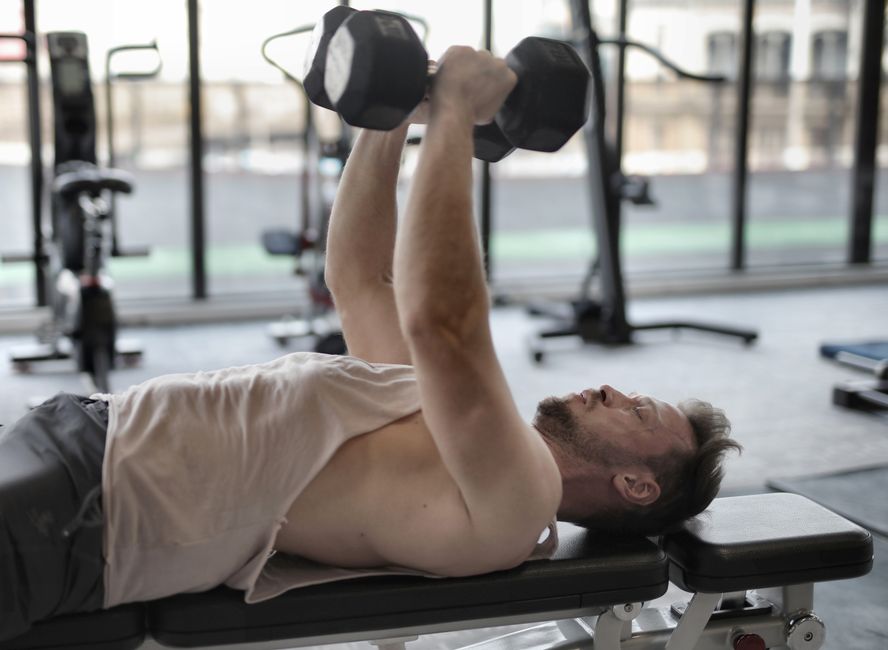
Most people hold their breath when a weight feels heavy. That instinct is not wrong — it is a real reflex — but using it on every rep is a mistake. The right way to breathe when lifting weights is to exhale through the hard part of the lift and inhale on the easy part. For a bicep curl, that means breathing out as you curl up and in as you lower. For a squat, it means breathing in at the top, bracing, then breathing out as you stand up.
That simple pattern keeps your blood pressure steadier and your muscles supplied with oxygen. There is one exception worth knowing about, and it involves very heavy lifts. More on that below.
Why Does Breathing Matter So Much During Lifting?
Your muscles need oxygen to keep working. When you hold your breath through a whole set, you starve them of it and your blood pressure spikes.
Here is what happens. When you inhale, oxygen enters your lungs and moves into your blood. Your heart pumps that blood to working muscles. When you exhale, you clear carbon dioxide, a waste product your body makes constantly. If you never exhale, carbon dioxide builds up and oxygen delivery drops.
Breath-holding also triggers something called the Valsalva maneuver. That is the medical term for bearing down against a closed airway — the same thing that happens when you strain on the toilet. It raises pressure inside your chest, which briefly raises your blood pressure. In healthy people during a single heavy lift, this is a normal response. Repeated across an entire workout, it adds up.
Good breathing does two things at once. It keeps oxygen flowing to your muscles, and it helps control the pressure inside your abdomen, which stabilizes your spine. Both matter for lifting well and lifting safely.
What Is the Correct Breathing Pattern for Most Lifts?
Exhale on effort. Inhale on the return. That single rule covers most of what you will do in a gym.
The “effort” is the part of the movement where your muscles are working hardest against resistance. For a bench press, that is the push up. For a row, it is the pull toward your body. For a deadlift, it is the initial pull off the floor and the lockout.
The “return” is the easier part — lowering the weight, releasing the tension, returning to the start. That is when you breathe in.
Some people find it easier to think of it this way: breathe out as you push or pull, breathe in as you come back. It works for almost every standard exercise.
- Bicep curl: exhale as you curl up, inhale as you lower
- Bench press: inhale as the bar comes down to your chest, exhale as you press up
- Squat: inhale at the top, brace, exhale as you stand up
- Row: exhale as you pull the weight toward you, inhale as you extend
- Overhead press: inhale at the bottom, exhale as you push overhead
You do not need to force every last bit of air out. A steady, controlled exhale works better than a hard puff. The goal is rhythm, not maximum force.
Should You Ever Hold Your Breath While Lifting?
Yes, but only in specific situations and for short periods. This is where the Valsalva maneuver comes back in.
When you lift very heavy weight — close to your maximum — briefly holding your breath and bracing your core can increase stability and help you complete the lift. Powerlifters and Olympic weightlifters do this deliberately. The breath is held for a few seconds during the hardest part of the lift, then released.
This is not the same as holding your breath through an entire set of ten reps. That is the mistake most beginners make. The deliberate version is short, controlled, and used only when the weight genuinely demands it.
There is an important caveat. Breath-holding during lifting raises blood pressure sharply and briefly. For people with cardiovascular conditions, uncontrolled high blood pressure, or a history of stroke, this technique carries real risk. Some clinicians advise against it entirely for these groups. If you have any of these conditions, talk to your doctor before using breath-holding during lifts.
Even for healthy lifters, the technique is not necessary for moderate weights. You can build substantial strength without ever holding your breath. It becomes relevant mainly when you are pushing close to your limits.





What Happens If You Breathe Wrong?
The most common consequence is dizziness or lightheadedness. That comes from holding your breath too long and letting carbon dioxide build up.
You might also notice a headache during or after training. Some people feel a sudden, sharp head pain during a heavy lift — sometimes called an exertional headache. These are usually harmless and go away, but they can be a sign you are straining too hard without breathing.
More seriously, chronic breath-holding during exercise puts repeated stress on your cardiovascular system. Over time, that is not ideal.
The fix is straightforward. If you feel dizzy during a set, stop, breathe normally, and let it pass. Then check your breathing pattern. Odds are you were holding your breath without realizing it.
One thing worth knowing: many people hold their breath without noticing. It is a natural response to effort. Filming yourself or having a training partner watch can help you catch it.
How Do You Breathe During Cardio or High-Rep Sets?
For lighter weights and higher reps, the rules relax. You do not need a strict inhale-exhale pattern matched to each rep.
When the weight is light enough that you could do 15 or 20 reps, your breathing can be more continuous. Breathe steadily throughout the set. Let your body find a rhythm. The key is to keep breathing — not to hold your breath through the whole set.
Cardio is different again. During running, cycling, or rowing, there is no single “effort” phase to match a breath to. You breathe continuously, and your rate increases with intensity. Most people naturally fall into a pattern — two steps per inhale, two steps per exhale, for example. There is no single correct pattern. What matters is that you are breathing enough to support the work.
If you cannot speak a short sentence while doing cardio, you are probably working above a comfortable pace. That is fine for intervals, but not for an entire session.
What About Breathing During Core Exercises?
Core work is where breathing gets tricky, because the muscles involved in breathing and the muscles involved in bracing are the same ones.
Your diaphragm sits at the base of your ribcage. When you inhale, it contracts and moves down. Your deep abdominal muscles wrap around your middle like a corset. They work together to control pressure inside your abdomen.
For most core exercises — planks, dead bugs, bird dogs — the rule is simple: keep breathing. Do not hold your breath. A steady, even breath helps you maintain the brace without spiking pressure.
For crunches and sit-ups, exhale as you crunch up, inhale as you lower. Same principle as other lifts.
The one exception is heavy loaded carries or very heavy compound lifts, where a brief breath-hold may help. Again, that is a technique for advanced lifters working near their maximum.
How Do You Build Better Breathing Habits?
Start by paying attention. Most people have no idea what their breathing does during a set until they check.
Try this. On your next warm-up set, say the word “out” silently as you exhale on the effort. That gives your brain something to attach the breath to. After a few sessions, it becomes automatic.
You can also practice outside the gym. Lie on your back, put one hand on your belly and one on your chest. Breathe in slowly through your nose. Your belly hand should rise more than your chest hand. That is diaphragmatic breathing — using your diaphragm rather than your upper chest. It is the same pattern you want during lifting.
Some research suggests that breathing training can improve performance and reduce breath-holding during exercise, though the evidence is not uniform across all studies. What is clear is that conscious attention to breathing during lifting reduces the automatic tendency to hold your breath.
Give it a few weeks. Like any skill, it takes repetition before it feels natural.
Frequently Asked Questions
Should I exhale on the way up or the way down when lifting?
Exhale on the way up — the effort phase — and inhale on the way down. This pattern keeps oxygen flowing and helps control blood pressure during the lift.
Is it bad to hold your breath while lifting weights?
Holding your breath briefly during a very heavy lift is a known technique, but doing it through an entire set is not recommended. It raises blood pressure and can cause dizziness.
How do I breathe during a squat?
Inhale at the top, brace your core, then exhale as you stand up. For very heavy squats, a brief breath-hold at the bottom is common among experienced lifters.
Why do I get dizzy when lifting weights?
Dizziness usually comes from holding your breath too long, which builds up carbon dioxide and reduces oxygen delivery. Stop the set, breathe normally, and check your breathing pattern.
