
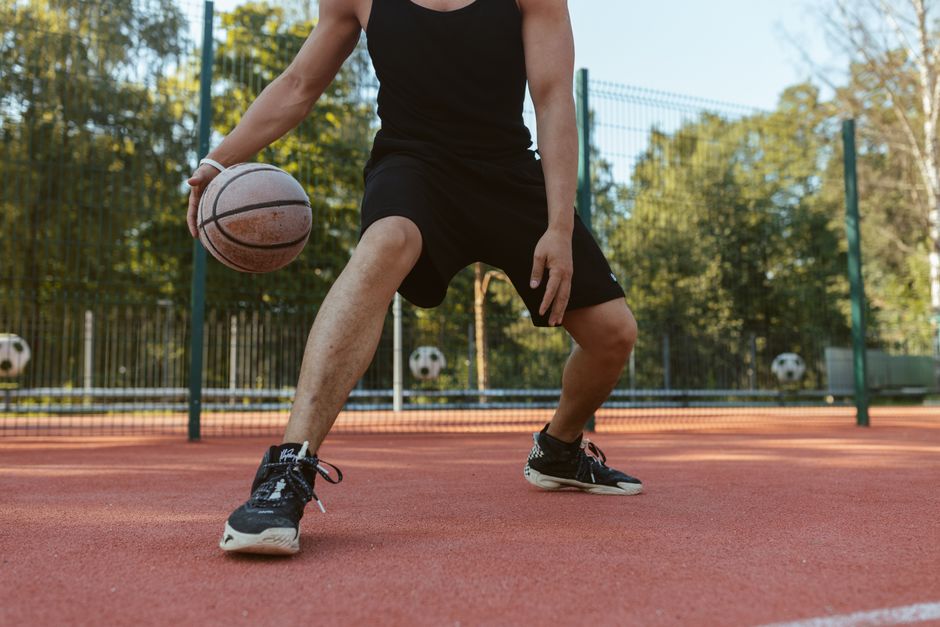
Getting quicker on the basketball court comes down to three things: building force into the ground, training your nervous system to react faster, and changing direction without losing your balance. Speed in basketball is rarely about running in a straight line. It is about the first two steps, the stop, and the restart. Those qualities respond to specific training, not just to playing more basketball.
How To Be Quicker In Basketball Speed And Agility Tips
Basketball quickness is a skill built from several physical qualities at once. You need leg strength to push off, elastic energy in your tendons to bounce back, and a nervous system that fires the right muscles fast. No single drill covers all of it.
Think about what actually happens when a defender beats you off the dribble. The first step is explosive, maybe two or three strides, then a hard stop, then a lateral slide. That whole sequence lasts a second or two. Straight-line sprint speed matters less than how fast you can start, stop, and change direction.
One clarification worth making early. Getting “quicker” and getting “faster” are not the same thing in basketball terms. Maximal sprint speed is a track quality. Court quickness is an acceleration and deceleration quality. A player who wins a 40-yard dash is not automatically the first one to the ball. Train for the second quality and you will see it where it counts.
What actually limits quickness
Three factors show up again and again in players who feel slow on the court.
- Weak or slow force production. If your legs cannot push hard into the floor, your first step will be slow no matter how motivated you are.
- Poor deceleration. Many players can accelerate but cannot brake. You cannot change direction if you cannot stop.
- Slow reaction. Quickness starts in the brain and eyes. If you are reacting late, your body is already behind.
Most training programs focus only on the first factor. That leaves real speed on the table.
Why Is Strength Training Important For Basketball Speed?
Force into the ground is what moves you. Muscle and connective tissue have to produce that force, and strength training is how you build it. This is well established in sports science. Stronger athletes generally accelerate faster and jump higher, though the relationship is not perfectly linear and other factors matter too.
The lifts that help most are the ones that train your legs to push hard and fast. Squats, trap bar deadlifts, and hip hinge variations build the base. But heavy lifting alone does not make you quick. It makes you strong. You still need to teach that strength to express itself quickly.
That is where power training comes in. Jumping, bounding, and medicine ball throws train your body to produce force in a fraction of a second. Research on jump training and sprint performance is fairly consistent. Programs that include regular plyometric work tend to improve sprint and change-of-direction performance in team sport athletes, though the size of the effect varies by study and by how well the program is run.
A common mistake is doing all strength work and no power work, or the reverse. You need both. Strength without speed is a heavy engine with no transmission. Speed without strength is a fast engine with no fuel.
Can Agility Drills Make You Quicker On The Court?
Yes, but only if the drills are done right. The word “agility” gets used loosely. There is a real difference between changing direction on a planned course and reacting to something you did not expect.
Pre-planned drills like cone ladders and shuttle runs train your body to move through a pattern. They build coordination and conditioning. They do not fully train the reaction part of agility, because you already know where you are going.
Reactive agility drills are different. Someone calls a direction, or you mirror a partner, or you respond to a ball. Your brain has to read the signal and fire the right muscles fast. This is closer to what happens in a game. Research on agility training suggests that drills with a reactive component transfer better to sport than drills that are entirely pre-planned. The evidence is not overwhelming, but the direction is consistent.
If you only have time for one type, choose the reactive version. If you have time for both, do both.





What Drills Improve First-Step Quickness?
The first step is where most basketball plays are won or lost. Here are drills that target it directly.
- Split stance starts. Stand with one foot forward, one back. On a signal, explode forward for three or four steps. Alternate which foot is forward.
- Lateral push-offs. From an athletic stance, push hard sideways and take two quick steps. Focus on the push, not the steps.
- Resisted starts. Use a partner or a band to add light resistance. Keep the resistance low enough that your mechanics stay clean.
- Reactive ball drops. A partner drops a tennis ball. You react and catch it before the second bounce. This trains your eyes and your first move together.
Keep reps short. Three to five steps per rep is plenty. Quality beats quantity here. If your last rep looks slow and sloppy, you have done too many.
How Do You Train Deceleration And Change Of Direction?
Stopping is a skill, and most players never train it. Deceleration puts a huge load on your knees and hips. If you cannot control that load, you either slow down early, which costs you position, or you risk injury.
Good deceleration starts with the hips. You lower your center of mass, plant a foot, and absorb the force through your leg rather than your joint. Train this with drills that force you to stop on a dime.
- Deceleration runs. Sprint five to ten yards, then come to a complete, controlled stop in as few steps as possible.
- Lateral shuffle to sprint. Slide sideways, then plant and explode forward.
- Backpedal to turn. Backpedal, then turn your hips and accelerate out.
These drills are as much about body control as speed. Land softly, keep your knees from caving inward, and stay balanced. If your knee wobbles on the plant, slow the drill down until it does not.
Does Reaction Time Matter More Than Raw Speed?
In a game, yes, often it does. A player who reacts a fraction of a second earlier is already moving while a faster player is still processing. Reaction time is trainable, but it is also partly about anticipation.
Anticipation is the skill of reading what is about to happen before it happens. Experienced players are not necessarily faster. They often just see the play developing sooner. This is why film study and court awareness matter for quickness. You cannot react to something you did not notice.
Training reaction is simple but easy to do poorly. You need a genuine unknown signal. A partner, a light, or a ball works. A cone you placed yourself does not, because you already know the answer. Keep the signal random and keep the reps short so your attention stays sharp.
What Role Do Recovery And Nutrition Play In Quickness?
Speed work is demanding on your nervous system. Unlike slow jogging, sprinting and jumping require your muscles to fire at near-maximum effort. That kind of training needs recovery to produce results.
If you train speed every day, you will get slower, not faster. Most athletes do well with two to three high-quality speed or power sessions per week, spaced out. The rest of the week can hold skill work, strength, and lower-intensity conditioning.
Sleep is the biggest recovery lever. Most adults need seven or more hours, and athletes often need more. Sleep is when your body repairs muscle and consolidates the motor learning that makes new movement patterns automatic.
Nutrition supports the work but does not replace it. Adequate protein helps muscle repair. Carbohydrates fuel high-intensity efforts. Hydration affects nerve and muscle function. None of this is glamorous, and none of it will make you quicker on its own. It simply keeps the training you do from being wasted.
Common Mistakes That Keep Players Slow
Plenty of players train hard and stay slow. The reasons are usually predictable.
- Only playing, never training. Games build skill. They do not build the physical qualities behind speed.
- Too much volume, too little intensity. Speed work must be fresh. Tired reps train slowness.
- Ignoring deceleration. You cannot change direction if you cannot stop.
- No reactive work. Pre-planned drills alone leave the reaction system untrained.
- Skipping recovery. No sleep, no gains.
Fixing even two or three of these often produces noticeable change within a few weeks, though the timeline varies by person, training age, and how consistently the work is done.
Frequently Asked Questions
How long does it take to get quicker in basketball?
Many athletes notice changes in first-step and change-of-direction ability within four to eight weeks of consistent, well-structured training. The exact timeline depends on your starting point, training background, and how well you recover.
Can you get faster without lifting weights?
You can improve quickness with bodyweight plyometrics, sprint work, and reactive drills alone, especially if you are new to training. Adding strength work generally produces larger and more durable gains, but it is not strictly required to start.
Are agility ladders worth doing?
Ladders can improve foot coordination and serve as a warm-up, but they do not build the force or reaction speed that drives real court quickness. They are a small piece of the puzzle, not the main event.
Does stretching make you quicker?
Static stretching before activity does not improve speed and may briefly reduce power output. Dynamic warm-ups that move your joints through a full range are a better fit before speed and agility work.
