
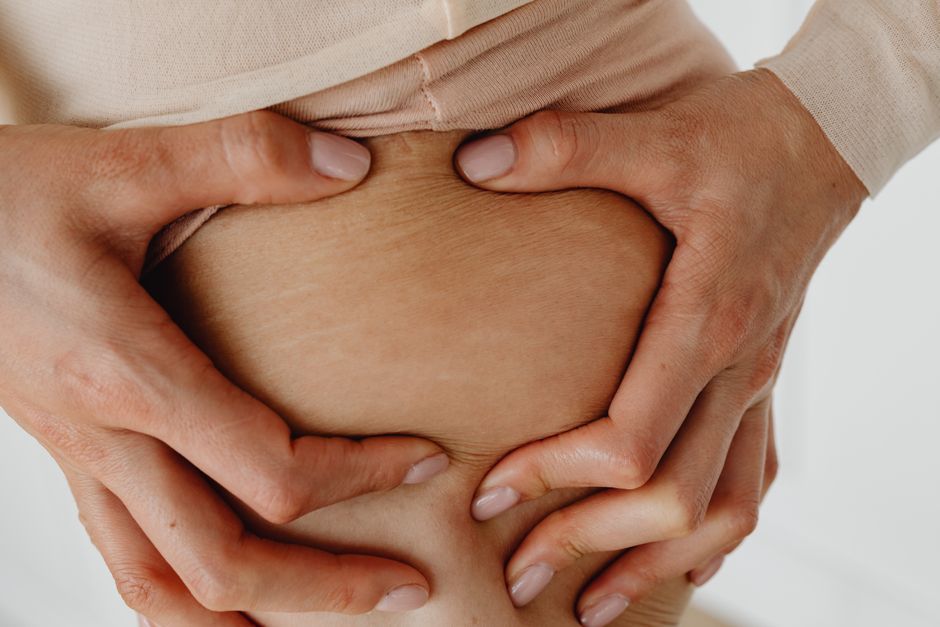
You cannot fully prevent stretch marks during pregnancy. Genetics play the largest role in whether you get them. But you can lower your risk somewhat by keeping weight gain within your doctor’s recommended range, moisturizing to ease itching, and avoiding rapid changes in weight. No cream or oil has been proven to erase or block stretch marks entirely.
Stretch marks, called striae gravidarum, appear in roughly half to 90 percent of pregnant women. That wide range reflects how differently researchers count them. The honest takeaway is that they are very common and mostly influenced by things you cannot control. What follows is a realistic step-by-step approach, with clear notes on what the evidence supports and what it does not.
What Actually Causes Stretch Marks During Pregnancy?
Stretch marks form when the skin stretches faster than its supporting structures can adapt. The dermis, the middle layer of skin, contains collagen and elastin fibers that give skin its strength and bounce. When skin stretches quickly, these fibers can tear. The result is a mark that starts red or purple and later fades to a pale, silvery line.
Hormones matter here too. Pregnancy raises levels of cortisol and relaxin, hormones that affect connective tissue. Some research suggests these hormonal shifts make the skin’s elastic fibers more vulnerable to tearing. This helps explain why stretch marks can appear even in women who gain modest amounts of weight.
Genetics is the single strongest predictor. If your mother or sister had stretch marks during pregnancy, your odds are higher. Studies looking at risk factors consistently find family history near the top of the list. Age, personal history of stretch marks during puberty or rapid growth, and the amount and speed of weight gain also appear to play a role.
One clarification worth knowing: stretch marks are not a sign you did something wrong. They are not caused by skipping lotion or by gaining “too much” weight in most cases. They are largely a matter of skin biology and inherited tendency.
How To Avoid Stretch Marks During Pregnancy: The Step-By-Step Approach
Follow these steps in order of how much they are likely to help. The first steps rest on solid ground. The later ones are lower-risk habits that may help with comfort even if their effect on stretch marks is unproven.
Step 1: Keep weight gain within your recommended range
This is the step with the most evidence behind it. Gaining weight steadily and staying within the range your doctor recommends for your starting body mass index (BMI) reduces rapid skin stretching. The standard guidance comes from the Institute of Medicine (now the National Academy of Medicine) and is based on pre-pregnancy BMI:
- Underweight (BMI under 18.5): about 28 to 40 pounds
- Normal weight (BMI 18.5 to 24.9): about 25 to 35 pounds
- Overweight (BMI 25 to 29.9): about 15 to 25 pounds
- Obese (BMI 30 or higher): about 11 to 20 pounds
These are general ranges. Your own target may differ if you are carrying twins or have certain health conditions. Your prenatal care provider is the right person to set your specific goal. Rapid weight gain in a short period stretches skin faster, so steady, gradual gain is the aim.
Step 2: Gain weight gradually rather than in bursts
Speed matters as much as total amount. Skin adapts better to slow, steady change than to sudden jumps. If you notice your weight climbing quickly over a few weeks, that is worth mentioning at your next prenatal visit. Sometimes fast gain reflects fluid retention rather than fat, which is a medical question for your provider, not a skin one.
Step 3: Keep skin moisturized to reduce itching and discomfort
As skin stretches, it often itches. Keeping it moisturized can ease that discomfort. What moisturizers cannot reliably do is prevent stretch marks. Reviews of the research have not found strong evidence that any cream, oil, or lotion prevents striae gravidarum. Some studies have looked at specific ingredients, but results are mixed and no product has emerged as clearly effective.
That does not make moisturizing pointless. Comfort matters, and dry, itchy skin is uncomfortable. Choose a product you like and can afford. There is no need to spend heavily on products marketed specifically for stretch marks.
Step 4: Eat a balanced diet that supports skin health
Your skin needs protein, vitamin C, and zinc to build and repair collagen. A balanced diet with adequate protein and plenty of fruits and vegetables supports normal skin maintenance. No specific food or supplement has been shown to prevent stretch marks. Be cautious with any supplement marketed for skin during pregnancy, and check with your provider before starting one.
Step 5: Stay physically active as your provider allows
Regular movement, such as walking or prenatal-approved exercise, supports healthy weight gain and general well-being. It has not been shown specifically to prevent stretch marks. Follow your provider’s guidance on what activity is safe for your pregnancy.
Step 6: Stay hydrated
Drinking enough water supports normal skin function and overall health. There is no evidence that a specific amount of water prevents stretch marks. Drink to thirst and follow your provider’s advice, especially if you have any conditions that affect fluid balance.
Do Stretch Mark Creams and Oils Really Work?
The evidence does not support the claim that any cream or oil prevents or removes stretch marks. This is one of the most heavily marketed areas in pregnancy products, and the marketing runs well ahead of the science.
Researchers have tested a range of ingredients, including cocoa butter, olive oil, almond oil, and various commercial formulations. Overall, reviews of these studies have not found convincing evidence that they prevent stretch marks. Some individual trials have reported benefits with specific products, but the results have not been consistent or strong enough to establish a reliable recommendation. When you see a product described as “clinically proven,” treat that claim with skepticism unless it points to large, well-designed trials.
A few ingredients are sometimes discussed in clinical settings, including centella asiatica extract and hyaluronic acid. Some studies suggest possible benefit, but the evidence is not strong enough to call them proven preventives. If you want to try a product, choose one that is safe for use during pregnancy and inexpensive enough that you will not feel misled if it does nothing.
What About Stretch Marks That Have Already Appeared?
Once a stretch mark forms, no cream will erase it. Early marks are red or purple because blood vessels are visible through the thinned skin. Over months to years, they fade to pale, silvery lines. This fading happens on its own.
For women who want to reduce their appearance after pregnancy, some treatments are used in clinical practice. These include prescription retinoids (which are not safe during pregnancy or breastfeeding), laser therapy, microneedling, and other procedures performed by dermatologists. Evidence for these varies by treatment, and results are usually modest rather than complete removal. Any decision about treatment should wait until after pregnancy and breastfeeding, and should be discussed with a qualified clinician.
It helps to set realistic expectations. Most treatments soften the look of stretch marks rather than remove them. Cost, downtime, and possible side effects are real considerations.
Which Risk Factors Can You Actually Change?
Sorting risk factors into what you can influence and what you cannot helps set realistic expectations.
- Cannot change: family history, your age, your skin type, and a personal history of stretch marks earlier in life
- Can influence somewhat: the total amount and speed of weight gain during pregnancy
- Little to no proven influence: which moisturizer you use, how much water you drink, or specific foods you eat
This is not meant to discourage you. It is meant to redirect effort toward the step that matters most, which is healthy, steady weight gain guided by your provider, and away from expensive products that make promises the evidence does not back.
When Should You Talk to Your Doctor?
Mention rapid weight gain, severe itching, or skin changes that concern you at a prenatal visit. Severe itching, especially on the hands and feet or with a rash, can sometimes signal a liver condition of pregnancy called cholestasis. That is a medical matter, not a cosmetic one, and it needs prompt evaluation. Do not self-treat persistent or intense itching during pregnancy.
For stretch marks themselves, there is no medical urgency. They are a normal skin change for many women. If their appearance bothers you after pregnancy, a dermatologist can discuss realistic options.
Frequently Asked Questions
Can stretch marks during pregnancy be prevented completely?
No. Genetics plays the largest role, so no method prevents them in every case. Keeping weight gain within your recommended range may lower your risk somewhat.
Does cocoa butter or oil prevent stretch marks?
Research has not found convincing evidence that cocoa butter, oils, or lotions prevent stretch marks. They can ease itching and keep skin comfortable.
Are stretch marks during pregnancy dangerous?
No, stretch marks are a harmless skin change. However, severe itching during pregnancy should be checked by your provider because it can sometimes signal a liver condition.
Do stretch marks go away after pregnancy?
They fade over time but usually do not disappear. Most marks change from red or purple to pale, silvery lines over months to years.
