
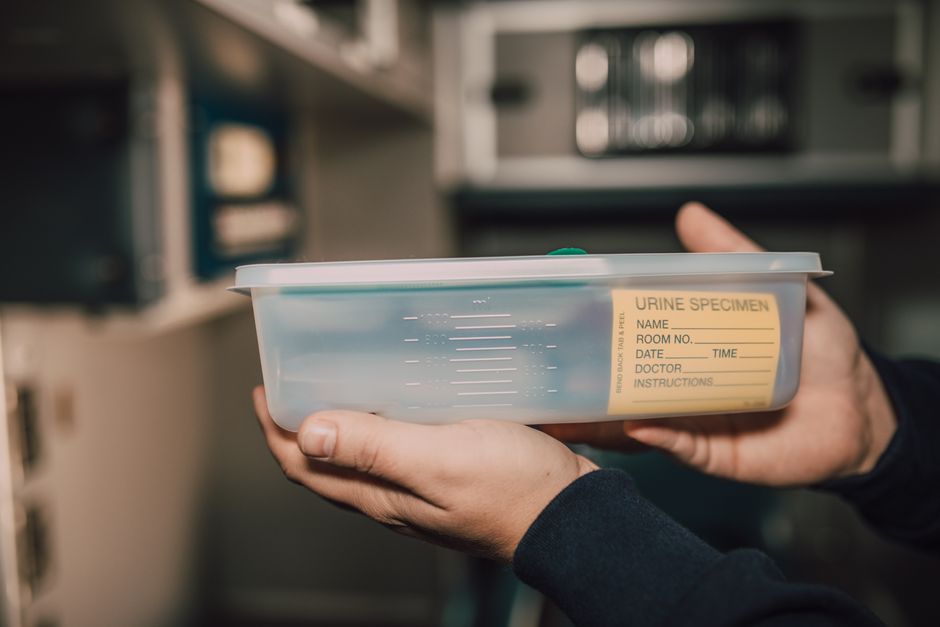
THC tests work by looking for THC or its breakdown products in a sample from your body. The main types are urine, blood, saliva, and hair. Each one has its own detection window, its own strengths, and its own limits. Urine is the most common. Blood shows recent use. Saliva is used for roadside checks. Hair holds the longest record but takes the longest to show anything.
The word “test” covers a lot of ground. A screening test and a confirmation test are not the same thing. Understanding that difference explains why results sometimes change between the first test and the second.
What Does a THC Test Actually Look For?
Most tests do not look for THC itself. They look for metabolites — the chemicals your body makes when it breaks THC down.
The main one is THC-COOH (11-nor-9-carboxy-THC). Your liver produces it, and it leaves your body mainly in urine and feces. It is not psychoactive. A positive result means your body processed THC, not that you are high at that moment.
This is where a lot of confusion starts. A urine test can be positive days or weeks after the effects have worn off. The test measures exposure, not impairment.
Testing falls into two steps in most labs:
- Screening — a fast, inexpensive immunoassay. It gives a yes or no based on a cutoff level.
- Confirmation — a more precise method, usually gas or liquid chromatography with mass spectrometry (GC-MS or LC-MS). It identifies the specific compound.
A screening result is not a final answer. Labs typically confirm any positive screen before reporting it as positive. This is standard practice, and it is why a “false positive” on a cheap screen often does not survive confirmation.
How Do Urine Tests Work and How Long Does THC Stay in Urine?
Urine testing is the most widely used method because it is cheap, non-invasive, and detects the metabolite THC-COOH well.
THC and its metabolites are fat-soluble. They store in body fat and release slowly. That slow release is why urine can stay positive far longer than blood or saliva.
Detection windows vary a lot from person to person. The general picture:
- One-time or occasional use — often detectable for a few days.
- Regular use — commonly detectable for days to a few weeks.
- Heavy, long-term daily use — sometimes detectable for a month or longer.
These are ranges, not guarantees. Body fat percentage, dose, frequency, hydration, and individual metabolism all shift the timeline. Someone who uses heavily and has more body fat may test positive longer than someone who uses lightly.
Drinking a lot of water before a test can dilute the sample. Labs check for dilution using a measure called specific gravity and by testing for creatinine, a waste product normally present in urine. A diluted sample may be flagged as invalid rather than negative. Dilution is not a reliable way to beat a test, and it can backfire.
How Do Blood Tests Work and What Do They Show?
Blood tests measure THC itself, not just the metabolite. That makes them good at showing very recent use.
THC appears in blood within minutes of smoking or vaping and usually clears within hours. The metabolite THC-COOH stays detectable somewhat longer, but blood windows are still short — generally hours to a couple of days, not weeks.
Blood testing is used in some workplace, legal, and medical settings where recent exposure matters. It is more invasive and more expensive than urine. It is not a routine screening tool.
One limit worth knowing: even a blood test measures presence, not impairment. THC levels in blood do not map cleanly onto how impaired a person is. Someone with a detectable level may not be impaired, and impairment involves many factors beyond a single number. This is an active area of research, and no blood threshold is universally accepted as a measure of impairment.
How Do Saliva Tests Work?
Saliva testing, also called oral fluid testing, looks for THC in the mouth. It is popular for roadside and on-the-spot checks because it is fast and easy to collect.
Saliva tends to detect THC for a shorter window than urine — often hours to about a day after use. Smoking and vaping can leave THC in the mouth for a short time right after use, which can produce a positive result even if blood levels are low.
Saliva is good at catching recent use. It is less useful for detecting use from days earlier. Collection matters too — what a person ate or drank right before can affect the sample.
How Do Hair Tests Work and Why Do They Last So Long?
Hair testing works differently from the others. As hair grows, it traps THC and its metabolites inside the strand. Those chemicals stay there as the hair grows out.
Because hair grows slowly — roughly half an inch per month on average — a hair test can reflect a long history of use. Detection windows are often described in months, not days. A sample taken close to the scalp covers recent months; a longer strand can reach further back.
Hair testing has real limitations:
- It takes time to show up. Because hair grows slowly, very recent use may not appear yet.
- External contamination is a concern. Chemicals in the environment, smoke, or hair products can deposit on the outside of the hair. Labs use washing steps to reduce this, but contamination is a known issue in the field.
- Hair color and texture can affect how much binds. This has raised fairness questions in some settings.
Hair testing is used in some workplace, legal, and child welfare contexts. It is not universal, and its reliability for cannabis has been debated.
How Do the Different THC Tests Compare?
The table below summarizes the general detection windows. Treat these as typical ranges, not fixed rules.
| Test type | What it detects | Typical detection window | Common use |
|---|---|---|---|
| Urine | THC-COOH metabolite | Days to weeks (longer with heavy use) | Workplace, clinical, legal screening |
| Blood | THC and metabolite | Hours to a couple of days | Recent-use and legal testing |
| Saliva | THC in oral fluid | Hours to about a day | Roadside and on-site checks |
| Hair | THC trapped in hair | Months | Long-history testing |
The single biggest factor in any detection window is how often and how much a person uses. Frequent use builds up more stored metabolite and stays detectable longer across every method.
What Causes a False Positive or False Negative?
No test is perfect. Screening tests can produce false positives, meaning a positive result when no THC is present.
Some medications and substances have been reported to cross-react with cannabis screening tests. Certain common drugs have been linked to false positives on some immunoassays. This is why confirmation testing matters — it identifies the actual compound and rules out cross-reactivity.
False negatives happen too. A sample collected too soon after use, a diluted urine sample, or a very light user whose metabolite levels stay below the cutoff can all produce a negative result.
The cutoff level is the threshold a lab uses to call a sample positive. Different labs and settings use different cutoffs, so the same person can get different results from different tests. This is one reason results are not always comparable across settings.
Do THC Tests Measure Impairment?
No. This is one of the most important things to understand about cannabis testing.
A positive test shows that THC or its metabolites are present. It does not show whether a person is impaired right now. Urine and hair especially can stay positive long after any effect has passed.
This gap between “presence” and “impairment” is a known challenge for workplace policy, traffic safety, and legal settings. Researchers are still working on reliable ways to measure cannabis impairment, and no single test currently does it well. Anyone who tells you a positive test proves someone was impaired is overstating what the test can show.
Frequently Asked Questions
How long does THC stay in your system?
It depends on the test and how often you use. Urine can stay positive for days to weeks, blood for hours to a couple of days, saliva for hours to about a day, and hair for months.
Can a urine test detect THC after one use?
Yes, often for a few days after a single use. The exact window varies with dose, body fat, hydration, and individual metabolism.
Does a positive THC test mean you are high?
No. A positive test shows THC or its metabolites are present, not that you are currently impaired, and urine and hair can stay positive long after effects wear off.
Can hair tests be affected by secondhand smoke?
Possibly. External contamination from smoke or the environment can deposit on hair, which is why labs use washing steps, though contamination remains a known concern.
