
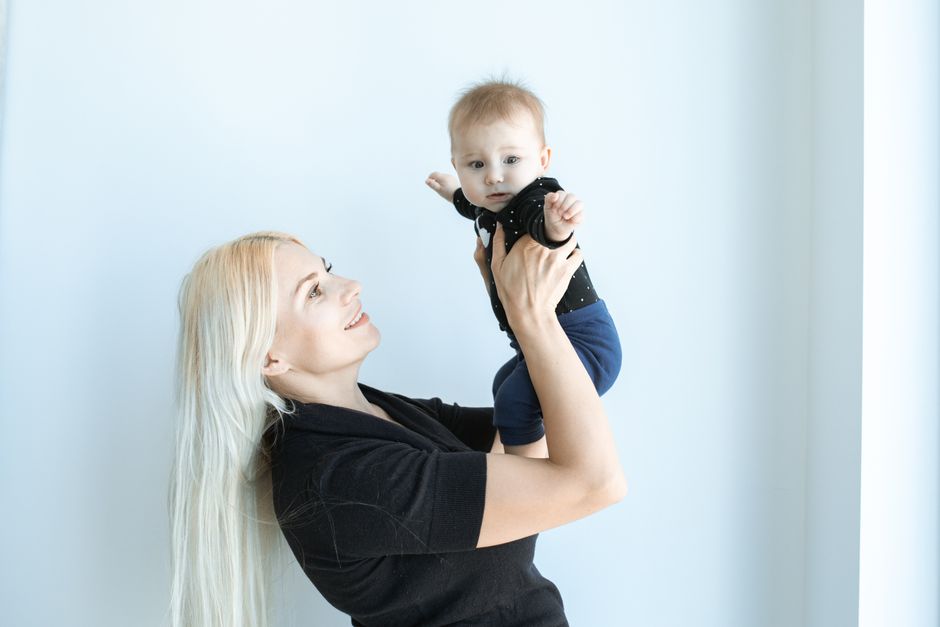
You can hold a newborn safely by supporting the head and neck with one hand and cradling the body against your chest with the other. A newborn’s neck muscles are not strong enough to control the head, so that support is not optional — it is the single most important part of carrying a baby. Every hold, lift, and transfer follows the same rule: head and neck supported, body close to yours, movements slow and smooth.
Why Do Newborns Need Their Head Supported?
Newborns cannot hold their heads up on their own. The muscles that control the neck and trunk are still developing, and the head is proportionally large and heavy compared to the rest of the body. Without support, the head can flop backward or forward suddenly.
That floppy motion matters because it can strain the neck. It can also briefly interfere with a baby’s airway if the head falls into a position that bends the neck too far. This is why every standard newborn handling technique — in hospitals, in parenting guides, and in pediatric guidance — starts with head and neck support.
Most babies begin to gain meaningful head control between 2 and 4 months of age. Some reach it a little earlier or later. Until your baby can hold their head steady and in line with their body during a supported sit, keep supporting the head every time you pick them up or carry them.
What Is the Safest Basic Hold for a Newborn?
The cradle hold is the most common position for carrying a newborn. It keeps the baby’s head higher than the body and close to yours.
Here is how it works:
- Slide one hand under the baby’s head and neck, cradling the base of the skull.
- Slide your other hand under the bottom and lower back.
- Lift the baby smoothly toward your chest, keeping them close to your body.
- Settle the head into the crook of your elbow or against your forearm, with your hand supporting the bottom.
Keep the baby’s head slightly higher than the feet. This position is comfortable for most parents and gives you one free hand once the baby is settled.
An alternative is the upright hold, sometimes called the shoulder hold. Rest the baby against your chest with their chin clear of your shoulder, one hand supporting the head and neck and the other supporting the bottom. This position can help with burping and is often soothing for babies who prefer being upright. Make sure the baby’s face is never pressed into your shoulder or clothing — the nose and mouth need to stay clear at all times.
How T O Carry Newborn During Feeding and Burping
Feeding positions and carrying positions overlap, and the same head-and-neck rule applies. Whether you breastfeed, bottle-feed, or burp your baby, the head should be supported and slightly elevated.
For bottle-feeding, hold the baby in a semi-upright position with the head supported in the crook of your arm. Keep the bottle tilted so milk fills the nipple and the baby is not swallowing extra air. Never prop a bottle and leave a newborn to feed alone — this raises the risk of choking and ear infections, and it removes the head support a newborn needs.
For burping, sit the baby upright on your lap facing away from you, with one hand supporting the chest and chin and the other patting or rubbing the back. Or hold the baby against your shoulder with the head supported and the face turned to the side so the nose and mouth stay clear.
After feeding, many parents keep the baby upright and supported for a short while. Some babies spit up less this way. The evidence that position alone reduces spitting up is modest, but upright positioning during and right after feeds is standard practice and does no harm when the head is supported.





What Should You Avoid When Carrying a Newborn?
Certain habits are worth avoiding until your baby has head control.
- Do not lift a newborn by the arms or hands. This pulls on the shoulders and neck without supporting the head.
- Do not hold a newborn with one arm while the head is unsupported, even briefly.
- Do not shake a baby for any reason. Shaking can cause serious brain injury, and it is one of the most preventable causes of infant harm.
- Do not carry a newborn in a car seat or carrier that lets the head slump forward. If the head falls forward, the chin can press toward the chest and narrow the airway.
- Do not pass a newborn to another person without a clear handoff — both people should have a hand on the baby during the transfer.
One point that surprises many parents: a newborn’s head control is not all-or-nothing. It develops gradually over the first few months. A baby who can briefly lift their head during tummy time is not yet ready to be carried without support. Tummy time builds the muscles, but carrying still requires your hands until control is consistent.
How Do You Use a Baby Carrier Safely?
Baby carriers and wraps can be safe and convenient, but they require the same attention to the head, neck, and airway as holding a baby in your arms.
The general safety principles for carriers are well established:
- The baby should be high enough on your chest that you can easily kiss the top of their head.
- The face should always be visible and never covered by fabric.
- The chin should not be pressed into the chest — keep the head turned to the side or upright so the airway stays open.
- The back should be supported and the baby should not slump or curl into a C-shape that closes off the airway.
- Check the baby frequently, especially in the first months when head control is limited.
For newborns, a carrier that supports the head and neck is important. Some wraps and carriers are designed for the newborn period; others are not suitable until the baby is larger and has more head control. Follow the manufacturer’s weight and age guidance, and if you are unsure whether a carrier fits your newborn safely, ask your pediatric provider.
What About Car Seats and Strollers?
Car seats are required for travel and are designed to protect a newborn, but they are not meant for extended carrying or sleeping outside the car. When a newborn is in a car seat, the seat should be reclined to the angle specified by the manufacturer so the head does not fall forward.
For strollers, check the manufacturer’s guidance. Many strollers are not suitable for newborns unless the seat reclines flat or a newborn insert or bassinet attachment is used. A newborn who cannot yet hold their head up should not be placed in a stroller seat that lets the head slump forward or to the side.
Some research has raised questions about how long it is safe for a newborn to remain in a car seat, particularly for breathing and posture. The evidence is not fully settled, and recommendations vary. A reasonable, widely supported approach is to use the car seat for travel and avoid using it as a general-purpose carrier or sleep surface when you are not driving. If you have concerns about your baby’s breathing or position in a car seat, talk with your pediatric provider.
How Does Carrying Change as Your Baby Grows?
As head control develops, carrying gets easier. By around 4 months, many babies can hold their head steady when supported upright. By 6 months, many can sit with support and have much better head control. These are general ranges — babies develop at different rates, and some reach milestones earlier or later.
Even as control improves, keep supporting the head during quick movements, when the baby is tired, and during transitions like lifting out of a crib or car seat. A baby who is calm and strong during play can still let their head loll when they are sleepy or startled.
If your baby seems to have very little head control, seems floppy, or has a head that consistently tilts to one side, mention it to your pediatric provider. These can be normal variations, but they can also be signs worth evaluating.
What About Skin-to-Skin and Frequent Holding?
Holding a newborn often is not spoiling them. Skin-to-skin contact — placing a diaper-clad baby directly on a parent’s bare chest — is used in hospitals right after birth and is associated with benefits for both babies and parents, including helping with temperature regulation, feeding, and bonding. For stable newborns, skin-to-skin is generally encouraged.
Frequent holding does not create bad habits in newborns. Young infants do not have the developmental capacity to manipulate or to be “spoiled” in that sense. Responding to a newborn’s cues is part of normal care.
The practical takeaway is simple: hold your newborn often, support the head and neck every time, keep the face clear, and move slowly. Those four habits cover almost everything that matters when carrying a newborn.
Frequently Asked Questions
How do you pick up a newborn safely?
Slide one hand under the head and neck and the other under the bottom, then lift smoothly toward your chest while keeping the head supported. Move slowly and keep the baby close to your body throughout the lift.
Until what age does a newborn need head support?
Most babies need head support until they can hold their head steady on their own, which usually happens between 2 and 4 months. Keep supporting the head during quick movements and when the baby is tired even after that.
Can you carry a newborn in one arm?
Only if that arm fully supports the head, neck, and body against your chest, and only for short periods. For most parents, using both arms or a properly fitted carrier is safer while head control is still developing.
Is it safe to carry a newborn in a baby carrier?
Yes, when the carrier supports the head and neck, keeps the face visible and clear, and prevents the chin from pressing into the chest. Check your baby often and follow the carrier’s weight and age guidance.
