

If you are watching the calendar and wondering whether that twinge means something, the short answer is this: most people who notice early pregnancy symptoms start to feel them around the time of a missed period, roughly one to two weeks after conception. A smaller number notice changes earlier, sometimes about a week after ovulation. Many notice nothing at all until well past their expected period.
That range is wide because the hormone behind most early symptoms, human chorionic gonadotropin (hCG), only starts being produced after a fertilized egg implants in the uterus. Implantation usually happens about 6 to 12 days after ovulation. Until that happens, the body has no pregnancy-specific signal to react to.
What Happens in the Body Before Symptoms Can Start?
Pregnancy symptoms cannot begin before implantation because there is no hormonal signal yet. Understanding this timeline explains why the “two-week wait” feels so long and why testing too early often gives a false negative.
Here is the sequence:
- Ovulation releases an egg, which lives about 12 to 24 hours.
- If sperm meets the egg, fertilization usually occurs within a day of ovulation.
- The fertilized egg travels down the fallopian tube and divides into a ball of cells called a blastocyst.
- The blastocyst reaches the uterus and implants into the lining, typically 6 to 12 days after ovulation.
- Only after implantation do the cells that will become the placenta begin releasing hCG.
hCG is the hormone that tells the corpus luteum (the leftover follicle in the ovary) to keep producing progesterone. Progesterone maintains the uterine lining and prevents a period. Rising hCG and progesterone together drive most of the physical changes people associate with early pregnancy.
This is why the earliest possible symptoms are tied to implantation, not to fertilization. A person who conceived today will not feel anything tomorrow. The hormonal clock has not started.
How Soon Do You Experience Pregnancy Symptoms After Ovulation?
The earliest symptoms generally appear between 6 and 14 days after ovulation, with most people noticing them closer to the two-week mark. Symptoms that show up before implantation are not caused by pregnancy, because the pregnancy hormone is not yet present.
Some people report breast tenderness, mild cramping, or fatigue in that first week after ovulation. These can be real, but they are also common symptoms of the normal luteal phase, the second half of the menstrual cycle when progesterone rises whether or not pregnancy occurs. Progesterone alone can cause breast sensitivity, bloating, mood shifts, and tiredness.
That overlap is the central difficulty with early symptom spotting. The same hormone that supports a possible pregnancy also produces premenstrual symptoms. A twinge at day 8 after ovulation does not reliably tell you which direction things are heading.
What is well established is the biology: no implantation, no hCG, no pregnancy-specific symptoms. What varies enormously is how sensitive any individual is to rising progesterone and hCG, and how early those shifts become noticeable.
Which Symptoms Tend to Show Up First?
Breast tenderness and fatigue are among the most commonly reported early symptoms, followed by nausea and a missed period. The order and intensity vary widely from person to person and from pregnancy to pregnancy.
Common early symptoms include:
- Breast tenderness or fullness — often one of the first changes, driven by rising progesterone and hCG.
- Fatigue — profound tiredness is frequently reported in early pregnancy, though the exact cause is not fully pinned down; hormonal shifts and increased metabolic demand are likely contributors.
- Nausea — “morning sickness” can start around week 4 to 6 of pregnancy (which is roughly 2 to 4 weeks after conception, since pregnancy is dated from the last menstrual period). It can occur at any time of day.
- Mild cramping and spotting — sometimes called implantation bleeding, though not everyone experiences it and it is easily confused with an early period.
- Frequent urination — usually becomes noticeable a bit later as blood volume increases and the uterus begins to press on the bladder.
- Food aversions or heightened smell — reported by many, though the mechanism is not fully understood.
One clarification worth making: implantation bleeding is real but often over-interpreted. Light spotting in early pregnancy can have several causes, and light spotting before a period is also common in cycles that do not result in pregnancy. Spotting alone is not a reliable sign either way.



Why Do Some People Feel Symptoms Earlier Than Others?
There is no single reason some people notice symptoms at day 7 and others notice nothing until week 8. Several factors likely play a role, and much of the variation is not fully explained by current research.
Factors that may influence timing and intensity:
- Implantation timing — a blastocyst that implants at day 6 will trigger hCG production earlier than one that implants at day 12.
- hCG rise rate — hCG typically doubles roughly every 48 hours in early pregnancy, but the starting point and pace vary.
- Individual hormone sensitivity — people respond differently to the same hormonal levels.
- Prior pregnancies — some people report noticing symptoms earlier in subsequent pregnancies, though this is based on personal report rather than strong controlled evidence.
- Cycle length and ovulation timing — a person who ovulates on day 20 of a 34-day cycle will have a different calendar than someone who ovulates on day 14 of a 28-day cycle.
The last point matters more than many people realize. Pregnancy is dated from the first day of the last menstrual period, not from conception. So “week 4 of pregnancy” is roughly two weeks after conception. When someone says symptoms started at “week 4,” they usually mean about two weeks after ovulation.
Can You Have Pregnancy Symptoms Before a Positive Test?
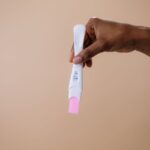
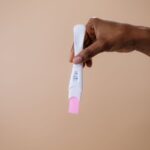
Yes, it is possible to feel symptoms before a home test turns positive, but the symptoms are usually caused by progesterone rather than by pregnancy specifically. A home urine test generally detects hCG reliably around the time of a missed period, sometimes a day or two before.
The timing problem is this: symptoms and detectable hCG rise on overlapping but not identical schedules. Early pregnancy tests are designed to detect hCG at low levels, but testing too soon after ovulation can produce a negative result even if pregnancy is underway, because hCG has not yet reached the detectable threshold.
If symptoms are present but a test is negative, the usual explanation is one of two things. Either the symptoms are from premenstrual hormonal changes, or the test was taken before hCG was high enough. Waiting a few days and retesting is the standard approach. A blood test ordered by a clinician can detect hCG earlier than a urine test.
No symptom pattern can confirm or rule out pregnancy on its own. Testing is what answers the question.
When Should You Test or Talk to a Clinician?
Testing around the first day of a missed period gives the most reliable result for most people. If the result is negative and the period still has not started, retesting in a few days is reasonable.
Contact a clinician if:
- You have a positive test and want to confirm the pregnancy or begin prenatal care.
- You have severe pain, heavy bleeding, or symptoms that feel unusual.
- You have been trying to conceive for a year without success (or six months if you are over 35), as this is a common threshold for further evaluation.
- You have a condition or take a medication that could affect pregnancy and want guidance.
It is worth saying plainly: early pregnancy symptoms are real but nonspecific. They overlap heavily with ordinary cycle changes. A missed period plus a positive test is the reliable combination, not a particular feeling or twinge.
Frequently Asked Questions
How soon after conception can you feel pregnancy symptoms?
Most people who notice symptoms start feeling them about 6 to 14 days after ovulation, around the time of a missed period. Symptoms cannot begin before implantation, which usually occurs 6 to 12 days after ovulation.
Can you have pregnancy symptoms 3 days after ovulation?
No, pregnancy-specific symptoms cannot occur that early because implantation has not happened and hCG has not been produced. Any changes felt at that point are from normal progesterone shifts in the luteal phase.
What is the earliest symptom of pregnancy?
Breast tenderness and fatigue are among the most commonly reported early symptoms, often appearing around the time of a missed period. However, these symptoms overlap with premenstrual changes and cannot confirm pregnancy on their own.
Can you get a positive pregnancy test before symptoms start?
Yes, a home urine test can turn positive around the time of a missed period, sometimes before any symptoms are noticed. Testing too early can give a false negative because hCG may not yet be at a detectable level.
