
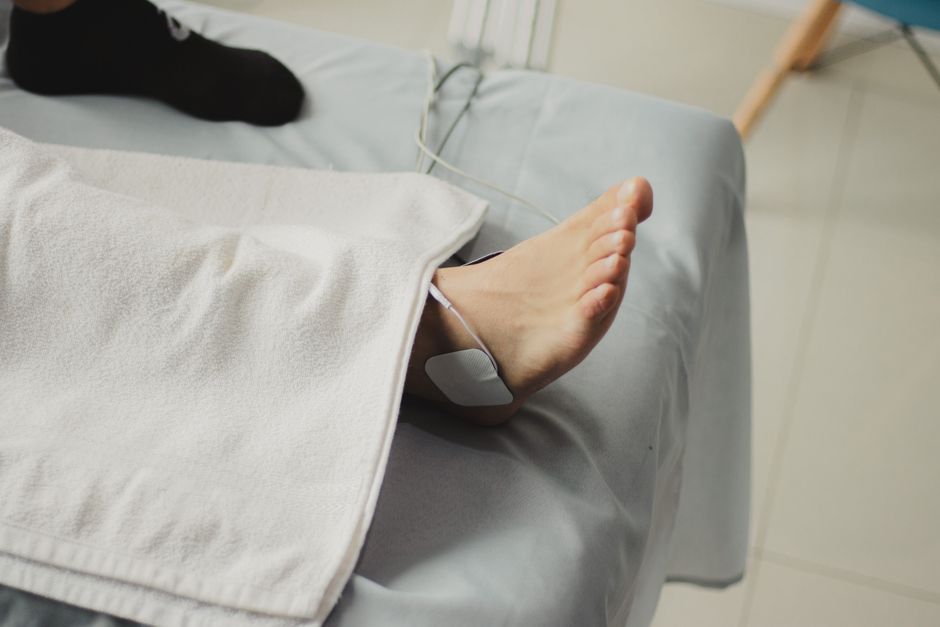
NMES — neuromuscular electrical stimulation — sends small electrical pulses through electrodes on the skin to make a muscle contract. The current reaches the motor nerve, not the muscle directly, and that nerve fires the muscle fibers it controls. For rehabilitation, this matters because a muscle can be made to work even when the brain’s signal to move it is weak, blocked, or temporarily unavailable after injury or surgery.
How Nmes Therapy Works For Muscle Rehabilitation?
NMES works by recruiting motor nerves with an electrical current, which then trigger muscle contraction in a pattern the person cannot always produce voluntarily.
The current travels from the electrodes through the skin and soft tissue to the motor nerve. When the current reaches a certain strength, the nerve fires and the muscle fibers it supplies contract. Increase the current and more fibers join in, which is why the contraction gets stronger.
This is different from how a voluntary contraction works. When you decide to lift your arm, your brain recruits motor units in a specific order — smaller, fatigue-resistant units first, larger, powerful units later. Electrical stimulation tends to recruit them in the reverse order and all at once. That difference helps explain why NMES contractions feel different from your own, and why the technique is used as a supplement to training, not a replacement for it.
The other thing to understand is timing. NMES is not a passive treatment you receive while doing nothing. It is typically used alongside active exercise, and the muscle work it produces is meant to add to what you can already do voluntarily.
What Conditions Does NMES Help With?
NMES has the strongest evidence in situations where a muscle is present and its nerve supply is intact, but the person cannot fully activate it. That includes recovery after knee and hip surgery, where the quadriceps often shuts down temporarily.
Research on post-surgical knee recovery has found that adding NMES to standard rehabilitation can improve quadriceps strength compared with exercise alone. The effect is most consistent in the early weeks after surgery, when voluntary activation is most impaired.
Other areas where NMES is used include:
- Stroke rehabilitation, where stimulation can help re-engage muscles affected by reduced neural drive from the brain
- Spinal cord injury, where it may help maintain muscle mass and circulation below the level of injury
- Critical illness and prolonged bed rest, where muscle wasting is rapid and voluntary exercise is limited
- Chronic obstructive pulmonary disease, where leg muscle weakness limits activity
- Urinary incontinence, where pelvic floor stimulation is used in some clinical settings
A key limitation: NMES requires an intact lower motor nerve. If the nerve itself is destroyed — as in a severe peripheral nerve injury — the current has nothing to activate. In those cases, a different approach is needed.
NMES vs. TENS: What Is the Difference?
NMES and TENS both use electrodes and electrical current, but they aim at different targets and produce different results.
TENS — transcutaneous electrical nerve stimulation — is designed to affect sensory nerves for pain relief. The goal is a tingling sensation, not a muscle contraction. It is used for pain management, not for building or restoring muscle function.
NMES is designed to reach motor nerves and produce a visible, palpable muscle contraction. The current parameters — frequency, pulse width, and amplitude — are set to achieve that contraction, not just a sensory response.
Some devices combine both modes, which can cause confusion. If your goal is muscle rehabilitation, the setting that produces a real contraction is the one that matters. A gentle tingle that does not move the muscle is not doing the work NMES is intended to do.



What Does a Typical NMES Session Involve?
A session usually involves placing electrodes over the target muscle, setting the device to produce a strong but tolerable contraction, and cycling through work and rest periods. The exact parameters vary by device and clinical protocol.
Common features of clinical NMES use include:
- Electrodes positioned over the muscle belly and its motor point
- A current strong enough to produce a visible contraction — often described as strong but not painful
- Cycles of contraction and rest, with the rest period allowing the muscle to recover
- Sessions typically supervised by a physical therapist or trained clinician, especially early on
The intensity question matters. If the current is too low, the muscle does not contract meaningfully and the session does little. If it is too high, it becomes painful and the person cannot tolerate it. Finding the right level usually takes some adjustment, which is one reason early sessions are best done with guidance.
Some people use NMES at home after being trained by a clinician. Home units exist, but the evidence for unsupervised home use is weaker than for supervised clinical use. If you are considering a home device, a conversation with your physical therapist or physician about whether it fits your situation is worth having.
What Does the Evidence Actually Show?
The evidence for NMES in muscle rehabilitation is real but uneven. It is strongest in specific, well-defined situations and weaker in others.
Where evidence is relatively consistent:
- Quadriceps strength after knee surgery — multiple studies show benefit when NMES is added to standard exercise
- Muscle strength in people who cannot voluntarily activate a muscle after stroke or injury
- Muscle mass maintenance during periods of immobilization or critical illness
Where evidence is more limited or mixed:
- Long-term functional outcomes — it is less clear whether strength gains translate into better walking, balance, or daily function over months and years
- Chronic conditions where the muscle can already be activated voluntarily — here NMES adds less
- Home-based use without supervision
One honest limitation: many NMES studies are small, use different protocols, and measure different outcomes. That makes it hard to draw sweeping conclusions. The technique is not a cure, and it does not replace exercise. It is a tool that can help when voluntary activation is the bottleneck.
What Are the Risks and Limitations?
NMES is generally well tolerated when used appropriately, but it is not risk-free and it is not for everyone.
Common issues include skin irritation under the electrodes, discomfort during strong contractions, and muscle soreness afterward similar to what follows a hard workout. These are usually temporary.
More serious concerns exist for certain people. NMES should not be used over the chest in people with certain heart conditions, over the neck or head, or over areas with implanted electronic devices such as pacemakers or defibrillators, unless a physician has specifically approved it. It should not be applied over areas of active infection, broken skin, or suspected blood clots.
Pregnancy is a situation where caution is warranted, and NMES should only be used under clinical guidance. For children and infants, no clinical guidelines currently exist for general NMES use, so it should not be applied without specialist direction.
The bigger limitation is conceptual. NMES produces a contraction, but it does not teach the brain and muscle to work together. That re-learning comes from active, voluntary movement. NMES is most useful as a bridge — helping a muscle stay active or regain strength while the person works on the voluntary control that ultimately matters more.
Does NMES Build Muscle Like Exercise Does?
NMES can increase strength and help preserve muscle mass, but it does not produce the same broad effects as voluntary exercise.
Voluntary exercise does more than contract a muscle. It trains coordination, balance, and the neural pathways that control movement. It also drives cardiovascular and metabolic adaptations that NMES does not. For a healthy person who can exercise, NMES is not a substitute and is not recommended as one.
Where NMES earns its place is when voluntary exercise is not possible or not enough. After surgery, when the quadriceps will not fire properly, NMES can bridge the gap. After a stroke, when the brain’s signal is weakened, it can help keep the muscle engaged. In those situations, the goal is not to replace exercise but to make exercise possible again.
The research on NMES in healthy athletes is less convincing. Some studies suggest it can add a small amount of strength, but the effect is modest compared with actually training. Marketing that presents NMES as a shortcut to fitness overstates what the evidence supports.
Who Should Consider NMES?
NMES is most likely to help someone who has a specific, identifiable problem with voluntary muscle activation. That is usually determined by a clinician, often with a physical therapist.
Signs it might be worth discussing:
- You had surgery and the muscle still will not activate normally weeks later
- You had a stroke or nerve injury and cannot fully contract a muscle
- You are immobilized or on bed rest and at risk of rapid muscle loss
- Standard exercise is not producing the strength gains expected
It is less likely to help if you can already activate the muscle fully and just want to get stronger faster. In that case, the evidence does not support NMES as a meaningful addition.
The decision should be individualized. A physical therapist or physician can assess whether the problem is activation, strength, or something else — and whether NMES fits.
Frequently Asked Questions
Does NMES actually build muscle?
NMES can increase strength and help preserve muscle mass, particularly when voluntary activation is impaired. It does not build muscle as effectively as voluntary exercise in people who can already activate their muscles normally.
How often should NMES be used for muscle rehabilitation?
Frequency depends on the condition and the clinical protocol, and there is no single standard that applies to everyone. A physical therapist or physician should set the schedule based on your specific situation.
Is NMES the same as TENS?
No. TENS targets sensory nerves for pain relief and produces a tingling sensation, while NMES targets motor nerves to produce a visible muscle contraction. They use similar equipment but serve different purposes.
Can I use NMES at home without a therapist?
Home units exist, but the evidence for unsupervised use is weaker than for supervised clinical use. If you are considering a home device, talk with your physical therapist or physician first to see whether it fits your situation.
