
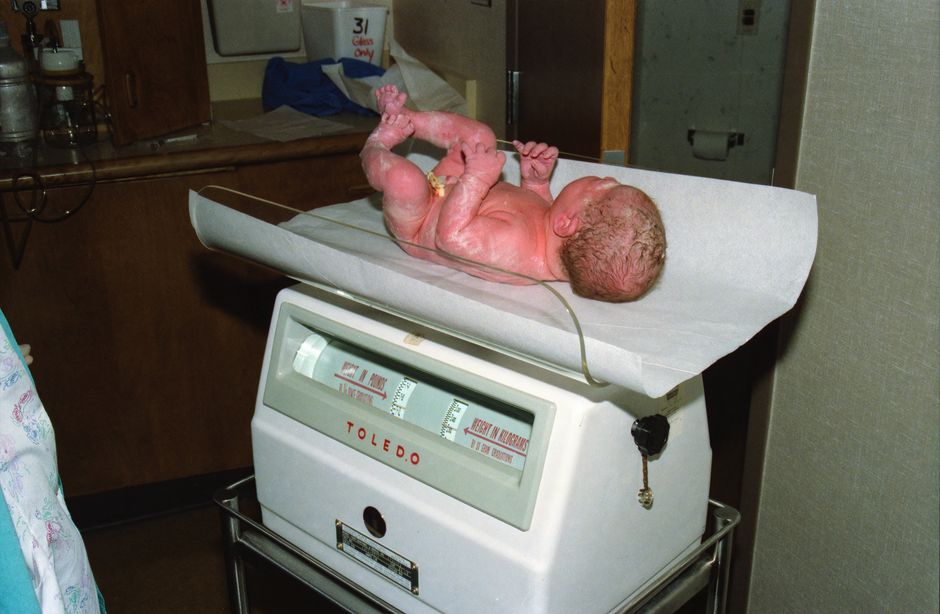
Newborns typically gain about 5 to 7 ounces per week in the first few months of life. This rate is an average, and healthy babies often gain more or less in any given week. The real measure of healthy growth is the overall trend over several weeks, not a single weekly number.
How Much Weight Do Newborns Gain Each Week?
In the first three to four months, most babies gain roughly 5 to 7 ounces (150 to 200 grams) per week. After the fourth month, the rate of gain typically slows down. From four to six months, babies often gain about 4 to 5 ounces per week. Between six and twelve months, the average drops to about 2 to 4 ounces per week.
These are averages, not requirements. A baby who gains 3 ounces one week and 8 ounces the next is still following a normal pattern. Pediatricians watch the curve over time, not single points on it.
Why Do Babies Lose Weight Right After Birth?
It is normal for newborns to lose weight in the first few days of life. Most babies lose about 5 to 7 percent of their birth weight before they start gaining. This happens because babies are born with extra fluid that they shed in the first days. They also have small stomachs and are just learning to feed.
A loss of up to 10 percent of birth weight is generally considered within normal range for healthy, full-term babies. Most babies return to their birth weight by the time they are 10 to 14 days old. If a baby loses more than 10 percent, or has not returned to birth weight by two weeks, a doctor should evaluate feeding and health.
What Affects a Newborn’s Weight Gain?
Several factors influence how fast a baby gains weight. The most important is feeding. Breastfed and formula-fed babies gain weight at slightly different rates in the first months. Breastfed babies often gain a bit faster in the first three months, while formula-fed babies may gain slightly faster after that.
Other factors include the baby’s birth weight, genetics, and overall health. A baby born at 5 pounds will not follow the same growth pattern as a baby born at 9 pounds. Premature babies have their own growth charts and expectations.
Feeding frequency matters too. Newborns need to eat every 2 to 3 hours, which is about 8 to 12 feedings per day. Babies who are sleepy and do not wake to feed may gain weight more slowly.





How Do Doctors Track Newborn Weight Gain?
Pediatricians use growth charts from the World Health Organization (WHO) and the Centers for Disease Control and Prevention (CDC). These charts plot weight, length, and head circumference against age. The charts show percentiles, which compare a baby to other babies of the same age and sex.
A baby at the 25th percentile weighs more than 25 percent of babies the same age and less than 75 percent. What matters is not the specific percentile but that the baby follows a consistent curve. A baby who drops across two major percentile lines may need evaluation.
Doctors also look at weight-for-length. This helps tell if a baby is growing proportionally. A baby can be small but well-proportioned, which is different from a baby who is not gaining enough relative to length.
When Should Parents Worry About Slow Weight Gain?
Slow weight gain is a real concern, but the definition matters. A baby who gains 3 ounces in a week after gaining 7 ounces the week before is not necessarily in trouble. A baby who consistently gains less than the expected range, or who loses weight after the first two weeks, needs attention.
Signs that warrant a call to the pediatrician include fewer than six wet diapers per day after the first week, dark urine, extreme sleepiness that interferes with feeding, or a baby who seems hungry but is not gaining. Jaundice that persists beyond two weeks can also be related to feeding problems.
Most slow weight gain in newborns is caused by feeding issues, not illness. Poor latch, low milk supply, or a baby who falls asleep at the breast are common causes. A lactation consultant or pediatrician can help identify the specific issue.
What Is a Healthy Weight Gain Pattern by Month?
Growth is fastest in the first months and slows gradually through the first year. The following table shows average weekly gains by age range.
| Age Range | Average Weekly Gain |
|---|---|
| Birth to 3 months | 5 to 7 ounces (150–200 g) |
| 3 to 6 months | 3 to 5 ounces (100–140 g) |
| 6 to 12 months | 2 to 4 ounces (60–110 g) |
Most babies double their birth weight by about 4 to 5 months. They typically triple it by their first birthday. These milestones are useful guides, but individual variation is enormous.
Length and head circumference matter as much as weight. A baby who gains weight slowly but grows steadily in length may be perfectly healthy. A baby who stalls in all three measurements needs more urgent evaluation.
Do Breastfed and Formula-Fed Babies Gain Weight Differently?
Yes, but the differences are modest and not a reason to choose one feeding method over another. Breastfed babies tend to gain weight more rapidly in the first 3 months. Formula-fed babies often gain slightly faster between 3 and 12 months.
Breastfed babies also have a different pattern of weight loss in the first days. They may lose slightly more weight initially and take a few extra days to return to birth weight. This is normal when breastfeeding is going well.
The WHO growth charts are based on breastfed infants as the norm. Using these charts for all babies is standard practice in many countries. Formula-fed babies plotted on WHO charts may appear to grow faster, which is expected and not a concern.
Can Parents Do Anything to Support Healthy Weight Gain?
Feeding on demand is the single most important thing. Newborns should feed whenever they show hunger cues, not on a strict schedule. Cues include rooting, sucking on hands, and fussing that is not from a wet diaper.
For breastfed babies, ensuring a good latch and letting the baby finish the first breast before offering the second helps the baby get the higher-fat hindmilk. Feeding frequently in the early weeks also helps establish milk supply.
For formula-fed babies, following the instructions on the container is important. Adding extra powder to make the formula “stronger” is dangerous and can harm a baby’s kidneys. Never dilute formula either, unless a doctor has specifically instructed it.
Skin-to-skin contact supports feeding and weight gain. Babies who spend time skin-to-skin with a parent tend to feed more regularly and gain weight well. This is especially helpful in the first weeks.
What Is Not a Sign of Healthy Weight Gain?
Some things parents believe indicate healthy growth are not reliable. A baby who seems satisfied after feeding is not the same as a baby who is gaining well. Babies can seem content and still not be transferring enough milk.
Frequent feeding is not a sign of a problem. Newborns cluster feed, especially in the evenings. This is normal behavior, not a sign that the baby is starving or that milk supply is low.
A baby who spits up often can still be gaining well. Spitting up is common and usually harmless. The issue is only a concern if the baby is not gaining weight or shows signs of distress during feeds.
Frequently Asked Questions
How many ounces should a newborn gain per week?
Most newborns gain about 5 to 7 ounces per week in the first three months. Individual weeks can vary, and the overall trend matters more than any single week.
Is it normal for a newborn to lose weight after birth?
Yes, most babies lose 5 to 7 percent of their birth weight in the first days. They usually return to birth weight by 10 to 14 days old.
When should I worry about my baby’s weight gain?
Call your pediatrician if your baby loses weight after the first two weeks, has fewer than six wet diapers a day, or is not back to birth weight by two weeks. A consistent drop across growth chart percentiles also needs evaluation.
Do breastfed babies gain weight slower than formula-fed babies?
Breastfed babies often gain faster in the first three months, while formula-fed babies may gain slightly faster after that. Both patterns are normal and healthy.
