
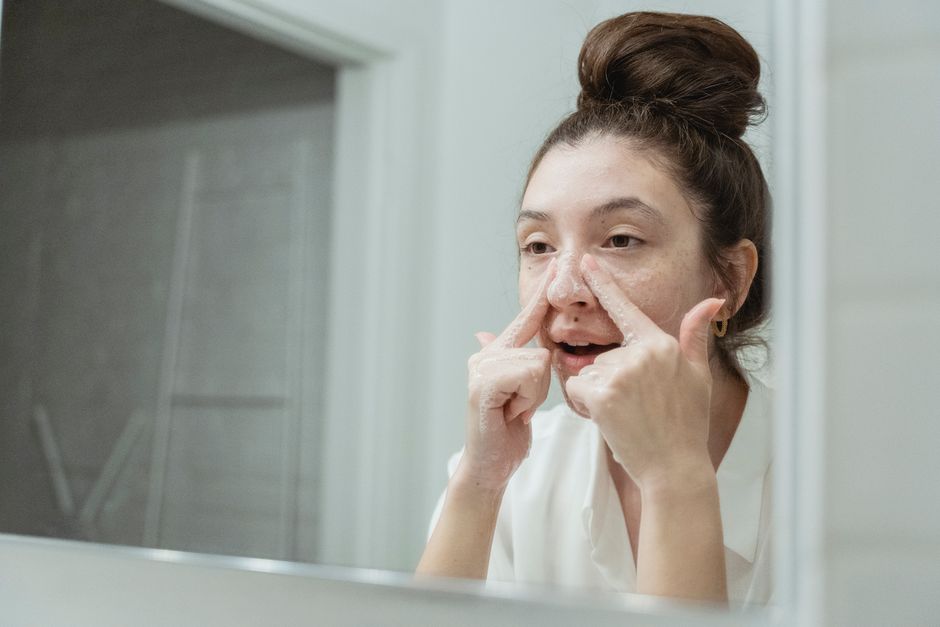
Tretinoin is one of the most studied prescription treatments for acne and photoaging, and one of the most misused. The short answer: there is no single correct amount for everyone, but the standard approach clinicians use is a pea-sized amount for the entire face, applied as a thin layer — not a thick one. More tretinoin does not work faster. It irritates more, and irritation is the main reason people quit before they see results.
How Much Tretinoin Should You Actually Apply?
A pea-sized amount — roughly the size of a small green pea — is the amount most dermatologists recommend for the full face. This applies to standard tretinoin creams and gels, not to microsphere formulations, which are dosed differently by the prescribing clinician.
The logic is simple. Tretinoin works by binding to retinoic acid receptors in skin cells and altering how those cells grow, mature, and shed. That process is dose-dependent up to a point, but the receptor response does not scale linearly with how much product you smear on. Once the receptors are engaged, adding more tretinoin does not speed up the result. It just increases the concentration sitting on the skin surface, which drives irritation, peeling, and redness without a matching benefit.
Think about coverage, not volume. The pea-sized amount is enough to cover the entire face in a thin film. If you can see a visible layer of product sitting on your skin, you have used too much.
Why the Pea-Sized Rule Exists
The pea-sized guideline comes from clinical practice rather than a single landmark trial. It reflects decades of dermatology experience showing that irritation is the limiting factor in how well people tolerate tretinoin. When patients use more than a thin layer, they tend to develop redness, stinging, flaking, and a compromised skin barrier — often within the first two to four weeks.
That irritation leads to two bad outcomes. People stop using it, or they use it less often, and either way they never reach the point where tretinoin produces its visible benefits. Consistent, tolerable use beats aggressive, short-lived use every time.
Does a Higher Concentration Mean Faster Results?
No. Higher concentrations of tretinoin do not produce faster or better results for most people — they produce more irritation. This is one of the most counterintuitive things about the drug, and it is well established in dermatology.
Tretinoin is available in several strengths, commonly 0.025%, 0.05%, and 0.1%. A common assumption is that starting at the highest strength will clear acne or smooth wrinkles sooner. The evidence does not support that. What higher strengths reliably do is increase the rate and severity of irritation, especially in the first several weeks.
For many patients, a lower concentration used consistently produces results comparable to a higher concentration that the skin cannot tolerate. The best strength is the one you can keep using.
- 0.025% — often used as a starting strength, generally the best tolerated
- 0.05% — a middle option, sometimes used after the skin adjusts
- 0.1% — the highest commonly prescribed strength, associated with the most irritation
Strength and frequency are adjusted by your prescribing clinician based on how your skin responds. That adjustment matters more than any fixed rule about milligrams or percentages.
How Often Should You Apply Tretinoin?
Start less often than you think you should. Many clinicians recommend beginning with two or three nights per week, then gradually increasing as the skin tolerates it. Some people build up to nightly use over several weeks or months. Others do best staying at a few nights a week indefinitely.
The reason to start slowly is that tretinoin causes a predictable period of adjustment sometimes called retinization. During this phase — often the first few weeks — the skin may become dry, flaky, red, or more sensitive. This is not an allergic reaction in most cases. It is the skin adapting to a medication that accelerates cell turnover.
If you start nightly at a high strength, you are far more likely to hit that adjustment period hard and quit. If you start slowly, the skin has time to adapt, and you are more likely to stay with it long enough to see results.
There is no single schedule that fits everyone. The right frequency is the one that keeps irritation manageable while allowing consistent use over months, because tretinoin’s benefits build over time, not overnight.





What Happens If You Use Too Much Tretinoin?
Using too much tretinoin causes irritation, not faster results. The most common signs are redness, stinging, burning, peeling, and dry, tight skin. In more severe cases, the skin barrier can break down, leading to raw, cracked, or weeping areas.
This is sometimes called retinoid dermatitis or retinoid burn, though it is not a true burn. It is an irritation reaction driven by an over-stressed skin barrier. It typically appears within the first days to weeks of starting or increasing tretinoin.
If irritation develops, the usual approach is to reduce how often you apply it, use a smaller amount, or pause temporarily and let the skin recover. Moisturizing and gentle skincare help. If irritation is severe, painful, or does not improve, contact your prescribing clinician rather than pushing through.
Pushing through heavy irritation is a mistake. It does not speed up results and often sets people back by forcing them to stop entirely.
How Should You Apply Tretinoin Correctly?
Apply tretinoin to clean, completely dry skin, usually at night. Wet skin increases absorption and irritation, so waiting after washing matters. A thin layer over the whole face is the goal.
The sequence that most clinicians suggest:
- Wash your face with a gentle cleanser and pat dry
- Wait until the skin is fully dry — several minutes is often recommended
- Apply a pea-sized amount of tretinoin in a thin layer over the face
- Avoid the eyelids, the corners of the nose, and the corners of the mouth, which are more prone to irritation
- Follow with a moisturizer if your clinician recommends it
- Use sunscreen every morning, because tretinoin makes skin more sensitive to the sun
Some clinicians recommend a technique sometimes called buffering, where you apply moisturizer before tretinoin to reduce irritation. This can help people with sensitive skin tolerate the medication. Whether it changes how well tretinoin works is not fully settled, so follow your clinician’s guidance.
Sun protection is not optional. Tretinoin increases sun sensitivity, and unprotected sun exposure works against the very goals — clearer skin, fewer signs of aging — you are using it for.
Does Tretinoin Work Differently for Acne Versus Aging?
Tretinoin is used for both acne and photoaging, and the amount you apply is the same in both cases. What differs is the timeline and what you are watching for.
For acne, tretinoin helps by preventing clogged pores and reducing the formation of new acne lesions. Improvement is typically gradual. Many people see some change within a few weeks, but meaningful improvement often takes longer — commonly several months of consistent use. Some people notice their acne appears worse before it improves during the adjustment phase.
For photoaging — fine lines, uneven tone, and rough texture from sun damage — the timeline is longer still. Visible changes often take months of consistent use, and the benefits build the longer you stay with it. This is not a fast fix, and no amount of extra product changes that timeline.
In both cases, the limiting factor is tolerance, not dose. The person who can use a pea-sized amount consistently for months usually does better than the person who uses a large amount for a week and then stops because their skin is angry.
What Else Affects How Much You Should Use?
Your skin type, your climate, and what else you put on your face all affect how much tretinoin you can tolerate. There is no universal number that ignores these factors.
People with dry or sensitive skin often need to start at a lower strength, use it less often, or buffer with moisturizer. People in dry or cold climates may find their skin more easily irritated. Using other active ingredients — such as exfoliating acids, benzoyl peroxide, or other retinoids — at the same time can compound irritation.
This is why tretinoin is a prescription medication with clinician guidance rather than a fixed over-the-counter dose. The amount and schedule are adjusted to the individual over time.
One clarification worth making: tretinoin is not the same as retinol. Retinol is a weaker, over-the-counter retinoid that the skin converts into retinoic acid. Tretinoin is already the active form, which is why it is stronger and prescription-only. The dosing logic is similar — thin layer, build up slowly — but tretinoin is more potent and generally more irritating.
Frequently Asked Questions
How much tretinoin should I use on my face?
A pea-sized amount is enough to cover the entire face in a thin layer, which is the amount most clinicians recommend. Using more does not work faster and mainly increases irritation.
Can I use too much tretinoin?
Yes, and it causes irritation rather than faster results. Signs include redness, stinging, peeling, and dry or cracked skin, which usually means you should reduce how often you apply it or contact your clinician.
Does a higher strength of tretinoin work faster?
No, higher strengths do not produce faster or better results for most people. They mainly increase the risk of irritation, and the best strength is usually the one your skin can tolerate consistently.
How long until tretinoin starts working?
For acne, some change may appear within a few weeks, but meaningful improvement often takes several months of consistent use. For fine lines and uneven tone from sun damage, visible changes typically take longer still.
