
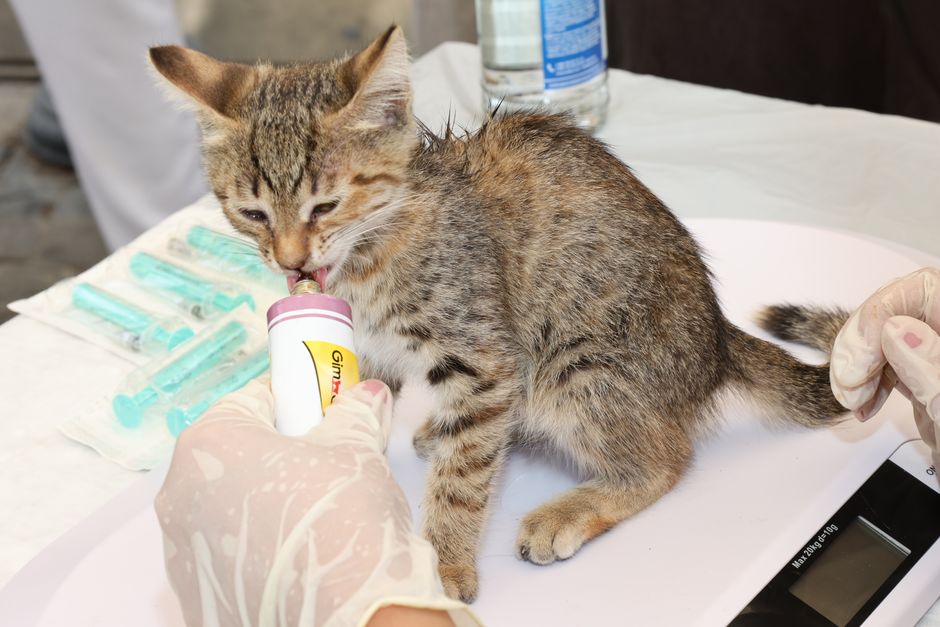
A 3-month-old kitten needs roughly 250 to 350 calories per day, split across three to four meals. That daily total is what matters most, not a fixed scoop size, because calorie needs vary with the kitten’s weight, body condition, and activity level. At this age a kitten is growing fast and should be eating a growth-formula food made for kittens, not adult maintenance food.
How Much To Feed A Kitten 3 Months?
The reliable way to answer this is to work in calories, then translate that into the food you actually have in the bowl. Most 3-month-old kittens land somewhere in the range of 250 to 350 calories a day. A kitten on the smaller or less active end of that spectrum sits near the lower number; a larger, very active kitten sits near the upper end.
You do not have to guess this out of thin air. Kitten food packaging is required to state a calorie content, usually written as kcal ME per cup for dry food or kcal ME per can for wet food. If your dry food lists 400 kcal per cup, then 300 calories is three-quarters of a cup per day. If a 3-ounce can lists 90 kcal, then 300 calories is a little over three cans. The math is simple once you know the calorie density of your specific product.
Here is the part many owners miss. The number printed on the bag as a “feeding guide” is a starting point, not a prescription. Manufacturers build those charts around average kittens. Your kitten is not an average. Use the chart to get in the right neighborhood, then adjust based on how your kitten actually looks and grows.
Why calories matter more than cups
Two kitten foods can have very different calorie densities. One cup of one brand might deliver 350 calories while a cup of another delivers 500. Feeding the same measured cup of each gives your kitten wildly different energy intakes. This is why “feed one cup a day” is meaningless without knowing the food. Calories are the common language.
How Many Meals A Day Does A 3-Month-Old Kitten Need?
Three to four meals a day is the standard for a kitten this age. Their stomachs are small and their energy needs are high, so they cannot comfortably take in a full day’s calories in one or two sittings. Spreading food across the day also keeps blood sugar steadier, which matters for growing kittens.
By around 6 months, many kittens can move toward two or three meals a day. But at 3 months, keep the schedule frequent. A predictable routine also helps with litter training and household rhythm.
Free-feeding, where dry food is left out all day, is common and some kittens do fine on it. The trade-off is that you lose control over how much is eaten and it becomes harder to notice a drop in appetite, which is often an early sign of illness. Measured meals let you track intake. If you do free-feed, weigh your kitten regularly so you can catch problems early.
How Do I Know If I’m Feeding The Right Amount?
Your kitten’s body is the best feedback tool you have. Adjust the amount based on what you see and feel, not just the number on the label.
Run your hands along the sides of the chest. You should be able to feel the ribs easily under a thin layer of fat, without them poking out sharply and without having to press. Look at your kitten from above while standing. There should be a visible waist behind the ribs, a slight inward curve. From the side, the belly should tuck up gently toward the hind legs.
Weigh your kitten on a kitchen scale every week or two and write it down. Steady weight gain is the goal. A kitten that stops gaining, or loses weight, needs a closer look, and a vet visit is reasonable if it continues.
- Too thin: ribs, spine, and hip bones feel sharp, no visible fat, waist looks pinched
- Just right: ribs felt easily, gentle waist visible from above, belly tucks up from the side
- Too heavy: ribs hard to feel, no waist, belly rounds outward or sags
Kittens are not small adults. A chubby kitten is not automatically a healthy one, and excess weight gain early can set a pattern. If your kitten looks round and you cannot feel the ribs, you are likely overfeeding and can trim the daily total slightly.




Should A 3-Month-Old Kitten Eat Wet Food, Dry Food, Or Both?
Either can work. Both wet and dry kitten foods are formulated to meet the same nutritional standards, so the choice often comes down to what your kitten will eat and what fits your routine. Many owners feed a mix.
Wet food has a higher water content, which supports hydration. That can be helpful for kittens who do not drink much water on their own. Dry food is convenient, stays fresh longer in the bowl, and is often more economical. Some kittens prefer one texture over the other, and a kitten that refuses food is a bigger problem than which type you picked.
Whatever you choose, it must be labeled for growth or for all life stages. A food labeled “adult maintenance” does not have the calorie and nutrient profile a growing kitten needs. Check the label rather than assuming a food marketed with kittens on the package is actually complete for growth.
If you switch foods, do it gradually over several days, mixing increasing amounts of the new food into the old. Abrupt changes can cause digestive upset.
What Should A 3-Month-Old Kitten Be Eating?
Kitten food, specifically. A 3-month-old is still in a rapid growth phase and has different needs than an adult cat. Growth diets are higher in calories, protein, and key nutrients like calcium and phosphorus, and they are balanced for the demands of a developing body.
Look for a statement on the label that the food is “complete and balanced” for growth, or meets the nutrient profiles for growth set by the Association of American Feed Control Officials. That statement is your assurance the food is formulated to a recognized standard rather than just marketed to sound like it.
Treats should stay a small part of the diet. A common guideline is to keep treats under about 10 percent of daily calories so they do not crowd out complete nutrition. At 3 months, that is a very small amount, so keep treats occasional.
Fresh water should always be available. Even on wet food, kittens need free access to clean water.
Common Feeding Mistakes With Young Kittens
Most problems come from a handful of predictable missteps.
- Feeding adult food too early. Adult maintenance food does not meet a growing kitten’s needs and can shortchange development.
- Trusting the bag chart as exact. It is a starting estimate for an average kitten, not a personalized amount.
- Never adjusting. Needs change as kittens grow. What was right at 3 months may be off by 5 months.
- Overloading treats. Too many treats and table scraps dilute the complete diet.
- Ignoring appetite changes. A kitten that suddenly eats less or stops eating is a real concern and warrants prompt veterinary attention.
One clarification worth making: a kitten that cleans the bowl every time is not necessarily underfed. Kittens often eat eagerly. Appetite alone is not a reliable gauge. Body condition and steady weight gain are the better signals.
When To Talk To Your Vet
Feeding amounts are a general guide, and individual kittens vary. Your veterinarian can give you a specific target based on your kitten’s weight, body condition, and any health issues.
Contact a vet if your kitten is not gaining weight, is losing weight, has persistent diarrhea or vomiting, seems lethargic, or stops eating. Kittens can decline quickly when something is wrong, so it is better to check early than to wait.
Your vet can also confirm your kitten is on track with vaccinations, deworming, and other preventive care that matters as much as feeding during these early months.
Frequently Asked Questions
How many calories does a 3-month-old kitten need per day?
Most 3-month-old kittens need roughly 250 to 350 calories a day, depending on their weight, body condition, and activity level. Use your kitten’s body condition and weekly weight gain to fine-tune within that range.
How many times a day should I feed my 3-month-old kitten?
Feed three to four measured meals a day at this age. Small, frequent meals suit a kitten’s small stomach and high energy needs better than one or two large ones.
Can I free-feed my 3-month-old kitten?
Some kittens do fine with dry food left out, but measured meals let you track how much your kitten actually eats. If you free-feed, weigh your kitten regularly to catch any problems early.
Should a 3-month-old kitten eat wet or dry food?
Either works as long as the food is labeled for growth or all life stages. Wet food adds water, while dry food is convenient, and many owners feed a mix of both.
