
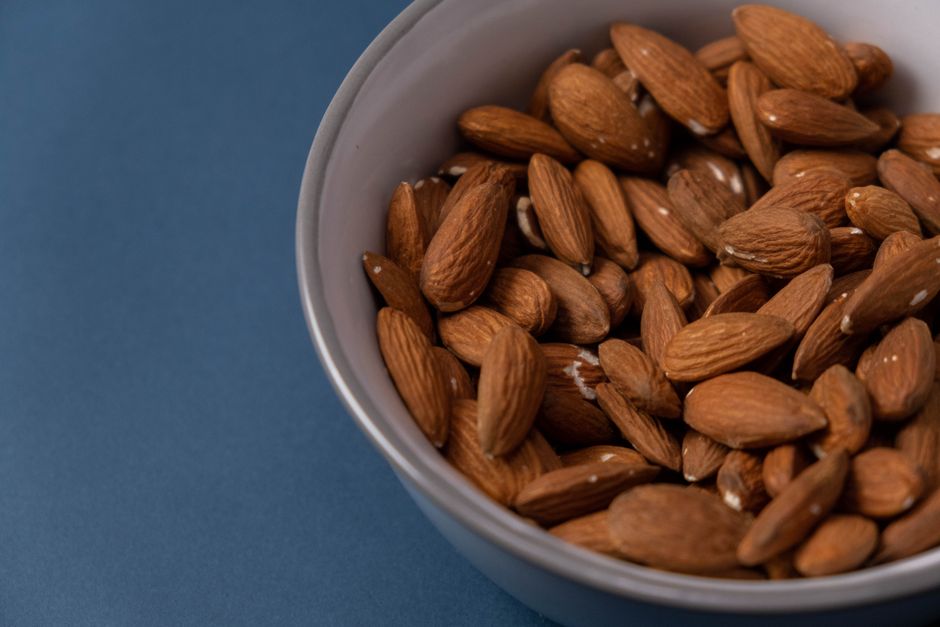
Almonds contain about 6 grams of protein per ounce — roughly 23 whole kernels. That protein is not complete on its own. Like most nuts, almonds are low in the essential amino acid lysine, so they cannot fully stand in for animal proteins or soy.
That single fact matters more than most snack marketing suggests. Almonds are a genuinely nutritious food. They are just not a protein source in the way eggs, chicken, or tofu are. Understanding the difference helps you use them well.
How Much Protein Is In Almonds And Is It Complete?
One ounce of raw almonds — about 23 kernels, or a small handful — provides roughly 6 grams of protein, 14 grams of fat, 6 grams of carbohydrate, and 3 to 4 grams of fiber. Those figures come from the USDA nutrient database and are widely consistent across sources.
The protein quality question is separate from the quantity question. Protein is built from 20 amino acids. Nine of them are essential, meaning your body cannot make them and must get them from food. A “complete” protein supplies all nine in roughly the proportions your body needs.
Almonds fall short on lysine, one of the nine essential amino acids. Lysine is abundant in animal foods, soy, and legumes like beans and lentils. It is scarce in most nuts and grains. Because of that gap, nutrition scientists do not classify almond protein as complete.
This does not make almonds a poor food. It means the protein they carry is best understood as part of a broader diet rather than a standalone protein source.
What Is The Protein Content Of Almonds Compared To Other Foods?
Per ounce, almonds sit in the middle of the pack. They beat most other nuts on protein but trail the foods people usually reach for when they want protein.
| Food (1 oz unless noted) | Protein | Complete protein? |
|---|---|---|
| Almonds (23 kernels) | ~6 g | No — low in lysine |
| Peanuts | ~7 g | No — low in lysine |
| Walnuts | ~4 g | No |
| Cashews | ~5 g | No |
| Pistachios | ~6 g | No |
| Chicken breast | ~8 g | Yes |
| Egg (1 large, ~50 g) | ~6 g | Yes |
| Tofu (firm, 3 oz) | ~8 g | Yes |
| Cooked lentils (1/2 cup) | ~9 g | Near-complete |
The comparison is not meant to rank foods as good or bad. It is meant to show that an ounce of almonds delivers about the same protein as one egg, but without the complete amino acid profile. Both are useful. They just do different jobs.
Almonds also carry more fat and calories per gram of protein than lean meat, eggs, or tofu. That is not a flaw — the fat is mostly unsaturated — but it does mean almonds are better framed as a nutrient-dense snack than a protein delivery system.
Why Are Almonds Considered An Incomplete Protein?
Protein completeness comes down to amino acid balance, not total grams. Your body needs all nine essential amino acids at the same time to build and repair tissue efficiently.
Almonds contain every essential amino acid, but lysine is present in relatively small amounts. When lysine runs low, the body cannot use the other amino acids as efficiently for protein synthesis. The rest are still used for energy or other purposes, but the tissue-building job is limited by the scarcest amino acid.
This is sometimes called the “limiting amino acid” concept. It is well established in nutrition science and applies across plant foods. Wheat is limited by lysine. Corn is limited by lysine and tryptophan. Rice is limited by lysine too. Legumes like beans and lentils are limited by methionine instead — which is why beans and rice together form a complete protein.
Almonds are not unusual in this respect. They are simply one more plant food that works better alongside complementary foods than alone.





Does It Matter If You Eat Almonds Alone Or With Other Foods?
It matters less than older nutrition advice suggested. For decades, people were told they needed to combine complementary proteins at every meal — beans with rice, peanut butter with whole wheat bread — to get complete protein.
Current understanding is more forgiving. Your body maintains a pool of free amino acids and can draw on amino acids from foods eaten across the day. You do not need to pair rice and beans in the same bite. Eating a variety of plant proteins over the course of a day generally covers the essential amino acid needs of most healthy adults.
That said, the practical takeaway is simple. Almonds on their own are a fine snack. Almonds with yogurt, oatmeal, or a handful of beans become part of a more complete protein picture.
One clarification worth making: the amino acid pool idea is well established, but it does not mean protein timing is irrelevant for everyone. People doing heavy resistance training or recovering from illness may benefit from more attention to protein distribution across the day. For most adults eating a mixed diet, the daily total matters more than the exact pairing.
Are Almonds A Good Protein Source For Vegetarians And Vegans?
Almonds are a useful food for plant-based diets, but they are not a primary protein source. They contribute protein, fiber, healthy fats, vitamin E, magnesium, and other nutrients. What they do not do is replace beans, lentils, soy, or whole grains as the backbone of plant protein intake.
For vegetarians and vegans, the more reliable protein foods include:
- Legumes — beans, lentils, chickpeas, split peas
- Soy foods — tofu, tempeh, edamame
- Whole grains — quinoa, oats, whole wheat
- Nuts and seeds — almonds, peanuts, pumpkin seeds, hemp
- Dairy and eggs if vegetarian
Almonds fit into that list, but they sit lower on it. A person relying on almonds as their main protein source would need to eat a large quantity to meet daily protein needs — and would take in a lot of calories along the way. Roughly 100 grams of almonds (about 3.5 ounces) provides around 21 grams of protein and over 570 calories. That is a lot of calories for a modest protein return.
How Do Almonds Fit Into A Balanced Diet?
Almonds earn their place in a healthy diet for reasons beyond protein. A single ounce provides meaningful amounts of vitamin E, magnesium, and fiber. Research has linked regular nut consumption to cardiovascular benefits, though the exact mechanisms and effect sizes are still being studied.
For protein specifically, the practical guidance is straightforward. Treat almonds as a supporting player, not the lead.
If you are tracking protein intake, count the 6 grams per ounce and move on. Do not expect almonds to cover a protein target on their own. If you are building a plant-based meal, pair almonds with a legume or grain to fill in the lysine gap.
If you are simply looking for a satisfying snack that happens to carry some protein, almonds are an excellent choice. They are shelf-stable, portable, and nutrient-dense. They just are not a protein powerhouse, and the marketing around them sometimes suggests otherwise.
The bottom line: almonds are a good food with modest, incomplete protein. Used well, they add real value to a diet. Used as a protein substitute, they fall short.
Frequently Asked Questions
How much protein is in 10 almonds?
Ten almonds provide roughly 2.5 to 3 grams of protein. That is about half the protein in a single egg.
Are almonds a complete protein?
No. Almonds are low in the essential amino acid lysine, so they are classified as an incomplete protein. Combining them with legumes or grains fills that gap.
Can I get enough protein from almonds alone?
Not realistically. You would need to eat a very large quantity of almonds to meet daily protein needs, which would also mean a very high calorie intake. Almonds work best as part of a varied diet.
Which nuts have the most protein?
Peanuts and almonds are among the highest-protein nuts, at roughly 6 to 7 grams per ounce. Peanuts are technically legumes, not true nuts.
