
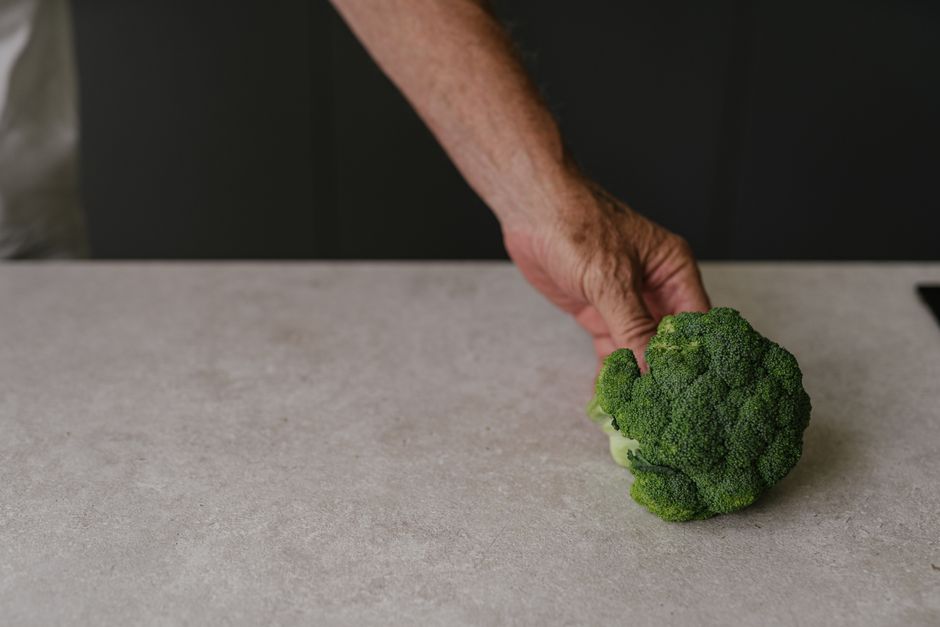
Broccoli contains about 2.5 grams of protein per cup of raw chopped florets, which works out to roughly 2.8 grams of protein per 100 grams. That is a modest amount next to beans, meat, or eggs. But broccoli earns its place in a healthy diet for reasons that have little to do with protein.
If you are trying to hit a protein target and wondering whether broccoli can help, the honest answer is: a little, not a lot. It is a low-calorie, nutrient-dense vegetable that contributes protein as part of a broader diet. It is not a protein source you build a meal around.
How Much Protein Does Broccoli Actually Have?
Per 100 grams of raw broccoli, you get about 2.8 grams of protein and only 34 calories. That is the number to hold onto.
Here is how it breaks down across common serving sizes, using USDA data:
| Serving | Weight | Protein | Calories |
|---|---|---|---|
| 1 cup raw, chopped | ~91 g | ~2.5 g | ~31 |
| 1 cup cooked, chopped | ~156 g | ~3.7 g | ~55 |
| 100 g raw | 100 g | ~2.8 g | ~34 |
| 1 medium stalk | ~150 g | ~4.2 g | ~51 |
Cooked broccoli shows more protein per cup because cooking removes water, so a cup weighs more. The protein itself does not change much. You are just fitting more broccoli into the same measuring cup.
For context, one large egg has about 6 grams of protein. A half-cup of cooked lentils has roughly 9 grams. To match a single egg’s protein, you would need to eat about two and a half cups of raw broccoli.
Is Broccoli a Good Source of Protein?
No, not in the way most people mean it. Broccoli is a vegetable with a small amount of protein, not a protein food.
That said, the protein broccoli does contain is decent quality. Like most plant proteins, it is lower in one or more essential amino acids. Broccoli is relatively low in methionine, an amino acid found in higher amounts in grains, eggs, and meat. This matters less than it sounds. If you eat a variety of foods across the day, your body pools amino acids and uses them as needed. You do not need every single food to be a complete protein.
What broccoli does offer is volume and nutrients for very few calories. A cup provides a meaningful amount of vitamin C, vitamin K, folate, and fiber. Those are the reasons to eat it. The protein is a small bonus.
Some people point to broccoli’s protein content as a reason it belongs in a plant-based diet. It does belong, but as a vegetable, not as a protein source. If you are eating plant-based, your protein is coming from beans, lentils, tofu, tempeh, whole grains, nuts, and seeds. Broccoli adds to the total but does not carry it.
How Does Broccoli Compare to Other Vegetables?
Broccoli is one of the higher-protein vegetables, but the gap between vegetables is small in absolute terms.
| Vegetable (100 g, raw) | Protein | Calories |
|---|---|---|
| Green peas | ~5.4 g | ~81 |
| Spinach | ~2.9 g | ~23 |
| Broccoli | ~2.8 g | ~34 |
| Kale | ~2.9 g | ~49 |
| Cauliflower | ~1.9 g | ~25 |
| Carrots | ~0.9 g | ~41 |
Green peas are the standout here. They are a legume, not a true vegetable in the botanical sense, and they carry noticeably more protein per 100 grams. Spinach and kale come in close to broccoli. Cauliflower and carrots fall well below.
The takeaway is not that broccoli beats other vegetables. It is that vegetables as a category are not where most of your protein comes from. They contribute to the total, and some contribute more than others.
Does Cooking Change the Protein in Broccoli?
Cooking does not destroy broccoli’s protein. It changes the water content, which changes how much protein you get per cup.
Raw broccoli is about 89 percent water. When you steam, boil, or roast it, some of that water leaves. The remaining nutrients, including protein, become more concentrated by weight. That is why a cup of cooked broccoli lists more protein than a cup of raw.
Very high heat or long cooking times can reduce some heat-sensitive nutrients, particularly vitamin C. Protein is more stable. Boiling can also leach water-soluble nutrients into the cooking water, so steaming or roasting tends to preserve more of them. This is a general pattern in vegetable cooking, not something unique to broccoli.
Frozen broccoli is nutritionally close to fresh. It is typically blanched before freezing, which causes a small loss of some vitamins, but the protein content is essentially the same. If frozen broccoli is what fits your budget or schedule, there is no protein-related reason to avoid it.
Can Broccoli Help You Meet Your Daily Protein Needs?
Only marginally. For most adults, broccoli will contribute a small fraction of daily protein.
General guidance from major health bodies puts daily protein needs for most adults somewhere in the range of 0.8 grams per kilogram of body weight, with higher intakes often recommended for older adults, people who are physically active, and those recovering from illness. For a 70-kilogram (154-pound) adult, that baseline is roughly 56 grams per day.
If you ate two cups of cooked broccoli, you would get about 7 grams of protein. That is around 12 percent of a 56-gram target. Useful, but not a solution on its own.
A more realistic role for broccoli is as a supporting player. It adds fiber, vitamins, and a small amount of protein to meals that already contain a primary protein source. A chicken breast, a bowl of lentils, or a serving of tofu does the heavy lifting. Broccoli fills out the plate.
One practical note: if you are trying to increase protein intake and you fill up on large volumes of low-calorie vegetables, you may feel full before you hit your protein target. That is a real issue for some people, especially older adults with smaller appetites. Broccoli is filling. That is usually a good thing, but it can work against you if protein is the goal.
Does Broccoli Have Any Other Nutritional Benefits?
Yes, and they are the stronger reason to eat it. Broccoli is one of the more nutrient-dense vegetables available.
- Vitamin C: A cup of raw broccoli provides a substantial share of daily vitamin C needs.
- Vitamin K: Broccoli is a good source, which matters for blood clotting and bone health.
- Folate: A B vitamin involved in cell division and red blood cell formation.
- Fiber: Supports digestion and is linked to lower risk of several chronic conditions.
- Glucosinolates: Compounds that break down into isothiocyanates, which have been studied for potential health effects.
The glucosinolate story is worth a careful note. Laboratory and animal studies have looked at compounds in broccoli and other cruciferous vegetables for their effects on cells and on cancer-related pathways. Human trial evidence is much more limited. Some observational studies have found associations between higher cruciferous vegetable intake and lower risk of certain cancers, but observational data cannot prove cause and effect. The honest position is that broccoli is a healthy vegetable worth eating, and the specific disease-prevention claims often attached to it are not firmly established in humans.
Vitamin K deserves a mention for people on blood-thinning medications such as warfarin. Broccoli is high in vitamin K, which interacts with these drugs. This does not mean you must avoid broccoli. It means keeping your intake consistent and talking with your clinician, since sudden changes in vitamin K intake can affect how the medication works.
How Should You Think About Broccoli and Protein?
Treat broccoli as a vegetable that happens to contain a little protein, not as a protein source. That framing keeps your expectations accurate.
If you enjoy it, eat it often. It is low in calories, high in several vitamins and fiber, and easy to prepare. If you are chasing a protein target, look to eggs, dairy, poultry, fish, beans, lentils, soy foods, and whole grains. Broccoli can be part of the picture, but it will not be the center of it.
The bigger point is that no single food needs to do everything. A diet built from a range of whole foods covers protein and the rest of your nutritional needs more reliably than any one ingredient can.
Frequently Asked Questions
How much protein is in one cup of broccoli?
One cup of raw chopped broccoli has about 2.5 grams of protein. A cup of cooked chopped broccoli has roughly 3.7 grams because cooking removes water and concentrates the nutrients by weight.
Is broccoli a complete protein?
No. Like most plant proteins, broccoli is lower in one or more essential amino acids, particularly methionine. Eating a variety of protein foods across the day covers your amino acid needs without any single food being complete.
Can you get enough protein from broccoli alone?
No. Broccoli has too little protein and too much volume to serve as a primary protein source. It contributes to your daily total but cannot realistically meet your needs on its own.
Does cooking broccoli reduce its protein?
No, cooking does not destroy broccoli’s protein. It reduces water content, which actually raises the protein listed per cup of cooked broccoli compared with raw.
