
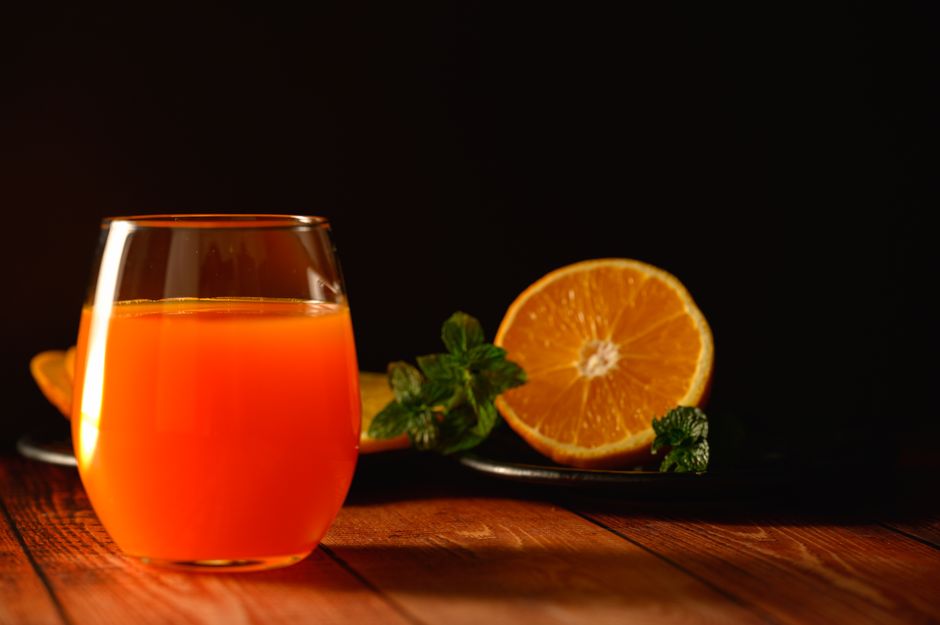
One medium navel orange holds roughly 2 to 3 fluid ounces of juice. That is about 60 to 90 milliliters, or somewhere between a quarter and a third of a standard 8-ounce glass. The exact amount shifts with the variety, the size of the fruit, how ripe it is, and how you juice it.
That number surprises most people. A single orange looks substantial, and juicing one produces a small puddle at the bottom of the glass. Understanding why helps explain a lot about orange juice as a whole — both the fresh-squeezed kind and the carton kind.
How Much Juice Does One Orange Actually Contain?
Most oranges yield between 2 and 3 ounces of juice. A large, heavy orange can push closer to 4 ounces. A small one might give you barely 2.
The single biggest factor is variety. Navel oranges are the classic eating orange — sweet, easy to peel, and seedless. They also juice reasonably well. Valencias are the workhorse of the commercial juice industry because they are juicier and their flavor holds up better over time. Blood oranges produce less juice but a distinctive color and taste.
Size and weight matter more than diameter. A heavy orange for its size means more water content and more juice. A light, spongy orange has lost moisture and will disappoint you at the juicer.
Ripeness plays a role too. Oranges do not ripen further after picking, so what you buy is what you get. Fruit that sat too long in storage or shipping loses moisture through the peel and yields less.
Why Does One Orange Produce So Little Juice?
An orange is mostly not juice. The peel, the white pith, the membranes between segments, and the pulp all take up space. The juice sacs inside each segment hold the liquid, but they are a fraction of the fruit’s total volume.
Think about what happens when you bite into an orange. You get a burst of juice, then a mouthful of fibrous pulp. That pulp is structural tissue. It does not liquefy. Even a powerful juicer separates it out rather than dissolving it.
Hand juicing also leaves liquid behind. A reamer or a manual press extracts most of the free juice, but some stays trapped in the pulp and membranes that get discarded. A commercial hydraulic press can pull out more, which is one reason industrial juicing is more efficient than anything you can do at home.
There is a non-obvious point here that most people miss: the amount of juice in an orange is not fixed at harvest. Oranges are living tissue. They continue to lose water after they are picked, and the rate depends on temperature, humidity, and how long they sit. An orange that feels heavy and firm in your hand is holding more juice than one that feels light.
How Much Orange Juice In One Orange Compared To A Serving?
A standard serving of orange juice is 8 fluid ounces, which is one cup. That means you need roughly 3 to 4 medium oranges to fill a single glass.
This is where the math gets interesting for anyone watching their sugar intake. An 8-ounce glass of orange juice contains about 21 grams of sugar and roughly 110 calories, according to USDA nutritional data. That is the sugar from 3 to 4 oranges, delivered in a form you can drink in under a minute.
The table below shows the approximate relationship between fruit count and juice volume.
| Oranges (medium navel) | Approximate juice yield | Notes |
|---|---|---|
| 1 | 2–3 fl oz (60–90 mL) | Barely a quarter glass |
| 2 | 4–6 fl oz (120–180 mL) | About half to two-thirds glass |
| 3 | 6–9 fl oz (180–270 mL) | Roughly one full serving |
| 4 | 8–12 fl oz (240–360 mL) | One to one-and-a-half servings |
These are approximate ranges. A juicier batch of Valencias will land at the higher end. Small or dry fruit will land lower.





Does Fresh-Squeezed Juice Differ From Store-Bought?
Fresh-squeezed and store-bought orange juice are nutritionally similar in their core vitamins, but they are not identical products.
Vitamin C is the headline nutrient in both. One medium orange provides a substantial share of the daily vitamin C requirement, and the juice from that orange carries most of it. Vitamin C is water-soluble and relatively stable, though it does degrade over time with exposure to heat, light, and oxygen.
Store-bought juice is typically pasteurized to kill pathogens and extend shelf life. Pasteurization involves heat, which reduces vitamin C content somewhat. Many commercial juices are later fortified to compensate. Not-from-concentrate juices are pasteurized too, despite the fresh-sounding name.
The bigger difference is fiber. A whole orange contains fiber, mostly in the pulp and membranes. Juice contains little to none, because the fiber is removed during extraction. Fiber slows the absorption of sugar and contributes to fullness. This is the main reason a whole orange and a glass of juice are not nutritionally equivalent, even when they come from the same fruit.
Some research suggests that liquid calories are less satiating than solid food calories. That means drinking the juice of 3 oranges is easier than eating 3 oranges, and it may not curb your appetite the same way.
Does Orange Size Or Variety Change The Yield?
Variety changes yield more than most people expect. Valencias tend to produce the most juice. Navels are solid but slightly behind. Blood oranges and many specialty varieties yield less.
Size matters in a straightforward way: bigger fruit, more juice, assuming the fruit is not dried out. But weight is the better indicator. A large orange that feels light will underperform a smaller one that feels dense.
Growing conditions affect this too. Oranges grown in different climates and soils vary in water content. Irrigation, rainfall, and harvest timing all influence how much liquid each fruit holds. Two oranges of identical size from different sources can yield noticeably different amounts.
Storage matters after purchase. Oranges kept in a cool, humid place hold their moisture longer than fruit left on a warm counter. Refrigeration helps, though very cold temperatures over long periods can affect texture.
Is Drinking Orange Juice The Same As Eating An Orange?
No. They share vitamins but differ in fiber, sugar delivery, and how full they make you feel.
A whole orange gives you fiber, water, and a chewy texture that slows you down. You eat one, maybe two, and you feel satisfied. The sugar enters your bloodstream gradually because the fiber and the physical structure of the fruit slow digestion.
Juice removes that structure. The sugar arrives faster, and it takes several oranges to make a glass. You can drink the equivalent of 3 or 4 oranges without the chewing, the fiber, or the same sense of fullness.
This does not make orange juice a bad choice. It is a concentrated source of vitamin C and other nutrients. But it is not a direct swap for whole fruit, and treating it as one misses the point. For most people, whole fruit is the better default, with juice as an occasional addition rather than a replacement.
If you do drink juice, portion matters. One 8-ounce glass is one serving. Drinking it slowly, or with a meal, is different from gulping it down on an empty stomach. Whether that difference is clinically meaningful is not fully settled, but the general direction is that whole fruit and juice are not interchangeable.
Frequently Asked Questions
How many oranges does it take to make a glass of juice?
It takes roughly 3 to 4 medium navel oranges to fill an 8-ounce glass. Juicier varieties like Valencias may need slightly fewer.
How much juice is in one large orange?
A large, heavy orange can yield close to 4 fluid ounces. A small or dry one may give you only about 2 fluid ounces.
Is fresh-squeezed orange juice healthier than store-bought?
Fresh juice retains slightly more vitamin C because it is not pasteurized, but the difference is modest. Neither fresh nor store-bought juice contains the fiber found in a whole orange.
Can I get the same nutrition from juice as from eating an orange?
No. Juice provides most of the vitamin C but almost none of the fiber, and it delivers sugar faster than whole fruit. A whole orange is the more complete choice.
