
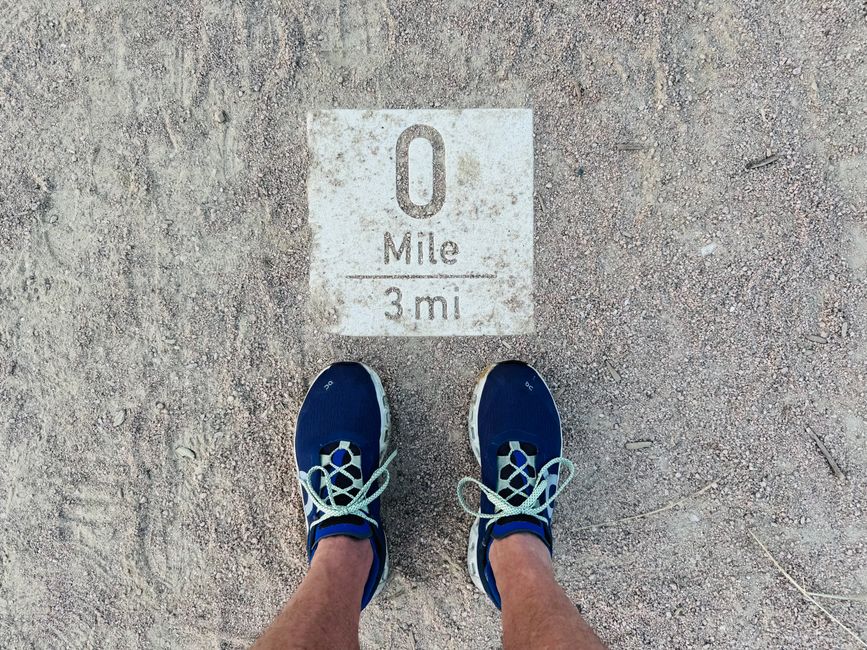
Ten thousand steps is roughly 5 miles for most people. The exact distance depends on your stride length, which is influenced by your height, walking speed, and gender. Most fitness trackers use an average stride length to estimate this distance, but your personal number can vary by a mile or more.
How Much Miles Is 10000 Steps?
The average person’s stride length is between 2.1 and 2.5 feet. At that pace, 10,000 steps covers about 4 to 5 miles. A commonly cited figure is 5 miles, which assumes a stride length of 2.5 feet.
Your actual distance depends on your leg length and how you walk. Taller people naturally have longer strides, so they cover more ground with fewer steps. Shorter people take more steps to cover the same distance.
Walking speed also matters. When you walk faster, your stride tends to lengthen. A brisk walker might cover 5 miles in 10,000 steps, while someone strolling casually might cover closer to 4 miles.
How to Calculate Your Personal Step Distance
You can calculate your own distance with a simple measurement. Walk 10 steps at your normal pace and measure the distance from your starting point to your ending point. Divide that number by 10 to get your average stride length.
Multiply your stride length in feet by 10,000, then divide by 5,280 (the number of feet in a mile). That gives you your personal distance for 10,000 steps.
For example, if your average stride is 2.2 feet, the math looks like this: 2.2 × 10,000 = 22,000 feet. Divide by 5,280 and you get 4.17 miles.
Most fitness trackers and phone apps use a default stride length based on your height and weight. If you enter your height accurately, the estimate improves. But even then, it remains an estimate rather than an exact measurement.
Why 10000 Steps Became the Standard
The 10,000-step goal did not come from a scientific study. It started as a marketing campaign in Japan in the 1960s. A company selling pedometers named its device “manpo-kei,” which translates to “10,000 steps meter.” The number was catchy and easy to remember.
Decades later, researchers began studying whether the number had real health benefits. Some studies suggest that people who walk more tend to have better cardiovascular health and lower mortality rates. But the specific number of 10,000 steps is not a magic threshold.
Research published in medical journals has found health benefits at lower step counts. Some studies indicate that the biggest differences in health outcomes appear when people who are very sedentary start moving more, even if they do not reach 10,000 steps.
The 10,000-step goal remains useful as a daily movement target. But it is not a clinical guideline. It is a reasonable benchmark for many people, not a requirement for health.





Steps Per Mile by Height
Your height is the single biggest factor in how many steps you take per mile. Taller people need fewer steps to cover a mile because their stride is longer.
Here are general estimates for steps per mile based on height:
- 5’0″ to 5’3″ — about 2,400 to 2,500 steps per mile
- 5’4″ to 5’7″ — about 2,200 to 2,300 steps per mile
- 5’8″ to 5’11” — about 2,000 to 2,100 steps per mile
- 6’0″ and taller — about 1,900 to 2,000 steps per mile
These numbers assume a normal walking pace. Running changes the math significantly. A runner takes longer strides and fewer steps per mile, often around 1,400 to 1,700 steps depending on pace and height.
At 2,400 steps per mile, 10,000 steps equals about 4.2 miles. At 1,900 steps per mile, 10,000 steps equals about 5.3 miles. The range across heights is roughly one mile.
Does Step Count Matter for Health?
Walking is one of the most accessible forms of physical activity. Studies consistently show that regular walking is associated with better cardiovascular health, improved blood sugar control, and lower risk of chronic disease.
But total movement matters more than step count alone. A person who walks 10,000 steps on flat ground at a leisurely pace gets a different workout than someone who walks 7,000 steps including hills or brisk intervals.
Intensity matters. Brisk walking raises your heart rate and challenges your cardiovascular system. A leisurely walk is still beneficial, but it does not provide the same conditioning effect.
Current physical activity guidelines recommend 150 minutes of moderate-intensity exercise per week. That is about 30 minutes most days. For many people, that translates to roughly 7,000 to 8,000 steps, depending on pace.
The evidence does not show that 10,000 steps is superior to other movement goals. It is one useful target among many. The most important thing is to move regularly and avoid long periods of sitting.
Accuracy of Fitness Trackers and Phones
Fitness trackers estimate steps using an accelerometer, which detects motion. They do not measure distance directly. Distance is calculated by multiplying your step count by an assumed stride length.
Most devices allow you to enter your height to improve accuracy. Some also use GPS to measure distance when you walk outdoors. GPS is generally more accurate for distance than step counting alone.
Studies comparing fitness trackers to manual step counting have found variable accuracy. Some devices are within 5 percent of actual steps. Others deviate more, especially at slow walking speeds or when you push a stroller or shopping cart.
If you rely on a tracker, focus on consistency rather than exact numbers. A tracker that underestimates or overestimates by 10 percent still gives you a reliable way to compare your activity from day to day.
How Long Does It Take to Walk 10000 Steps?
At a moderate walking pace of about 3 miles per hour, 10,000 steps takes roughly 80 to 100 minutes. That is about 1.5 hours of walking spread across the day.
Most people do not walk 10,000 steps all at once. Daily steps accumulate from walking to the car, climbing stairs, shopping, and other routine movement. For many people, a dedicated 30 to 45 minute walk plus everyday activity is enough to reach the goal.
A brisk pace of 4 miles per hour cuts the time to about 70 to 75 minutes. A leisurely pace of 2 miles per hour takes closer to 2 hours.
Breaking it up makes the goal more manageable. Three 20-minute walks plus normal daily movement can add up to 10,000 steps for many people.
Is 10000 Steps Right for You?
For most healthy adults, 10,000 steps is a safe and reasonable daily target. But it is not a medical prescription. Some people need fewer steps, and some benefit from more.
Older adults or people with joint problems may find 10,000 steps too demanding. Starting with 5,000 to 6,000 steps and gradually increasing is a sensible approach.
People who are already active may need more than 10,000 steps to see additional health benefits. The relationship between step count and health is not a simple threshold. More movement is generally associated with better outcomes, but the benefits level off at higher volumes.
If you have a chronic health condition or are new to exercise, talk to your doctor before starting a new walking routine. Walking is low risk for most people, but individual circumstances vary.
Frequently Asked Questions
How many miles is 10000 steps for a woman?
For an average woman with a stride length around 2.2 feet, 10,000 steps equals about 4.2 miles. Height and walking speed change this number in either direction.
Does 10000 steps burn calories?
Yes, but the amount varies by body weight, pace, and terrain. A 150-pound person walking at a moderate pace burns roughly 300 to 400 calories over 10,000 steps.
Is 10000 steps a day necessary for health?
No. Research shows health benefits at lower step counts, and the 10,000-step goal originated from a marketing campaign rather than clinical research. Moving regularly at any volume is more important than hitting a specific number.
How can I make my step count more accurate?
Enter your correct height in your fitness tracker and use GPS when walking outdoors. You can also measure your stride length manually and adjust your device settings if it allows manual entry.
