
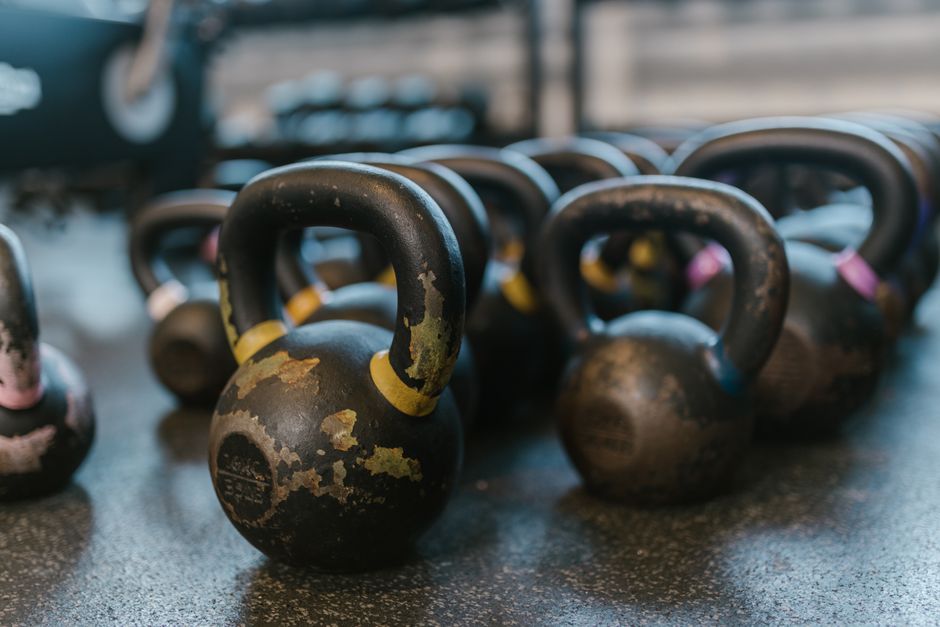
Choosing a kettlebell weight comes down to one question first: what are you trying to do? For general strength and conditioning, most men start with 16 kg (35 lb) and most women start with 8 kg (18 lb). For power and ballistic moves like swings, men often need 24 kg (53 lb) and women often need 12 kg (26 lb). For pure strength work like presses and rows, men may use 20–32 kg (44–70 lb) and women 12–20 kg (26–44 lb). These are starting points, not rules. Your body weight, experience, and the specific movement matter more than a chart.
Why the “One Weight Fits All” Approach Fails
Kettlebells are different from dumbbells. A dumbbell sits in your hand and stays put. A kettlebell shifts, swings, and moves around its handle. That changes the mechanics of every lift.
The weight you can press overhead is often much lower than the weight you can swing. Your shoulders and triceps are smaller muscles. Your hips and glutes are the largest muscles in your body. Swings use the big muscles. Presses use the small ones. Expect a big gap between what you can swing and what you can press.
This is why owning a single kettlebell is limiting. Most people need at least two weights — one for hip-hinge movements and one for upper-body pressing. Some people need three. The right number depends on your goals and the exercises you plan to do.
How Much Kettlebell Weight for General Fitness and Swings
Swings are the foundation of kettlebell training. They are a hip-hinge movement, not a squat. The power comes from your glutes and hamstrings snapping your hips forward. The bell floats up because of that force, not because your arms pull it.
For beginners, the goal is to learn the hinge pattern safely. Start lighter than you think you need. Men should start with 12–16 kg (26–35 lb). Women should start with 8–12 kg (18–26 lb). Master the hip snap and the hard stop at the top — the plank position where your body forms a straight line from head to heel.
Once the form is solid, most men can progress to a 24 kg (53 lb) bell for swings within a few months. Most women can progress to a 16 kg (35 lb) bell. This is not about strength alone. Heavier bells swing with better mechanics because the weight forces you to use your hips rather than your arms. A bell that is too light lets you muscle the movement with your shoulders, which defeats the purpose.
Some research suggests that heavier kettlebell swings produce greater power output and cardiovascular demand. The evidence is not overwhelming, but it aligns with basic exercise physiology. Heavier load equals greater force production equals greater training stimulus — up to the point where form breaks down.
How Much Kettlebell Weight for Strength Training
Strength training with kettlebells means slow, controlled movements — presses, rows, squats, deadlifts, and carries. These are different from swings. You are not using momentum. You are lifting the weight through a range of motion under tension.
For upper-body pressing, men typically use 16–24 kg (35–53 lb). Women typically use 8–16 kg (18–35 lb). If you can press a weight for more than 8–10 clean repetitions, it is too light for pure strength work. Strength is built in the 3–6 rep range with heavy loads. If you can do 15 presses without struggling, go heavier.
For lower-body movements like goblet squats and deadlifts, you can go significantly heavier. The legs are much stronger than the arms. Men often use 24–32 kg (53–70 lb) for goblet squats. Women often use 16–24 kg (35–53 lb). The limiting factor is usually grip strength and how long you can hold the bell in the rack position, not leg strength.
Single-arm movements need less weight than double-arm movements. A 16 kg bell pressed overhead with one arm feels much heavier than the same bell pressed with two arms. When you are testing a new exercise, always start with a weight you can control for at least 5 reps with perfect form.


How Much Kettlebell Weight for Muscle Building
Hypertrophy — muscle growth — requires volume and progressive overload. You need to challenge the muscle with enough weight and enough reps to create the stimulus for growth. The research on kettlebell training for hypertrophy is limited compared to traditional resistance training.
What the evidence does show is that kettlebell training can build muscle, but it works best for the muscles involved in the specific movement pattern. Swings build the posterior chain — glutes, hamstrings, and lower back. Turkish get-ups build the core, shoulders, and stabilizing muscles. Presses build the shoulders and triceps.
For muscle growth, use a weight that allows 8–15 reps per set with good form. The last 2–3 reps should be challenging. If you can do 15 reps easily, the weight is too light. Men often need 20–32 kg (44–70 lb) for lower-body hypertrophy work. Women often need 12–20 kg (26–44 lb). Upper-body hypertrophy work requires less — men at 16–24 kg (35–53 lb) and women at 8–16 kg (18–35 lb).
One non-obvious point: kettlebell training is excellent for grip strength and core stability. The offset center of mass forces your core to work harder than with a barbell or dumbbell. You are getting core training as a bonus in nearly every kettlebell exercise, even if your goal is arms or legs.
How Much Kettlebell Weight for Fat Loss and Conditioning
Kettlebell training is legitimately good for conditioning. Swings, snatches, and clean-and-presses performed in intervals will elevate your heart rate substantially. The research supports this. Studies have found that kettlebell training can improve aerobic capacity and cardiovascular fitness comparable to traditional forms of interval training.
For conditioning work, the weight matters less than the work-to-rest ratio. You want a weight you can move with speed and power for 30–60 seconds without your form collapsing. If you are gasping after 20 seconds, the weight is too heavy. If you can swing for 60 seconds without your heart rate rising, it is too light.
Men typically use 16–24 kg (35–53 lb) for conditioning intervals. Women typically use 12–16 kg (26–35 lb). The goal is to maintain power output across the interval. When your form degrades, stop. Swinging a heavy bell with a rounded back is how injuries happen.
How Much Kettlebell Weight for Beginners Over 50
Age changes the equation. Muscle mass naturally declines with age — a process called sarcopenia. This begins around age 30 and accelerates after 60. Kettlebell training can help slow this decline, but the starting weight should be conservative.
Men over 50 new to kettlebell training should start with 12 kg (26 lb). Women over 50 should start with 6–8 kg (13–18 lb). The focus in the first month is learning the hinge pattern and building confidence with the movement. Weight increases come after form is consistent.
This is not about weakness. It is about connective tissue adaptation. Tendons and ligaments adapt to load more slowly than muscles. A 50-year-old man might have the muscle strength to swing a 24 kg bell on day one, but his tendons need time to catch up. Start light, progress slowly, and prioritize recovery.
How to Test If a Kettlebell Weight Is Right for You
You do not need a complicated formula. Use the 5-rep test. Pick up the kettlebell and perform 5 repetitions of the main exercise you plan to do — swing, press, or squat. Evaluate honestly.
- Too light: You could easily do 10 more reps. The weight is not challenging your muscles.
- Just right: The last 2 reps are challenging but clean. Your form stays solid and your breathing is elevated.
- Too heavy: Your form breaks down by rep 3. You are using your lower back to swing the weight or arching heavily to press it.
For swings specifically, there is a practical test. The bell should feel like it is floating at the top of the swing, not like you are muscling it up with your shoulders. If your arms are doing the work, go lighter. If the bell feels weightless and you are not feeling it in your glutes and hamstrings, go heavier.
Common Kettlebell Weight Mistakes
The most common mistake is starting too heavy. People see experienced lifters swinging 32 kg bells and assume they should match that. They end up with lower back pain and poor form. Start light. The kettlebell will still be there next month.
The second mistake is never going heavy enough. Some people stick with a light bell indefinitely because it feels comfortable. Comfort is not the goal. Progressive overload — gradually increasing the weight over time — is what drives adaptation. If you have been swinging the same 12 kg bell for two years, you have been doing cardio, not strength training.
The third mistake is using one weight for everything. A 16 kg bell might be perfect for presses but too light for deadlifts and too heavy for a beginner learning the Turkish get-up. Buy a set of two or three weights as your budget allows. A common combination for men is 16 kg, 24 kg, and 32 kg. For women, 8 kg, 12 kg, and 16 kg.
Adjustable competition kettlebells are a practical option. They let you change the weight in small increments. This is useful because the jump from 16 kg to 24 kg is significant — a 50% increase. An adjustable bell lets you progress in 2 kg steps.
Frequently Asked Questions
What kettlebell weight should a beginner man start with?
A beginner man should start with 16 kg (35 lb) for most exercises and 12 kg (26 lb) for overhead pressing. This allows you to learn the hinge pattern and pressing mechanics without excessive strain.
What kettlebell weight should a beginner woman start with?
A beginner woman should start with 8 kg (18 lb) for upper-body work and 12 kg (26 lb) for swings and lower-body movements. Some women prefer 6 kg (13 lb) for overhead pressing when first learning the movement.
How do I know if my kettlebell is too heavy?
Your kettlebell is too heavy if your form breaks down within the first 3–5 repetitions or if you feel pain in your lower back or shoulders. A weight is appropriate when you can complete the set with controlled, consistent technique.
Can I build muscle with a single kettlebell weight?
Yes, but only to a point. You can build muscle with one kettlebell by increasing reps, slowing the tempo, and using more demanding variations. Eventually you will need a heavier bell to continue progressing, especially for lower-body exercises.
