
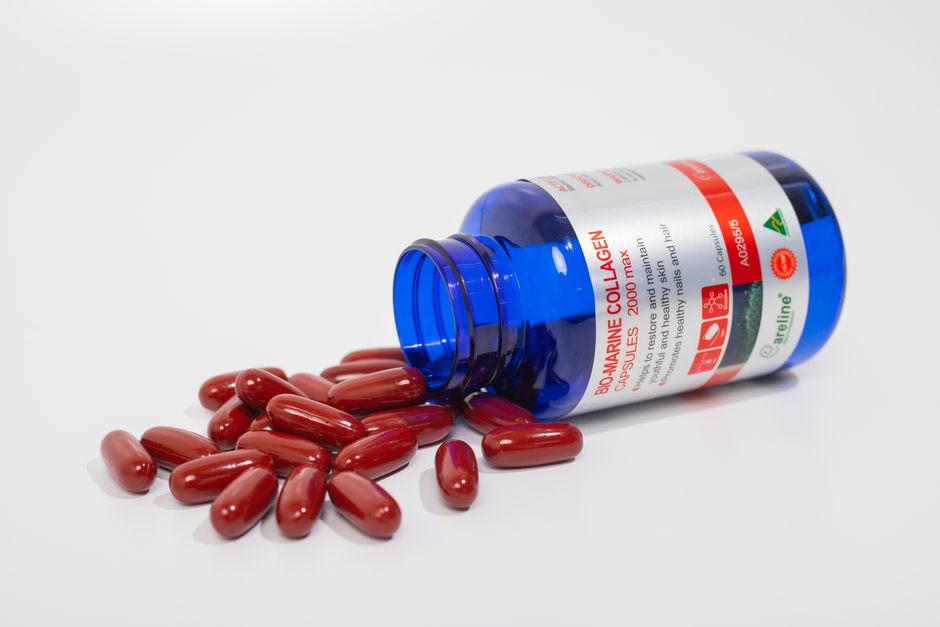
Collagen supplements have become one of the most popular products in the health aisle, but the question of how much to take depends entirely on what you are trying to support. For skin, most human studies have used 2.5 to 10 grams per day. For joint pain, the most commonly studied range is 8 to 12 grams daily. For muscle and body composition, research has typically used 15 grams per day, often combined with resistance training. These are the amounts that appear in published human trials, not official recommendations. No government body has established a recommended daily intake for collagen supplements.
What Is Collagen and Why Does the Body Need It?
Collagen is the most abundant protein in the human body. It provides structure and strength to skin, bones, tendons, ligaments, and cartilage. Think of it as the scaffolding that holds tissue together.
The body makes collagen on its own by combining amino acids — primarily glycine, proline, and hydroxyproline — into long protein chains. Vitamin C is required for this process. Without enough vitamin C, collagen production stalls. This is why severe vitamin C deficiency causes scurvy, a condition marked by bleeding gums and poor wound healing.
Collagen production declines with age. This is a normal part of aging, not a disease. After roughly age 20, the body produces about 1% less collagen per year. By middle age, visible signs appear: thinner skin, weaker cartilage, and slower tendon repair.
Collagen supplements are not the same as the collagen in your body. When you swallow a collagen powder or capsule, digestive enzymes break it down into short chains of amino acids called peptides, and sometimes into individual amino acids. These fragments are absorbed into the bloodstream. They do not travel intact to your skin or joints as ready-made collagen.
What they may do instead is signal to cells. Some research suggests certain collagen peptides can stimulate fibroblasts (skin cells) and chondrocytes (cartilage cells) to produce more collagen. That signaling idea is plausible but still an active area of research. It is not fully settled.
How Much Collagen Should You Take for Skin?
Most clinical trials on skin have used between 2.5 and 10 grams of hydrolyzed collagen per day. Hydrolyzed means the collagen has been broken into smaller peptides, which are easier to absorb.
In these studies, researchers typically measured skin elasticity, hydration, and wrinkle depth over periods ranging from 8 to 24 weeks. Some trials reported modest improvements in skin elasticity and hydration. Others found little or no difference compared to a placebo.
The evidence is mixed. A number of small studies show positive results, but many were short, involved few participants, and were funded by collagen manufacturers. That does not make them invalid, but it does mean the findings should be read with appropriate caution. Larger, independent trials are still limited.
What the research does not support is the idea that collagen supplements reverse aging or produce dramatic changes. Any effects seen in studies have been modest and measured with instruments, not always visible to the eye.
If someone chooses to try collagen for skin, the studied range is 2.5 to 10 grams daily. There is no established minimum effective dose, and no official guideline exists.
How Much Collagen Should You Take for Joints?
For joint pain, the most commonly studied dose is 8 to 12 grams per day. Some trials have used 10 grams daily, often for 3 to 6 months.
The research here is somewhat stronger than for skin, though still not definitive. Several studies involving people with knee osteoarthritis or activity-related joint pain have reported reductions in pain scores and improvements in joint function compared to placebo. Other studies have found no meaningful difference.
A few points are worth keeping in mind:
- Most positive studies used hydrolyzed collagen, not gelatin or unhydrolyzed collagen.
- Participants often had existing joint pain, not healthy joints.
- Improvements, when reported, were usually modest — not the elimination of pain.
- Many studies were small, and results have not always been replicated.
Collagen is not a treatment for osteoarthritis, rheumatoid arthritis, or any diagnosed joint disease. It is not a substitute for medical care. Some clinicians suggest it as a complementary option, but it is not part of standard treatment guidelines for arthritis.
For general joint support in healthy people, there is no established dose. The 8 to 12 gram range comes from studies of people with joint symptoms, not from prevention research.





How Much Collagen Should You Take for Muscle?
Muscle research has typically used 15 grams of collagen peptides per day, often taken after exercise. Some studies combined collagen with resistance training and measured changes in muscle mass or strength.
The results have been unimpressive compared to other proteins. Collagen is an incomplete protein. It lacks tryptophan, an essential amino acid, and is low in several others. For building muscle, whey protein and other complete proteins have consistently outperformed collagen in head-to-head comparisons.
One area where collagen has shown some promise is tendon and ligament health. A small number of studies have looked at collagen combined with vitamin C taken before exercise, with some evidence of improved tendon stiffness or reduced injury. This research is early and involves small numbers of participants. It is not enough to make firm recommendations.
If muscle growth is the goal, 15 grams of collagen daily is unlikely to match the same amount of whey or a complete protein source. The evidence does not support collagen as a primary muscle-building protein.
Does the Type or Form of Collagen Matter?
Collagen supplements come in several forms. The most common are types I, II, and III, though the labeling can be confusing.
| Type | Common Source | Often Marketed For | Evidence Strength |
|---|---|---|---|
| Type I | Bovine, fish, eggshell membrane | Skin, hair, nails, bones | Mixed; some small trials show modest effects |
| Type II | Chicken cartilage | Joints, cartilage | Mixed; some trials show modest joint benefits |
| Type III | Bovine | Skin, blood vessels | Limited direct research |
| Hydrolyzed peptides | Various | General use | Most studied form; best absorption |
Hydrolyzed collagen peptides are the most studied form. They are broken into smaller pieces that are more easily absorbed through the gut. Undenatured collagen, sometimes called native collagen, is not broken down and may work differently, though research on it is limited.
The type matters less than the form. Hydrolyzed peptides have the most human data behind them, regardless of whether they are type I or type II.
Are There Risks or Side Effects?
Collagen supplements are generally well tolerated in the amounts used in studies. Reported side effects are uncommon and usually mild — bloating, fullness, or minor digestive discomfort.
People with allergies to fish, shellfish, or eggs should check the source of their collagen. Fish-derived collagen is not safe for people with fish allergies. Eggshell membrane collagen is not safe for people with egg allergies.
Collagen is a protein, so it counts toward daily protein intake. For most people, this is not a concern. But for those with kidney disease or other conditions requiring protein restriction, adding collagen without medical guidance could be problematic.
There is no evidence that collagen supplements interact with medications. However, anyone taking prescription drugs should speak with a healthcare provider before adding any new supplement.
Pregnant and breastfeeding women should be cautious. No clinical guidelines currently exist for collagen supplementation in these populations.
Can You Get Enough Collagen from Food?
Collagen is found in animal foods, particularly in connective tissue. Bone broth, chicken skin, and cuts of meat with gristle contain collagen. But the amount varies widely and is hard to measure.
Eating collagen-rich foods does not directly translate to more collagen in your skin or joints. The same digestion process applies — the protein is broken down into amino acids and peptides before absorption.
What you can do is support your body’s own collagen production. Vitamin C is required for collagen synthesis. Good sources include citrus fruits, bell peppers, strawberries, and broccoli. A balanced diet with adequate protein provides the amino acids the body needs to build collagen.
There is no official recommended intake for dietary collagen. The body does not require collagen specifically — it requires the amino acids that make up collagen, which are found in many protein sources.
What Should You Take Away from This?
Collagen supplements are not a cure for aging skin, joint pain, or muscle loss. The evidence for their benefits is modest and mixed. Some studies show small improvements; others show none.
If you choose to try collagen, the amounts used in research are:
- Skin: 2.5 to 10 grams per day
- Joints: 8 to 12 grams per day
- Muscle: 15 grams per day, though results are weak compared to complete proteins
These are not official recommendations. They are the doses that appear in published human trials. No health agency has established a daily requirement for collagen supplements.
Collagen is generally safe for most healthy adults. It is not a replacement for a balanced diet, exercise, or medical treatment. If you have a diagnosed condition or take prescription medications, talk to your healthcare provider before starting any supplement.
Frequently Asked Questions
How much collagen should I take daily for skin?
Most skin studies have used 2.5 to 10 grams of hydrolyzed collagen per day. No official daily recommendation exists, and results in trials have been modest and mixed.
What is the best dose of collagen for joint pain?
Clinical trials for joint pain have typically used 8 to 12 grams per day, often for several months. Improvements, when reported, have generally been modest.
Can I take too much collagen?
No established upper limit exists for collagen supplements, and side effects in studies have been uncommon and mild. Very high intakes could cause digestive discomfort in some people.
Is collagen as good as whey protein for building muscle?
No. Collagen is an incomplete protein and has consistently underperformed whey and other complete proteins in muscle-building research.
