
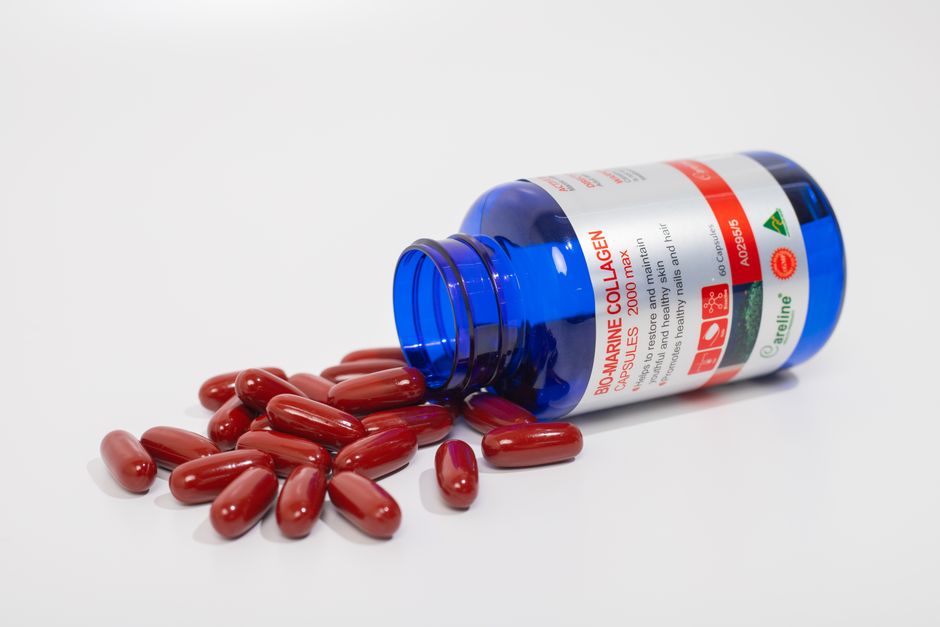
There is no official recommended daily amount of collagen. No health agency has set a dietary reference intake for it, because collagen is not an essential nutrient — your body makes its own. Most supplement research uses daily doses somewhere between 2.5 and 15 grams, and the specific dose studied varies by health goal. That range is where the evidence lives, not a government standard.
Collagen is the most abundant protein in your body. It gives structure to skin, bones, tendons, ligaments, and cartilage. After roughly your mid-20s, your natural production gradually declines. That decline is real and well documented. Whether swallowing collagen supplements meaningfully reverses it is a separate question — and the honest answer is that the evidence is promising in some areas and thin in others.
How Much Collagen Should You Take Per Day?
Most human studies that found a measurable effect used between 2.5 and 15 grams per day. There is no single correct number, and no regulatory body has established one.
The dose that shows up in research depends heavily on what researchers were measuring. Skin elasticity studies have generally used smaller amounts. Joint pain studies have often used larger amounts. Bone density research has used a range in between. This is not because one dose is “right” — it reflects how each study was designed.
What this means practically: if you are considering collagen, the studied range is the only reference point you have. Taking more than what was studied does not have evidence behind it. Taking less may fall below the amounts that showed effects in trials.
A note on units. Collagen is sold in grams, and labels vary — some list “collagen peptides” by total weight, others list a “serving” that contains a blend. Read the actual collagen content per serving, not the scoop size. A 20-gram scoop is not necessarily 20 grams of collagen.
What Doses Have Been Studied for Different Goals?
Research on collagen spans several areas, and the doses are not interchangeable across them. Here is what the published literature generally reflects.
- Skin: Studies on skin elasticity and hydration have commonly used doses in the lower-to-middle part of the range, often around 2.5 to 10 grams daily. Results have been modest and not uniform across trials.
- Joints and osteoarthritis: Trials on joint pain and function have often used higher doses, frequently in the range of 8 to 12 grams daily. Some studies report reduced pain scores; others show little difference from placebo.
- Bone density: Research in postmenopausal women has used doses in the middle of the range. Findings are early and should not be read as a substitute for established bone health measures.
- Muscle and tendon: Some studies have combined collagen with resistance exercise, often using around 15 grams. This is an emerging area with limited but growing evidence.
These are general patterns from the research, not official recommendations. The evidence across all of these areas is mixed — some trials show benefit, others do not, and study quality varies. No clinical guideline currently recommends collagen supplements for any of these purposes.
Does the Type of Collagen Matter for Dosing?
Collagen supplements are typically sold as type I, type II, or a blend. The type matters less for dosing than the form does.
Most research uses hydrolyzed collagen peptides — collagen that has been broken into smaller fragments. This is sometimes called collagen hydrolysate. The smaller fragments are easier to absorb, and this is the form used in the majority of clinical trials. If a study found an effect, it was almost certainly testing hydrolyzed peptides, not whole collagen.
Type II collagen is often sold in a different form, sometimes as undenatured collagen, and has been studied separately for joint conditions. Doses in that research differ from peptide studies, so you cannot assume a dose from one form applies to another.
The practical takeaway: match the form to the research you are relying on. A dose studied for hydrolyzed peptides does not automatically transfer to a different collagen product.
Is More Collagen Better?
No evidence supports taking large amounts of collagen for greater benefit. The dose-response relationship has not been well established in human trials.
This is where a common assumption breaks down. More protein does not mean more collagen in your skin or joints. When you eat collagen, your digestive system breaks it down into amino acids and small peptides. Your body then uses those building blocks wherever it needs them — not necessarily where you want them. There is no mechanism by which eating extra collagen directs it to your skin or knees.
Some research suggests the small peptides may signal the body to produce more of its own collagen, but this is not fully established. The idea is plausible and has some laboratory support. It has not been confirmed as the main way collagen supplements work in people.
Taking very large doses is not known to be dangerous for most healthy adults, but it also is not known to help more. It adds cost and calories without demonstrated benefit.
Are There Risks or Limits to Collagen Doses?
Collagen supplements are generally well tolerated in the amounts studied. Reported side effects are usually mild — mostly digestive discomfort such as bloating or a feeling of fullness.
There are real considerations, though. Collagen is a protein, and it counts toward your total protein intake. People with kidney disease who have been advised to limit protein should talk to their doctor before adding a collagen supplement. The same applies to anyone on a medically restricted diet.
Collagen supplements are often derived from animal sources — bovine, porcine, or marine. People with allergies to those sources should check the origin. Some products also contain added ingredients, flavorings, or sweeteners that may matter to you.
One point that is often missed: supplements are not tightly regulated for content in the same way medications are. Independent testing has found that some collagen products contain less collagen than the label claims, or contain contaminants. Choosing products from manufacturers that publish third-party testing results is a reasonable precaution, though it does not guarantee quality.
If you are pregnant, breastfeeding, or giving collagen to a child, note that no clinical guidelines exist for collagen supplementation in these groups. Do not assume adult doses apply.
How Should You Take Collagen for Best Absorption?
There is no strong evidence that timing or combining collagen with other foods significantly changes how well it works. The research does not support specific timing rules.
Collagen peptides dissolve easily in liquid and can be taken with or without food. Some people take it on an empty stomach based on the idea that it absorbs better, but this has not been confirmed in human studies. The more reliable approach is consistency — taking it daily, at a time you will remember.
One area where timing may matter is exercise. Some research has combined collagen with vitamin C before resistance training, based on the role vitamin C plays in collagen synthesis. This is an emerging area, and the evidence is not yet strong enough to call it a recommendation.
If you decide to try collagen, a reasonable starting point is the lower end of the studied range, taken consistently for a period long enough to judge. Many trials ran for several weeks to a few months before measuring outcomes. Do not expect changes in days.
What Should You Expect From a Collagen Supplement?
Expectations should be modest and grounded in what the research actually shows. The evidence is strongest — though still mixed — for skin hydration and elasticity, and for joint comfort in some people.
Results vary widely between individuals and between studies. Some trials show measurable improvements; others show differences from placebo that are small or absent. This inconsistency is a genuine feature of the research, not a reason to dismiss it entirely or to overstate it.
What collagen is not: it is not a treatment for any disease, and it is not a substitute for established approaches to bone health, joint health, or skin care. Sun protection remains the most evidence-backed way to slow skin aging. Weight-bearing exercise and adequate calcium and vitamin D remain the foundations of bone health. Collagen, if it helps at all, sits on top of those basics — not in place of them.
If you have a medical condition, take medications, or are considering collagen for a specific health concern, talk to your doctor or a registered dietitian. They can help you weigh whether it fits your situation. That conversation is worth more than any label on a tub.
Frequently Asked Questions
How much collagen should I take daily?
Most research used between 2.5 and 15 grams per day, with the amount depending on the health goal studied. No official recommended daily intake exists for collagen.
Can you take too much collagen?
No evidence shows that large doses help more, though they are not known to be harmful for most healthy adults. Collagen counts as protein, so people advised to limit protein should check with their doctor.
Does collagen need to be taken with vitamin C?
Some research has paired collagen with vitamin C around exercise, but the evidence is not strong enough to make it a recommendation. Vitamin C does play a role in your body’s own collagen production.
How long does collagen take to work?
Most studies measured results over several weeks to a few months, so changes in days are unlikely. Results vary, and some trials found little difference from placebo.
