
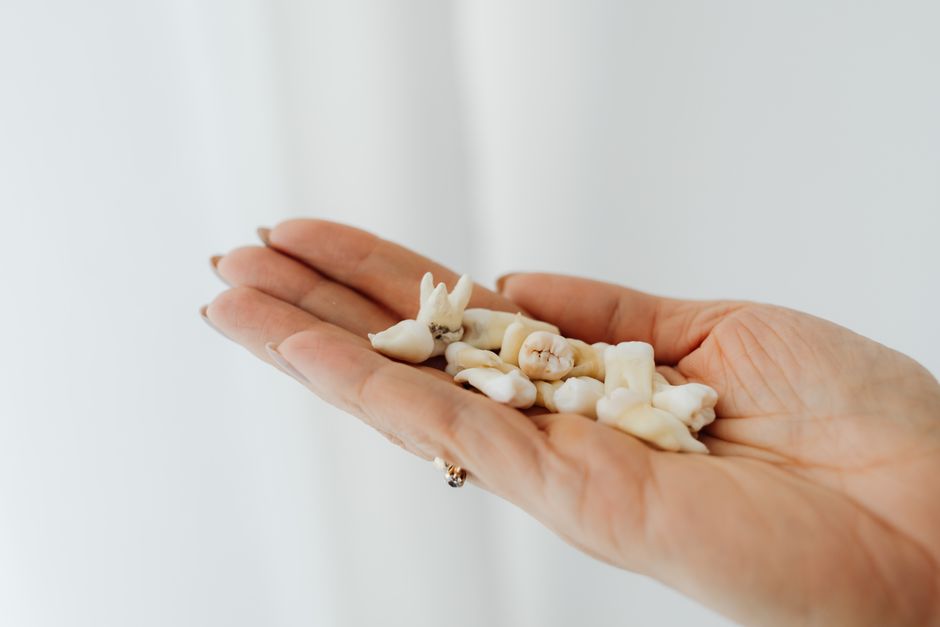
Most adults have 28 teeth if their wisdom teeth have not come in or have been removed. That number comes from four types of teeth in each jaw: incisors, canines, premolars, and molars.
Wisdom teeth, also called third molars, are the four teeth at the very back of the mouth. When they are included, the full adult set is 32. When they are not, the count is 28.
So the short answer is 28 teeth without wisdom teeth, and 32 teeth with them. That difference of four is the entire gap between the two numbers.
How Many Teeth Do Humans Have Without Wisdom Teeth?
Adults have 28 teeth before wisdom teeth are counted. The breakdown is the same in the upper jaw and the lower jaw.
Each jaw holds 14 teeth:
- 4 incisors — the front teeth used for cutting
- 2 canines — the pointed teeth beside the incisors
- 4 premolars — the teeth between canines and molars
- 4 molars — the large grinding teeth at the back
Double that for both jaws and you get 28. Add the four wisdom teeth, one at each far corner of the mouth, and the total reaches 32. That is the maximum number of teeth a person can have.
Worth noting: not everyone develops all four wisdom teeth. Some people have fewer, and a small number have none at all. The 32 figure is the full set, not a guarantee.
Why Are Wisdom Teeth Counted Separately?
Wisdom teeth are the last teeth to appear, and many people never get a full set of four. That is why they are usually counted on their own rather than folded into the standard adult number.
They typically emerge in the late teens or early twenties, though the timing varies widely. Some show up sooner, some later, and some stay buried under the gums and never break through at all.
Because they arrive so late and so unpredictably, dentists and researchers often describe the adult mouth as having 28 teeth as the baseline, with wisdom teeth as a separate category. It is a practical distinction, not a technical one.
There is also an evolutionary angle worth knowing. The human jaw has become smaller over a very long stretch of time, and many researchers think there is simply less room for a third set of molars than there once was. That mismatch between jaw size and tooth count helps explain why wisdom teeth so often cause crowding or get stuck.
What Teeth Make Up the 28?
The 28 permanent teeth are divided into four groups, each with a specific job. Understanding them helps explain why the number is what it is.
Incisors are the eight teeth at the front — four on top and four on the bottom. They are thin and flat, built for biting and cutting food.
Canines are the four pointed teeth, one on each side of the incisors in both jaws. They grip and tear food.
Premolars are the eight teeth just behind the canines. They have a flatter surface for crushing and grinding.
Molars are the eight large teeth at the back of the 28. They do the heaviest grinding work. The wisdom teeth, when present, sit behind these as a third set of molars.
This structure is shared across both jaws. The upper and lower sets mirror each other, which is why the total divides evenly.
How Many Baby Teeth Do Children Have?
Children have 20 baby teeth, also called primary teeth. That set is complete by around age three.
The baby set includes incisors, canines, and molars, but no premolars. Those come in with the permanent teeth later. The 20 baby teeth are eventually replaced by the 28 permanent teeth, with wisdom teeth possibly following in the late teens or twenties.
The transition happens gradually. Front baby teeth often loosen and fall out first, usually starting around age six, and the process continues into the early teens. By the time the permanent set is in place, the count has grown from 20 to 28.
Does Everyone Have 28 Teeth Without Wisdom Teeth?
No. The 28 figure describes the standard permanent set, but individual mouths vary. Some people are born missing one or more permanent teeth, a condition dentists call hypodontia. Others may have extra teeth, though that is less common.
Wisdom teeth themselves vary a great deal. A person might have all four, two, one, or none. Some wisdom teeth stay fully buried and never emerge. Others come in partway and get stuck against the neighboring molar, which is what people mean by an impacted wisdom tooth.
Because of this variation, the number of teeth actually visible in a given adult mouth can differ from the textbook count. A dentist looking at a full set of X-rays sees the real picture, not the average.
This is one reason the question has a clean answer on paper and a messier one in practice. The standard is 28. The reality depends on the person.
Do Wisdom Teeth Always Need to Be Removed?
No. A wisdom tooth that comes in fully, sits in a healthy position, and can be cleaned properly may not need removal. The decision depends on the individual case.
Removal is commonly recommended when a wisdom tooth is impacted, causes pain, damages a neighboring tooth, or is positioned where it cannot be kept clean. Dentists generally weigh the risks of leaving it against the risks of surgery.
It is worth being clear about the evidence here. Clinical guidance on when to remove symptom-free wisdom teeth has shifted over time, and recommendations vary between dentists and between countries. Some clinicians favor removing them early to prevent future problems. Others take a watch-and-wait approach when the tooth is not causing trouble.
This is a decision to make with a dentist who can see the tooth’s position and your overall oral health. There is no single rule that fits every mouth.
Why the Number Matters
Knowing the standard count helps you understand what is normal and what is not. If your dentist mentions a missing tooth or an extra one, you have a baseline to compare against.
It also explains common dental language. When a dentist says you have “28 teeth,” they mean the full permanent set without the third molars. When they talk about “third molars,” they mean the wisdom teeth that sit outside that count.
The numbers are simple, but they connect to real decisions about checkups, X-rays, and whether a wisdom tooth needs attention. A count of 28 is the norm. Anything different is worth a conversation with your dentist, not a reason to worry on your own.
Frequently Asked Questions
How many teeth do humans have without wisdom teeth?
Humans have 28 permanent teeth without wisdom teeth. Adding the four wisdom teeth brings the total to 32.
Is it normal to only have 28 teeth?
Yes, 28 is the standard permanent count before wisdom teeth are included. Many adults never develop all four wisdom teeth or have them removed, so 28 is common.
How many wisdom teeth does a person usually have?
Most people develop four wisdom teeth, one in each corner of the mouth. It is also common to have fewer than four, and some people have none.
Do all 32 teeth have to come in for a full set?
No. The full set is 32, but not everyone develops all four wisdom teeth. A complete set of 28 permanent teeth is normal on its own.
