
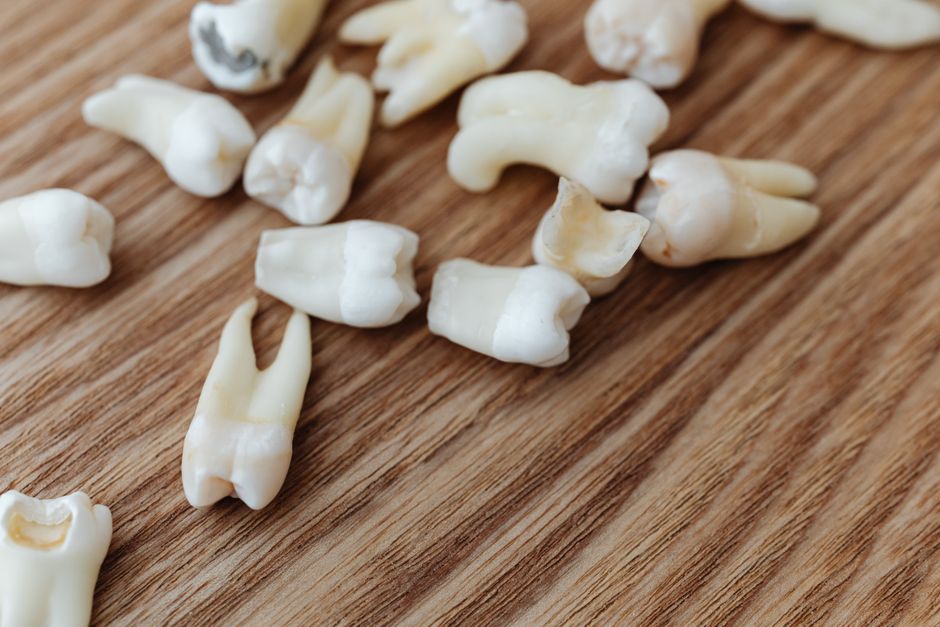
Most adults have 12 molars. That number includes four wisdom teeth, which are also called third molars. Children have a different set. Their 8 baby molars eventually fall out and are replaced by permanent premolars and molars.
The count changes through life. Understanding which teeth count as molars helps you make sense of dental charts, extraction recommendations, and everyday dental care.
How Many Molars Do We Have in a Full Adult Set?
A complete adult mouth has 32 teeth. Twelve of those are molars. They sit at the very back of the mouth, behind the premolars.
Here is the breakdown:
- 6 molars on the top arch (upper jaw)
- 6 molars on the bottom arch (lower jaw)
- 3 molars per quadrant (upper right, upper left, lower right, lower left)
Each quadrant contains a first molar, a second molar, and a third molar. The third molars are the wisdom teeth.
Not everyone keeps all 12. Many people have their wisdom teeth removed. Some people never develop all four wisdom teeth in the first place. It is common to have fewer than four wisdom teeth, and some people have none at all.
If you have had your wisdom teeth extracted, you still have 8 permanent molars remaining. That is a normal, healthy adult count.
How Many Baby Molars Do Children Have?
Children have 8 baby molars. These are part of the 20 primary teeth that erupt during early childhood.
The baby molars appear in two waves. The first molars usually come through around age 6 to 7. The second molars typically arrive around age 11 to 13. These ages vary from child to child.
Baby molars matter more than many parents realize. They hold space for the permanent teeth developing underneath. Losing a baby molar too early can cause neighboring teeth to shift into the gap, which may lead to crowding when adult teeth come in.
Unlike baby incisors and canines, baby molars are not directly replaced by new molars. They are replaced by premolars, which are also called bicuspids. The permanent molars that erupt behind them are entirely new teeth that did not replace any baby tooth.
What Is the Difference Between Molars and Premolars?
Molars and premolars are easy to confuse because they sit next to each other in the back of the mouth. They have different shapes and different jobs.
Molars are the largest teeth in the mouth. They have broad, flat surfaces with multiple cusps, which are the raised points on the chewing surface. Their job is grinding and crushing food into smaller pieces.
Premolars are smaller. They sit directly in front of the molars. Each premolar typically has two cusps, which is why they are sometimes called bicuspids. They help tear and crush food, but they do less heavy grinding than molars.
Adults have 8 premolars in a full set of teeth. They replace the baby molars during childhood.
A simple way to remember the difference: premolars come before molars in the dental arch, and they are smaller.





Why Do Wisdom Teeth Cause Problems?
Wisdom teeth are the third molars. They are the last teeth to erupt, usually between ages 17 and 25. They are also the teeth most likely to cause trouble.
Many jaws do not have enough room for these extra molars. When there is not enough space, wisdom teeth can become impacted. An impacted tooth stays trapped under the gum or grows at an angle instead of coming in straight.
Impacted wisdom teeth can lead to several issues:
- Pain and swelling in the back of the mouth
- Damage to the second molar next to them
- Infection or gum disease around the partially erupted tooth
- Cysts that can damage the jawbone
- Tooth decay because the area is hard to clean
Not all wisdom teeth need removal. A wisdom tooth that comes in straight, fully erupts, and can be cleaned properly may not cause any problems. Many dentists recommend monitoring these teeth rather than removing them automatically.
The decision to remove wisdom teeth is individual. Some clinicians recommend removal when there is clear evidence of current problems or a high risk of future problems. Others take a more conservative approach and wait. The evidence on removing symptom-free wisdom teeth is mixed, and guidelines vary.
Do You Need All 12 Molars to Chew Properly?
No. You can chew effectively with fewer than 12 molars. Most people who have their wisdom teeth removed notice little to no change in their ability to eat.
The first molars do the majority of the grinding work. They are often called the cornerstone of the dental arch. Losing a first molar has a larger impact on chewing than losing a wisdom tooth.
Second molars also contribute significantly to chewing. Losing both first and second molars on the same side can make chewing on that side noticeably harder.
When teeth are missing, the remaining teeth take on more work. This can increase wear on those teeth over time. It can also cause remaining teeth to shift into the empty spaces.
If you lose molars, a dentist can discuss replacement options. These include dental implants, bridges, and partial dentures. The right choice depends on which teeth are missing, the condition of the surrounding teeth, and your overall oral health.
How Many Molars Do You Have After Wisdom Tooth Removal?
After all four wisdom teeth are removed, you have 8 molars. This is the most common adult molar count in the United States.
Many people have their wisdom teeth removed in their late teens or early twenties. This is often done before the roots are fully formed, which can make the procedure and recovery easier.
Some people have only some wisdom teeth removed. If one wisdom tooth is healthy and fully erupted, a dentist may leave it in place while removing the others. In that case, the molar count would be 9, 10, or 11 depending on how many remain.
Some people never develop all four wisdom teeth. A 2023 review of studies on wisdom tooth development found that the number of wisdom teeth varies widely across populations. Some people have only one or two, and a small percentage have none.
Why Do Some Adults Have Extra Molars?
A small number of people have more than 12 molars. These extra teeth are called supernumerary teeth. The most common extra tooth in the molar region is a fourth molar, sometimes called a distomolar.
Fourth molars are rare. When they do appear, they usually sit behind the wisdom tooth. They may never erupt through the gum and may only be spotted on a dental X-ray.
Supernumerary teeth can cause crowding, delay the eruption of nearby teeth, or lead to cyst formation. In many cases, though, they cause no problems at all and are simply monitored.
Having an extra molar is not something you would typically notice on your own. It is almost always found during a dental examination with X-rays.
Frequently Asked Questions
How many molars do adults have?
Adults have 12 molars in a full set of 32 teeth. This includes the wisdom teeth, which are the third molars.
How many molars do you have without wisdom teeth?
Without any wisdom teeth, you have 8 molars. This is the normal count after all four wisdom teeth are removed.
How many baby molars do children have?
Children have 8 baby molars. These are replaced by premolars, not by new molars.
Are wisdom teeth considered molars?
Yes. Wisdom teeth are the third molars and are included in the adult molar count of 12.
Knowing your molar count is more than a dental trivia fact. It helps you understand what your dentist is looking at on X-rays, why wisdom teeth discussions happen, and what to expect if teeth need to be removed. If you are unsure how many molars you have, your dentist can tell you during your next routine exam.
