
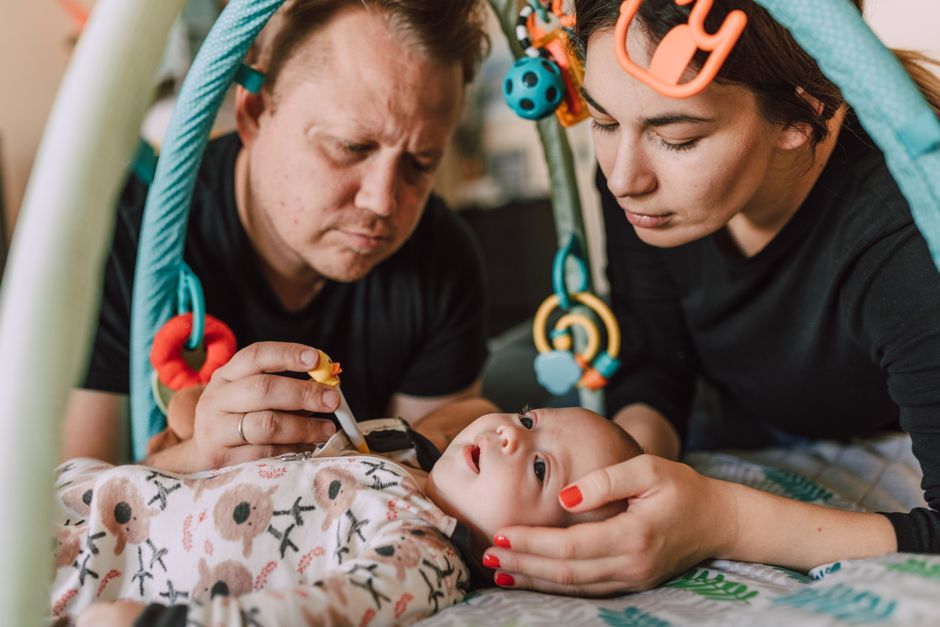
Newborn babies sleep a lot — but rarely in the way tired parents expect. In the first weeks of life, most infants sleep about 14 to 17 hours in a 24-hour period, spread across many short stretches of sleep both day and night. That total stays fairly high through the first year, though it gradually shifts toward longer nighttime sleep and fewer daytime naps. The pattern matters as much as the number, and understanding both can make the early months far less confusing.
How Many Hours Do Infants Sleep at Each Age?
Sleep needs are highest at birth and slowly decline over the first year. The ranges below reflect general guidance from pediatric sleep organizations and are based on typical patterns, not rigid rules.
Newborns from birth to about 3 months sleep roughly 14 to 17 hours per day. This is broken into stretches of 2 to 4 hours, because newborns have not yet developed a day-night rhythm and need to feed frequently.
From about 4 to 11 months, total sleep settles around 12 to 16 hours per day, including naps. Nighttime sleep lengthens, and most babies take two to three naps. By the end of the first year, many babies sleep 10 to 12 hours at night plus two naps.
These are averages across large groups of healthy infants. Individual babies vary widely, and a baby who sleeps at the low or high end of the range can still be perfectly healthy.
Why Do Newborns Wake So Often?
Frequent waking in newborns is normal biology, not a sleep problem. For most of human history, a newborn who slept through the night without waking would have been at risk. The system is built to keep them fed and protected.
Newborns have small stomachs and fast metabolisms, so they need to eat every few hours around the clock. They also spend a large share of their sleep in lighter, active sleep, which is thought to support rapid brain development. This lighter sleep makes them easier to rouse, which is protective.
Another factor is that newborns have not yet produced much melatonin, the hormone that helps regulate the sleep-wake cycle. Their internal clock, or circadian rhythm, is still forming. That clock typically starts to mature between 2 and 4 months, which is when many babies begin to cluster more sleep at night.
How Does Infant Sleep Change Over the First Year?
Sleep architecture shifts steadily across the first 12 months. The changes are gradual, and no two babies follow the same timeline.
- Birth to 3 months: Sleep is spread evenly across day and night, in short stretches.
- 3 to 6 months: A day-night pattern emerges. Nighttime stretches lengthen, and naps become more predictable.
- 6 to 9 months: Many babies take two to three naps and sleep longer at night, though teething, illness, and developmental leaps can disrupt this.
- 9 to 12 months: Most babies take two naps and sleep 10 to 12 hours at night, with occasional night waking still common.
It helps to remember that sleep regressions are a real and expected part of development. Skills like rolling, sitting, and crawling often coincide with temporary disruptions. These phases usually pass on their own.





What About Safe Sleep and Night Waking?
Safe sleep practices and realistic expectations about waking go hand in hand. The American Academy of Pediatrics recommends that infants sleep on their backs, on a firm flat surface, in their own sleep space, with no soft bedding, pillows, or toys. These steps are strongly linked to a lower risk of sleep-related infant deaths, and they should be followed for every sleep, including naps.
Room-sharing — keeping the baby’s sleep space in the parents’ room — is also recommended for at least the first 6 months. This makes nighttime feeding and monitoring easier and is associated with lower risk, though the exact reasons are still studied.
Waking at night is not a sign that something is wrong. It is a normal part of infant sleep. Responding to a hungry or distressed baby is appropriate and does not create bad habits. The idea that soothing a baby will “spoil” them is not supported by evidence.
When Should Parents Be Concerned About Infant Sleep?
Most variation in infant sleep is normal. Certain signs, however, warrant a call to a pediatrician.
Talk to a doctor if a baby is unusually difficult to wake, sleeps far more than expected and feeds poorly, or seems excessively sleepy during the day. Breathing that pauses, gasping, or noisy breathing during sleep should also be checked. In older infants, persistent trouble breathing at night or loud snoring may point to enlarged tonsils or other issues that a clinician can evaluate.
Parents who feel overwhelmed by sleep deprivation should also reach out. Postpartum mood changes are common and treatable, and support is available. Asking for help is a sign of good parenting, not a failure.
Can You Shape a Baby’s Sleep Patterns?
You cannot force a newborn to sleep through the night, but you can gently support the development of a day-night rhythm. During the day, keep lights brighter and interactions livelier. At night, keep feeds quiet and dim. This contrast helps the internal clock mature.
Some parents try formal sleep training methods after about 4 to 6 months. Research on these approaches suggests they can improve sleep for some families, though results vary and no single method works for everyone. The choice to sleep train, and when, is a personal one. There is no evidence that a responsive, comforting approach harms a baby’s development or emotional health.
What matters most is that the baby is fed, safe, and cared for. Sleep will consolidate over time. For most families, the first year involves some broken nights, and that is a normal part of the process rather than a problem to solve.
Frequently Asked Questions
How many hours should a newborn sleep in 24 hours?
Most newborns sleep about 14 to 17 hours per day, spread across many short stretches. This total is normal even though it is broken into frequent waking periods.
Is it normal for a 6-month-old to still wake at night?
Yes, night waking at 6 months is common and usually normal. Many babies this age still wake to feed or for comfort, even when they sleep well overall.
When do babies start sleeping through the night?
There is no set age, but many babies begin sleeping longer stretches at night between 3 and 6 months. Some take longer, and occasional waking can continue well past the first birthday.
Can a baby sleep too much?
A baby who sleeps more than usual but feeds well and is alert when awake is usually fine. If a baby is hard to wake or feeds poorly, contact a pediatrician.
