
A hen’s egg production depends almost entirely on her age, breed, and the season. Most breeds lay best in their first year, averaging roughly 200 to 300 eggs per year at peak. Production drops steadily after that, and by year three many hens lay far fewer eggs or stop entirely.
That range is wide because “chicken” covers everything from tiny bantams to heavy dual-purpose breeds. A backyard flock and a commercial barn are working with very different birds. Understanding what drives those numbers helps you set realistic expectations.
How Many Eggs Will A Chicken Lay in a Year?
A healthy hen from a productive breed typically lays between 200 and 300 eggs in her first laying year. Commercial strains bred specifically for egg output can exceed that. Heritage and dual-purpose breeds often land closer to 150 to 250.
The first year is almost always the most productive. A hen’s body allocates resources to egg production most efficiently when she is young. After her first full laying cycle, output declines. This decline is gradual at first, then steepens.
By the second year, many hens produce roughly 20 percent fewer eggs than in year one. By the third year, the drop is larger still. Some hens continue laying for several more years, but at a much reduced rate. A few stop almost completely after two or three seasons.
It helps to think in terms of a laying cycle rather than a calendar year. A hen does not lay continuously. She cycles through periods of laying and rest, and those cycles change as she ages.
What Determines How Many Eggs a Hen Lays?
Genetics is the single biggest factor. A hen’s breed sets her ceiling for egg production. Management, nutrition, and environment determine whether she reaches that ceiling or falls short of it.
Breed falls into rough categories:
- Layer breeds — bred for high output, often 250 to 300 eggs per year at peak. These include the breeds common in commercial egg production.
- Dual-purpose breeds — kept for both eggs and meat, typically 150 to 250 eggs per year. Examples include Orpingtons and Plymouth Rocks.
- Heritage and ornamental breeds — often lower output, sometimes under 150 eggs per year.
- Bantams — small birds that lay small eggs, with widely varying annual counts.
Nutrition matters almost as much as breed. Laying hens need adequate protein, calcium, and energy. A hen short on calcium will draw it from her own bones to form eggshells, which harms her health over time. Commercial layer feed is formulated to meet these needs. Table scraps alone generally do not.
Day length is another major driver. Hens need a certain number of daylight hours to keep laying. As days shorten in fall and winter, many hens slow down or stop. This is normal, not a sign of illness. Artificial light can extend production, a common practice in commercial operations.
Stress also suppresses laying. Predators, crowding, extreme heat, and sudden changes in routine can all reduce output. A hen that feels unsafe lays fewer eggs.
How Often Does a Hen Lay an Egg?
At peak production, a healthy hen can lay close to one egg per day. She does not lay every single day without pause, though. The cycle takes slightly more than 24 hours from one egg to the next.
Because the cycle runs a bit longer than a day, a hen’s laying time drifts later each day. She might lay in the morning one day and early afternoon the next. Eventually the timing pushes past a certain point, she skips a day, and the cycle resets to the morning.
This is why “one egg a day” is a rough average rather than a guarantee. A hen at peak might lay six or seven eggs in a week. During molt, winter, or after several years of age, that number can fall to a few per week or none at all.
Egg formation itself happens inside the hen’s reproductive tract. The yolk forms first, then the egg white, then the shell. The shell is added last, over several hours. If something interrupts this process, the egg may be laid without a shell, with a soft shell, or with an unusual shape. Occasional odd eggs are common and usually not a concern.





Why Do Hens Stop Laying?
Several normal biological events cause hens to pause or stop egg production. Molting is the most common. Once a year, usually in fall, a hen sheds old feathers and grows new ones. Her body redirects protein and energy to feather growth, and laying typically stops for weeks.
Shorter daylight in winter slows or halts production in many flocks. This is a seasonal response, not a problem. Production usually resumes as days lengthen in spring.
Broodiness is another cause. Some hens become broody, meaning their hormones shift toward incubating eggs rather than producing them. A broody hen may sit on the nest and stop laying for weeks. Not all breeds go broody, and some do so far more than others.
Age eventually reduces production permanently. A hen has a finite number of egg cells, set before she hatches. As she ages, she releases fewer of them. This is why older hens lay less, regardless of care.
Illness, parasites, poor nutrition, and stress can also stop laying. When a previously productive hen suddenly stops, it is worth checking for these causes rather than assuming it is just age.
Do All Chickens Lay Eggs?
Yes, but only hens lay eggs, and not every hen lays at the same rate. Roosters do not lay eggs at all. They are male birds kept for breeding or flock protection.
There is a common misconception that a hen needs a rooster to lay eggs. She does not. Hens lay eggs whether or not a rooster is present. A rooster is only needed if you want fertilized eggs that could hatch into chicks.
Another point that surprises many people: hens can lay eggs without ever being near a male, and those eggs are perfectly normal to eat. The eggs sold in grocery stores are typically unfertilized for exactly this reason.
Some hens never lay well, even within a productive breed. Individual variation is real. A hen that consistently underperforms may simply be a poor layer, and no amount of feed or care will change her genetics.
How Long Do Hens Lay Eggs?
Most hens lay for roughly two to three years at a meaningful rate. Peak production is in the first year. After that, output declines each year, and the decline accelerates over time.
Hens can live well beyond their productive years. A chicken may live eight to ten years or more with good care, but she will spend most of those years laying few or no eggs. This is a normal part of her biology.
For backyard keepers, this raises a practical question about what to do with older hens. Many keep them as pets, and some continue to get occasional eggs. Others add younger hens to maintain a steady supply. There is no single right answer, but it helps to plan for the reality that a hen’s laying years are limited.
Commercial operations typically replace hens after one or two laying cycles, when output no longer justifies the feed cost. That is an economic decision, not a biological one.
What Affects Egg Size and Shell Quality?
Egg size generally increases as a hen ages, at least up to a point. A young hen’s first eggs are often small. As she matures, her eggs get larger. Very old hens may lay unusually large eggs, sometimes with double yolks.
Shell quality depends heavily on calcium and overall health. A hen needs a steady supply of calcium to build strong shells. Oyster shell and limestone are common supplements. Layer feed usually includes calcium, but some keepers offer extra on the side.
Heat stress can thin shells. So can certain illnesses. Occasional thin or soft shells are usually not a concern. A pattern of them may point to a nutrition or health issue worth addressing.
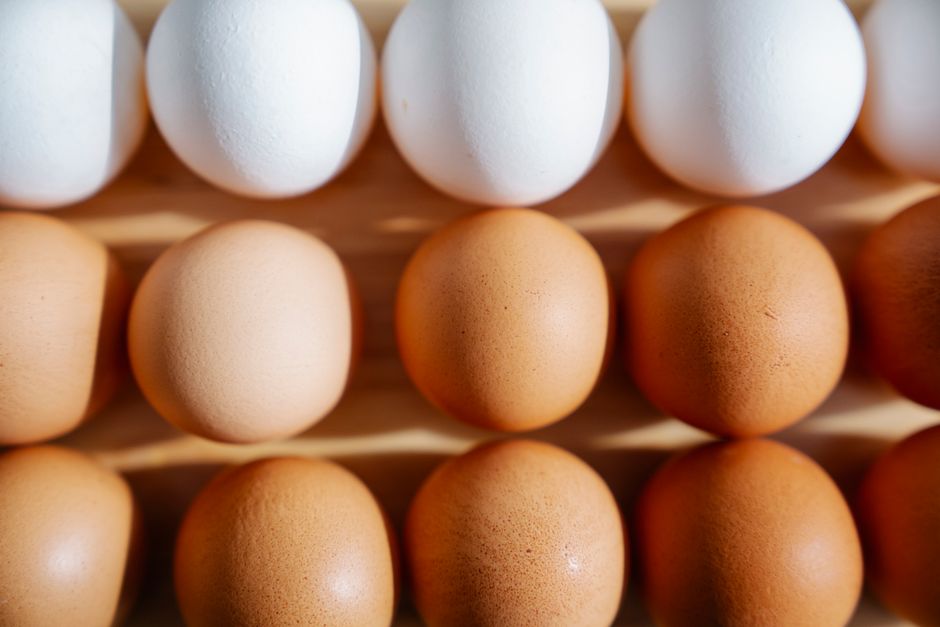
Egg color is determined by breed, not nutrition or care. Some breeds lay white eggs, some brown, some blue or green. Color has no bearing on nutritional value or taste.
How many eggs does a chicken lay per day?
A hen at peak production can lay close to one egg per day, but not every single day. The cycle takes slightly longer than 24 hours, so she typically skips a day periodically.
How many eggs does a chicken lay in a year?
A productive breed typically lays 200 to 300 eggs in her first laying year. Heritage and dual-purpose breeds often lay fewer, sometimes under 150.
Do you need a rooster for a hen to lay eggs?
No. Hens lay eggs whether or not a rooster is present. A rooster is only needed if you want the eggs to be fertilized.
How long do chickens lay eggs?
Most hens lay at a meaningful rate for about two to three years, with peak production in the first year. After that, output declines steadily with age.
Frequently Asked Questions
How many eggs does a chicken lay per day?
A hen at peak production can lay close to one egg per day, but not every single day. The cycle takes slightly longer than 24 hours, so she typically skips a day periodically.
How many eggs does a chicken lay in a year?
A productive breed typically lays 200 to 300 eggs in her first laying year. Heritage and dual-purpose breeds often lay fewer, sometimes under 150.
Do you need a rooster for a hen to lay eggs?
No. Hens lay eggs whether or not a rooster is present. A rooster is only needed if you want the eggs to be fertilized.
How long do chickens lay eggs?
Most hens lay at a meaningful rate for about two to three years, with peak production in the first year. After that, output declines steadily with age.
