
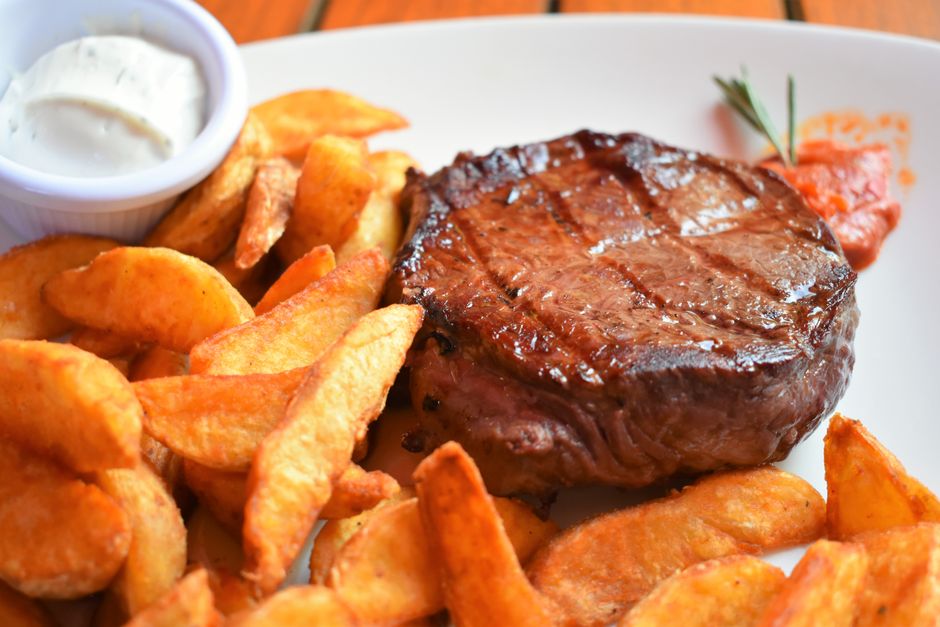
The number of calories in a steak depends heavily on the cut of meat and how much fat is left on it. A lean 3-ounce serving of sirloin steak has about 150 calories, while a fattier 3-ounce ribeye steak can have 220 calories or more. The biggest factor is visible fat — trimming it can cut calories by 30 to 50 percent depending on the cut.
How Many Calories Are In A Steak By Cut And Fat?
Steak calories vary widely because beef cuts have different amounts of marbled fat and exterior fat. Marbling is the white flecks of fat inside the muscle. Exterior fat is the thick white rim around the edge. Both add calories but in different ways.
A 3-ounce cooked portion of top sirloin — a lean cut — has roughly 150 calories and 6 grams of fat. A 3-ounce ribeye, which is heavily marbled, has about 220 calories and 15 grams of fat. T-bone and porterhouse steaks fall in the middle because they combine a lean tenderloin section with a fattier strip section.
The USDA provides specific data for common cuts. A 3-ounce serving of cooked beef eye of round — the leanest common cut — has 136 calories. The same size serving of cooked beef flank steak has 176 calories. Cooked beef ribeye filet has 202 calories. These numbers are for trimmed meat with all visible fat removed.
Does the Grade of Beef Change the Calorie Count?
Beef is graded by the USDA as Select, Choice, or Prime based on marbling. Prime has the most marbling, Select has the least. This grading directly affects calorie content even for the same cut of meat.
A Prime ribeye has significantly more marbling than a Select ribeye. Research from the USDA shows that Prime beef can have 10 to 15 percent more calories per serving than Select beef of the same cut. That difference comes entirely from fat content.
If you buy a Prime steak expecting the same calorie count as a Select steak of the same size, you will underestimate your intake. For calorie tracking purposes, the grade matters as much as the cut name. When a restaurant menu lists a ribeye, it is almost always Prime or high Choice grade, meaning higher calories than a grocery store Select ribeye.
How Much Does Trimming Fat Actually Save?
Trimming visible fat before cooking is the single most effective way to reduce steak calories. Studies have found that removing the exterior fat cap can reduce total calories by 30 to 50 percent depending on the cut. The fat cap on a ribeye can contain 80 to 100 calories per ounce by itself.
Marbled fat cannot be trimmed. It is inside the muscle fibers. So even a fully trimmed ribeye still has more calories than a fully trimmed sirloin. The marbling difference remains after trimming.
The USDA data shows that a 3-ounce untrimmed ribeye has about 270 calories. Trimmed, it drops to around 200 calories. A 3-ounce untrimmed sirloin has about 190 calories. Trimmed, it drops to 150 calories. The trimming benefit is real but it does not erase the inherent fat difference between cuts.





How Does Cooking Method Affect Steak Calories?
Cooking method changes calorie content in two ways. First, fat renders out during cooking. Second, added fats like butter or oil increase calories. Grilling and broiling allow more fat to drip away compared to pan-searing where fat stays in the pan.
Research published in the Journal of Food Science found that grilling a steak reduces its fat content by about 10 to 15 percent compared to pan-frying. This is because rendered fat drips through the grill grates rather than pooling around the meat. Braising or stewing steak also reduces fat content significantly because fat renders into the cooking liquid and is discarded.
Adding butter to a steak after cooking adds about 100 calories per tablespoon. Basting with butter during cooking adds similar calories. A steak cooked in a cast iron pan with two tablespoons of butter has roughly 200 extra calories compared to the same steak grilled without added fat. This difference can exceed the calorie difference between a lean cut and a fatty cut.
| Cut (3 oz cooked, trimmed) | Calories | Total Fat (g) |
|---|---|---|
| Eye of round | 136 | 5 |
| Top sirloin | 150 | 6 |
| Flank steak | 176 | 9 |
| T-bone (strip side) | 170 | 8 |
| T-bone (tenderloin side) | 160 | 7 |
| Ribeye | 202 | 13 |
| Porterhouse | 190 | 11 |
What About Different Serving Sizes and Doneness Levels?
Restaurant steaks are rarely 3 ounces. A typical restaurant serving is 8 to 12 ounces. An 8-ounce ribeye with visible fat has about 580 calories. A 12-ounce ribeye has about 870 calories. These numbers double or triple if the steak is cooked with butter.
Doneness level affects calorie content because cooking time influences fat rendering. A rare steak retains more of its original fat because less renders out. A well-done steak has more fat rendered away. The difference between rare and well-done for the same cut is roughly 5 to 10 percent fewer calories in the well-done version.
The USDA defines a serving as 3 ounces of cooked meat. Most people eat double that or more. A 6-ounce cooked sirloin is about 300 calories. A 6-ounce cooked ribeye is about 400 calories. If you add a butter sauce or marinade, add another 100 to 200 calories.
What Are the Most Common Misconceptions About Steak Calories?
The biggest misconception is that all red meat is high in calories. Lean cuts like eye of round and top sirloin have similar calorie counts to skinless chicken breast. A 3-ounce chicken breast has about 140 calories. A 3-ounce eye of round has 136 calories. The difference is negligible.
Another common myth is that grass-fed beef is significantly lower in calories than grain-fed beef. Research shows the calorie difference is minimal — roughly 5 to 10 calories per serving. Grass-fed beef has a slightly different fat profile with more omega-3s, but the total fat and calorie content are nearly identical.
Some people believe that marbling adds protein. It does not. Marbling is pure fat. A heavily marbled steak has the same protein content per ounce as a lean steak — about 7 grams per ounce. The extra calories from marbling come entirely from fat, not protein.
- Lean cuts like eye of round and sirloin are comparable to chicken breast in calories
- Grass-fed and grain-fed beef have nearly identical calorie counts
- Marbling adds fat calories, not protein
- Restaurant steaks are typically 2 to 4 times larger than a standard serving
- Butter and oil additions can double the calorie count of a lean steak
How to Accurately Track Steak Calories
The most reliable method is to weigh the cooked steak on a food scale and look up the USDA value for that specific cut. Do not rely on restaurant nutrition information. Restaurants often underestimate calories by 20 percent or more according to studies published by the Journal of the American Dietetic Association.
If you cannot weigh the steak, use visual estimation. A 3-ounce portion is about the size of a deck of cards. A 6-ounce portion is about the size of two decks of cards. Most restaurant steaks are two to four decks of cards in size.
For meal planning purposes, assume a 6-ounce cooked lean steak has about 300 calories. Assume a 6-ounce cooked fatty steak has about 400 calories. Add 100 calories per tablespoon of butter or oil used in cooking. These estimates are not precise but they are close enough for most people.
Frequently Asked Questions
How many calories are in a 8-ounce ribeye steak?
An 8-ounce cooked ribeye with visible fat trimmed has about 540 calories. An untrimmed 8-ounce ribeye has about 720 calories.
Does cooking steak reduce calories?
Yes, cooking reduces calories because fat renders out. Grilling or broiling removes more fat than pan-frying. The reduction is typically 10 to 15 percent.
What is the lowest calorie steak cut?
Eye of round is the lowest calorie common steak cut at 136 calories per 3 ounces cooked and trimmed. Top sirloin and flank steak are also low-calorie options.
How many calories are in a steak cooked with butter?
Each tablespoon of butter adds about 100 calories. A 6-ounce lean steak cooked with two tablespoons of butter has about 500 calories total.
