
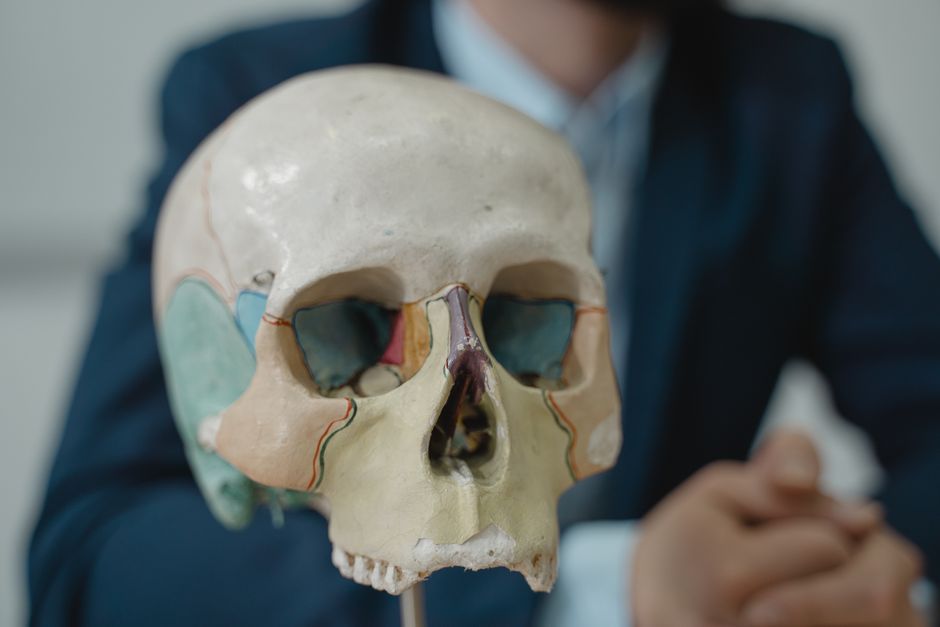
The human skull is made of 22 bones. That count covers the eight bones that form the cranium, which encases the brain, and the 14 bones that make up the facial skeleton. A separate group of six tiny bones — the three pairs of ear ossicles — sits inside the skull but is usually counted apart from the 22.
That is the short answer. The longer answer involves how those bones fuse, why the number is different in a newborn, and why some sources give you a different total entirely.
How Many Bones Make Up The Skull?
The adult skull contains 22 bones, not counting the ear ossicles. Of those, eight form the cranium and 14 form the face.
The eight cranial bones are the frontal, occipital, sphenoid, ethmoid, and the paired parietal and temporal bones. The frontal bone forms the forehead and the upper part of the eye sockets. The occipital bone sits at the back and base of the skull. The sphenoid and ethmoid are irregular bones tucked deeper in, forming parts of the eye sockets, nasal cavity, and the base of the skull.
The 14 facial bones include the paired maxillae, zygomatic, nasal, lacrimal, palatine, and inferior nasal conchae, plus the single mandible and vomer. The mandible is the lower jaw and the only skull bone that moves freely. The maxillae form the upper jaw and carry the upper teeth.
One clarification worth making: the hyoid bone sits in the neck, not the skull, and is usually counted separately. It is the only bone in the body that does not directly articulate with another bone.
Why Do Babies Have More Skull Bones Than Adults?
A newborn’s skull has more separate bone pieces than an adult’s because several bones have not yet fused. The most commonly cited figure is around 270 bones in a newborn’s entire body, dropping to 206 in adulthood as bones fuse.
In the skull specifically, the cranial bones begin as separate plates connected by flexible tissue called sutures. The soft spots you can feel on a baby’s head — the fontanelles — are gaps where these plates have not yet closed. The largest one, the anterior fontanelle, typically closes somewhere between 9 and 18 months of age, though the exact timing varies. The posterior fontanelle usually closes earlier, often within the first few months.
This flexibility is not a flaw. It lets the skull compress slightly during birth and gives the brain room to grow rapidly in the first years of life. By early childhood, the plates have fused into the solid structure of the adult skull.
What Are the Sutures and Why Do They Matter?
Sutures are the fibrous joints where cranial bones meet. They are not like the movable joints in your knee or shoulder. In a healthy adult, they are essentially locked together, allowing almost no movement.
The main sutures include:
- The coronal suture, running across the top of the skull from side to side
- The sagittal suture, running front to back along the top
- The lambdoid suture, at the back of the skull
- The squamous sutures, on each side where the temporal bones meet the parietal bones
These sutures serve a structural purpose. They allow the skull to grow evenly as the brain expands, then fuse to protect it. In adults, the sutures are visible as wavy lines on imaging. In forensic and archaeological work, suture closure patterns are sometimes used as a rough indicator of age, though the reliability of that method is debated.
When a suture fuses too early in a child — a condition called craniosynostosis — it can affect the shape of the head and, in some cases, put pressure on the brain. This is a medical condition that requires evaluation by a specialist, and treatment often involves surgery. It is not something to monitor at home.





What About the Ear Bones?
The six ear ossicles are the malleus, incus, and stapes — one of each in both ears. They are the smallest bones in the human body. The stapes, in particular, is tiny, roughly the size of a grain of rice.
These bones sit inside the middle ear cavity, which is located within the temporal bone of the skull. They transmit sound vibrations from the eardrum to the inner ear. Without them, hearing would be significantly impaired.
Whether to count them as skull bones is a matter of convention. Anatomically, they are housed within the skull. But most textbooks and reference sources count the skull as 22 bones and treat the ossicles as a separate category. If you include them, you get 28. If you also count the hyoid, you get 29. This is why you sometimes see different totals in different places.
Why Do Some Sources Give a Different Number?
The variation comes down to what gets included. The most common answer — 22 — refers to the cranium and facial skeleton only. That is the figure used in most anatomy textbooks and medical references.
Some sources include the ear ossicles and arrive at 28. Others include the hyoid bone and get 29. A few count the teeth, which are not bones, and produce a higher number still. None of these are wrong in an absolute sense. They are just counting different things.
If you are studying for a test or looking up a reference, 22 is the standard answer for the adult skull. The other numbers reflect broader definitions.
How Do the Skull Bones Fit Together?
The skull is not a single solid block. It is a set of bones joined at sutures, with openings for nerves, blood vessels, and the spinal cord.
The largest opening is the foramen magnum, at the base of the skull, where the spinal cord passes through. Other openings allow cranial nerves and blood vessels to enter and exit. The eye sockets, nasal cavity, and mouth are all formed by combinations of skull bones working together.
This arrangement gives the skull two jobs at once. It protects the brain and the sensory organs, and it provides attachment points for muscles that control chewing, facial expression, and head movement. The temporalis and masseter muscles, for example, attach to the skull and power the jaw.
The mandible is the exception to the skull’s rigidity. It connects to the temporal bone at the temporomandibular joint, which allows the jaw to open, close, and move side to side. That joint is one of the most used in the body, and problems with it are common.
Do Skull Bones Change With Age?
Yes, but mostly in ways that reduce the bone count rather than increase it. The main change is fusion. Bones that were separate in infancy become joined, and the total settles at 22.
Bone density also changes over time. Like other bones in the body, skull bones can lose mass with age, though the effect is generally less pronounced than in the hips or spine. The skull does continue to remodel throughout life, replacing old bone tissue with new.
In older adults, the sutures may become less distinct on imaging as they fully fuse. This is a normal part of aging and not a sign of disease.
What Else Should You Know About Skull Anatomy?
The 22-bone count is a useful reference point, but it is not the whole picture. The skull also includes cartilage, membranes, and the soft tissues of the face and scalp. The bones themselves are complex, with ridges, depressions, and openings that serve specific functions.
If you are trying to remember the number, the simplest version is this: 22 bones in the adult skull, eight cranial and 14 facial. Everything else — the ear bones, the hyoid, the fontanelles — is a detail that changes the total depending on how you count.
For most people, that is enough. If you need the number for a class, a test, or a reference, 22 is the one to use.
Frequently Asked Questions
How many bones are in the human skull?
The adult human skull has 22 bones: eight cranial bones and 14 facial bones. This count does not include the six ear ossicles or the hyoid bone.
How many bones does a baby’s skull have?
A baby’s skull has the same bones as an adult’s, but many are not yet fused. The separate plates and fontanelles allow for growth and flexibility during birth.
Is the jawbone part of the skull?
Yes. The mandible, or lower jaw, is one of the 14 facial bones of the skull. It is the only skull bone that moves freely.
Why do some sources say the skull has 28 bones?
Those sources include the six ear ossicles — the malleus, incus, and stapes in each ear — which sit inside the skull but are often counted separately. Adding them to the standard 22 gives 28.
