
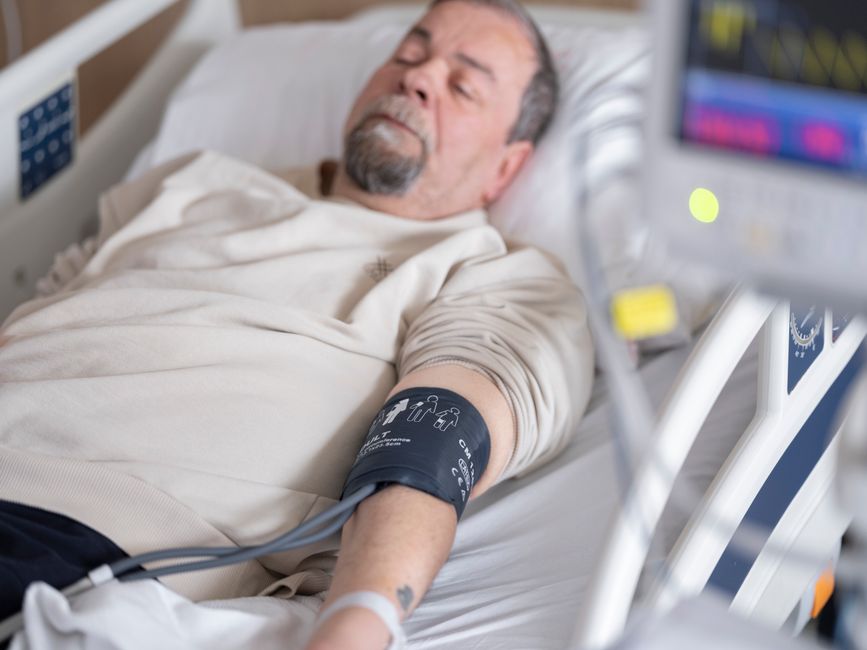
During healthy sleep, blood oxygen saturation normally stays between 95% and 100%. Brief dips to around 90% can happen even in healthy people, especially during REM sleep or after a long pause in breathing. Repeated drops below 90% that last more than a few seconds are not normal and are worth discussing with a doctor.
That is the short answer. The longer answer matters because sleep oxygen is not one steady number. It rises and falls with breathing, body position, and sleep stage. A single low reading on a consumer device often means less than people fear. A pattern of low readings over many nights means more.
What Is a Normal Blood Oxygen Level During Sleep?
Normal oxygen saturation, called SpO2, is 95% to 100% while awake and at rest. During sleep, most healthy adults stay in that same range.
Small, short dips are common and usually harmless. Breathing becomes slightly irregular as you move through sleep stages. During REM sleep, breathing patterns can shift, and a brief drop of a percentage point or two may show up. A healthy person typically returns to baseline within seconds.
What separates normal from concerning is not one number. It is how low, how long, and how often.
- How low: Dips that stay above roughly 90% are usually not a concern in an otherwise healthy person.
- How long: A dip lasting a few seconds is different from one lasting 30 seconds or more.
- How often: Occasional dips are normal. Dozens of dips per hour are not.
Doctors who read sleep studies look at all three. They also look at how much time is spent below 90%, because total time matters more than any single reading.
How Low Is Too Low? The 90% and 88% Thresholds
Below 90% is the line most clinicians treat as the start of concern. Oxygen saturation under 90% is generally called hypoxemia, meaning low oxygen in the blood.
Some sleep centers use 88% as a second marker. Time spent below 88% tends to carry more weight in a diagnosis than time spent below 90%. These numbers come from how oxygen binds to hemoglobin and how the body responds when saturation falls.
The relationship between saturation and oxygen delivery is not a straight line. Hemoglobin holds onto oxygen tightly until saturation drops into the lower 90s. Below that, the curve flattens, and small further drops release a larger share of oxygen to tissues. This is why the low 90s and high 80s get more attention than the difference between 97% and 99%.
One clarification worth knowing: a pulse oximeter measures saturation, not breathing. It cannot tell you whether a low reading came from a paused breath, shallow breathing, or a poor signal. That distinction requires a sleep study.
What Causes Blood Oxygen to Drop During Sleep?
The most common cause is obstructive sleep apnea. In this condition, the upper airway narrows or closes during sleep. Airflow stops even though the chest and belly keep trying to breathe. Oxygen falls, the brain briefly rouses the sleeper, the airway opens, and breathing restarts. This cycle can repeat many times an hour.
Other causes include:
- Central sleep apnea, where the brain stops sending the signal to breathe
- Obesity hypoventilation syndrome, where breathing is too shallow to clear carbon dioxide
- Chronic lung conditions such as COPD
- Heart failure, which can affect breathing patterns at night
- Certain medications, including opioids, which can slow breathing
- Alcohol before bed, which relaxes airway muscles
Body position plays a role too. Many people with sleep apnea have worse oxygen levels when sleeping on their back, because gravity pulls the tongue and soft tissue backward into the airway.
Altitude is another factor. At higher elevations, there is less oxygen in the air, so saturation runs lower for everyone, awake or asleep. A reading that would be normal at sea level may be expected at 8,000 feet.



Can You Trust a Smartwatch or Home Oximeter for Sleep Readings?
Consumer devices can spot a trend, but they are not diagnostic tools. A fingertip pulse oximeter and a smartwatch use different sensors and different algorithms, and both can be thrown off.
Common causes of false low readings include:
- Cold hands or poor circulation
- Movement during sleep
- Nail polish or artificial nails
- A loose or shifted sensor
- Irregular heart rhythms
Consumer sleep trackers often report an “oxygen variation” score rather than a true saturation number. That score is not the same as the SpO2 a sleep lab measures. A device flagging several drops is a reason to ask a doctor, not a diagnosis on its own.
If a home device shows repeated low readings, the next step is usually a formal sleep study. That test measures oxygen, airflow, brain activity, and breathing effort together, which is what allows a doctor to tell whether the dips are real and what is causing them.
When Should You See a Doctor About Low Sleep Oxygen?
Talk to a doctor if you notice repeated low readings along with symptoms. Oxygen numbers alone can be misleading, so symptoms matter just as much.
Warning signs that often travel with nighttime oxygen drops include:
- Loud snoring most nights
- Waking with a dry mouth or headache
- Gasping or choking during sleep
- Daytime sleepiness despite enough hours in bed
- Morning confusion or trouble concentrating
- Pauses in breathing noticed by a partner
Untreated sleep apnea is linked to higher risks of high blood pressure, heart rhythm problems, stroke, and type 2 diabetes. The link is well established in large studies. Treating the apnea can improve daytime alertness and blood pressure, though the effect on heart outcomes is still being studied.
Seek urgent care if oxygen stays below 90% while awake and resting, or if you have chest pain, severe shortness of breath, or confusion. Those are not sleep-related findings and need immediate attention.
What Do Sleep Study Results Actually Measure?
A sleep study reports more than a single oxygen number. It combines several measures into a full picture of your breathing overnight.
| Measure | What it shows |
|---|---|
| Oxygen saturation (SpO2) | How much oxygen your blood is carrying |
| Apnea-Hypopnea Index (AHI) | Number of breathing pauses or shallow breaths per hour |
| Oxygen desaturation index (ODI) | How many times per hour oxygen drops by a set amount |
| Time below 90% | Total minutes spent under the threshold |
The AHI is the number most often used to classify sleep apnea severity. The ODI and time below 90% add context about how much the drops actually stress the body. A person can have a moderate AHI but spend very little time below 90%, or the reverse.
This is why a doctor reads the whole report, not one line. Two people with the same oxygen low can have very different conditions depending on how often and how long the drops last.
Can You Raise Your Sleep Oxygen on Your Own?
Some steps may help, but none replace a diagnosis if apnea is present.
- Avoid alcohol and sedatives close to bedtime, since both relax airway muscles
- Sleep on your side rather than your back
- Keep nasal passages clear if congestion is a factor
- Maintain a healthy weight, since excess weight around the neck can narrow the airway
- Treat allergies or reflux that may affect nighttime breathing
These measures can reduce mild dips. They are not proven to fix moderate or severe sleep apnea. For that, the main treatment is positive airway pressure therapy, often called CPAP, which keeps the airway open with a steady stream of air. Other options include oral appliances and, in some cases, surgery.
If you use a home monitor and your numbers stay low despite these steps, that is a signal to get evaluated rather than keep adjusting on your own.
Frequently Asked Questions
What is a dangerously low oxygen level during sleep?
Saturation below 90% is generally considered low, and time spent below 88% is treated as more serious. Repeated or prolonged drops at these levels should be evaluated by a doctor.
Can blood oxygen drop to 80% during sleep and still be normal?
No. A drop to 80% is not normal and usually points to a breathing problem such as sleep apnea. It should be checked with a formal sleep study.
Is it normal for oxygen to drop during REM sleep?
Small, brief dips can happen during REM sleep even in healthy people because breathing patterns change. Larger or longer drops are not normal and suggest an underlying issue.
Can a smartwatch tell me if my sleep oxygen is too low?
A smartwatch can flag a pattern worth checking, but it is not accurate enough to diagnose a problem. Only a sleep study can confirm low oxygen and identify the cause.
