
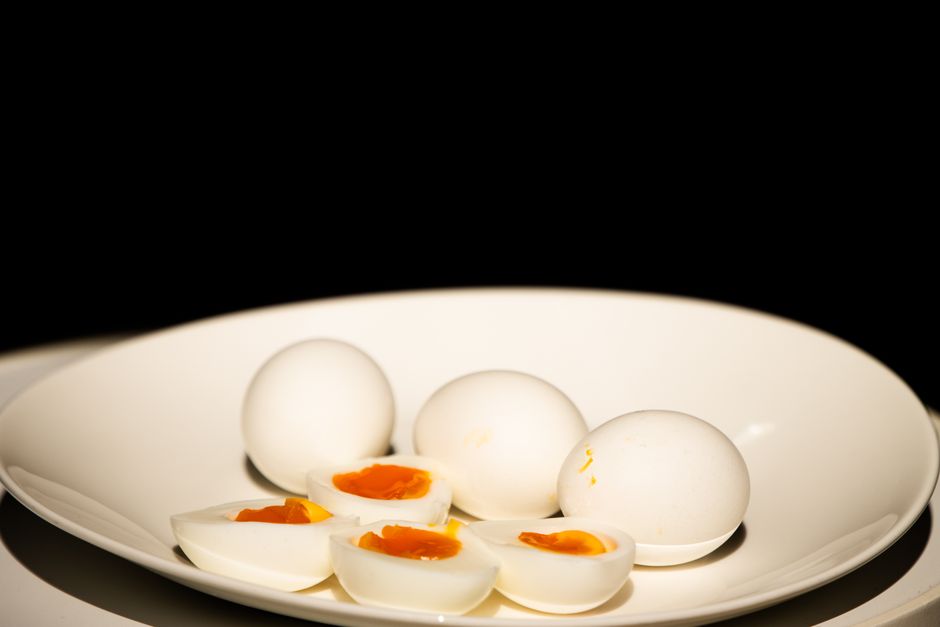
Soft-boiled eggs take about 6 minutes in actively boiling water for a large egg straight from the fridge. That timing gives you a fully set white and a yolk that is still runny in the center. If you want a jammy, slightly thickened yolk instead, add 30 to 60 seconds. If you want a yolk that is barely warm and very loose, pull the egg at 5 minutes. Those numbers assume you lower the egg into water that is already at a rolling boil, not cold water that heats up with the egg.
The single biggest reason soft-boiled eggs go wrong is not the timer. It is how the egg goes into the pot, how cold it was when it went in, and how fast you cool it down afterward. Get those three things consistent and the timing becomes repeatable.
How.Long To Boil Eggs Soft — A Simple Timing Guide
Timing depends on three variables: egg size, starting temperature, and how runny you want the yolk. The chart below assumes a large egg (about 50 grams of edible egg) lowered into already-boiling water.
| Desired yolk | Time in boiling water |
|---|---|
| Very runny, barely set white | 5 minutes |
| Runny yolk, fully set white | 6 minutes |
| Jammy, thickened yolk | 6 minutes 30 seconds to 7 minutes |
| Firm but not crumbly (medium) | 8 to 9 minutes |
For a medium egg, subtract roughly 30 seconds. For an extra-large or jumbo egg, add about 30 seconds. These are working ranges, not lab-measured constants — your pot, your stove, and your altitude all shift them slightly. The only way to lock in your own number is to test once and write it down.
One clarification that trips people up: “soft-boiled” and “soft-cooked” are used interchangeably, but a soft-boiled egg is cooked in the shell in water. A coddled egg is cooked in a cup in a water bath. A basted egg is cooked in a pan with steam. They are not the same method and the times do not transfer.
Why Does Starting Temperature Change the Timing So Much?
A fridge-cold egg needs more time than a room-temperature egg to reach the same internal temperature. That is basic heat transfer, not opinion. An egg pulled from a 40°F refrigerator and dropped into boiling water will have a cooler center at 6 minutes than one that sat on the counter for 20 minutes.
This is why recipes that say “6 minutes” without specifying starting temperature are unreliable. Two people can follow the same recipe and get completely different yolks.
The practical fix is consistency, not a different number. Pick one approach and stay with it:
- Always take eggs straight from the fridge and use the fridge-cold timing.
- Or always let eggs sit out for 15 to 20 minutes first and use a slightly shorter time.
Do not mix the two. If you sometimes use cold eggs and sometimes warm ones with the same timer, your results will vary and you will blame the method instead of the variable you changed.
Should You Start With Cold Water or Boiling Water?
Start with boiling water. This gives you a predictable clock. When you start with cold water, the timer begins before the water is even hot, and the actual cooking time depends on how powerful your burner is. That makes the timing far harder to repeat.
The boiling-water method also makes peeling easier for soft eggs, because the white firms up quickly against the shell rather than gradually. That said, soft-boiled eggs are never as easy to peel as hard-boiled ones — the white is delicate and the yolk provides no structure. Many people simply spoon the egg out of the shell rather than peel it.
If you do want to peel a soft-boiled egg, the standard approach is to tap the wide end, peel a small opening, and use a spoon to scoop the egg out in one piece. It works more reliably than trying to peel the whole shell by hand.





How Do You Stop the Cooking at the Right Moment?
You stop it with cold water, and you do it immediately. An egg keeps cooking from its own stored heat after you pull it from the pot. Leave a 6-minute egg on the counter for two minutes and the yolk will keep firming up. That carryover cooking is why so many people end up with a yolk that is firmer than they wanted.
The method that works:
- Move the egg straight from boiling water into a bowl of ice water.
- Leave it there for at least 1 to 2 minutes, or until it is cool enough to handle.
- Serve right away, or refrigerate and eat within a few days.
Ice water is more effective than tap water because it drops the temperature faster. Cold tap water works, but the egg will cool more slowly and the yolk will firm up a little more in the meantime.
Is a Soft-Boiled Egg Safe to Eat?
A soft-boiled egg is not fully cooked, and that matters for food safety. The concern is Salmonella, which can be present inside eggs even when the shell looks clean and intact. Cooking an egg until both white and yolk are firm reduces this risk. A runny yolk does not reach the same temperature.
The actual risk level depends on where you live and how the eggs were handled. In the United States, eggs sold at retail are typically washed, which removes the natural protective coating on the shell and is one reason US eggs are refrigerated. In many other countries, eggs are not washed and are stored at room temperature. These are different supply systems with different risk profiles, so advice from one country does not always apply in another.
Groups who are generally advised to avoid runny eggs include pregnant women, infants and young children, older adults, and anyone with a weakened immune system. If you are in one of those groups, the safer choice is to cook eggs until both white and yolk are firm. This is standard food safety guidance, not a soft recommendation.
If you want a soft yolk and are in a higher-risk group, pasteurized in-shell eggs are available in some markets. They have been heat-treated to reduce pathogens while still being usable for soft cooking. Availability varies, so check your local store.
Why Do Some Eggs Peel Easily and Others Do Not?
Peeling problems are mostly about the egg’s age and its internal pH. Fresh eggs have a lower pH in the white, which makes the white cling to the inner shell membrane. As an egg ages, it loses carbon dioxide through the shell, its pH rises, and the membrane separates more easily.
That is why older eggs peel better than very fresh ones. For soft-boiled eggs this matters less, because you are usually eating them out of the shell. For hard-boiled eggs it matters a lot.
Some people add salt or baking soda to the cooking water to raise the pH and improve peeling. There is a plausible mechanism for this, and it is a common kitchen practice, but the effect is modest and results vary. It is not a fix for very fresh eggs.
Does Altitude Change Soft-Boiling Time?
Yes, and it is worth knowing if you live at elevation. Water boils at a lower temperature as altitude increases — at sea level it boils at 212°F (100°C), and that temperature drops as you go higher. Because the water is cooler, the egg cooks more slowly.
At higher altitudes you generally need to add time, and the amount varies with how high you are. Rather than guessing, it is easier to test your own timing once at your elevation and adjust from there. There is no single conversion that works everywhere.
What About the Egg White Versus the Yolk?
Egg white and yolk set at different temperatures. The white begins to thicken and set at a lower temperature than the yolk. This is the whole reason a soft-boiled egg is possible at all — there is a window where the white is firm and the yolk is still liquid.
That window is narrow. It is roughly the difference between 6 minutes and 7 minutes for a large fridge-cold egg. Outside that range you either get a white that is still slimy or a yolk that has started to firm up. This is why soft-boiling rewards attention more than hard-boiling does.
Frequently Asked Questions
How long do you boil eggs for soft?
About 6 minutes in already-boiling water for a large egg from the fridge. That gives a set white and a runny yolk; add 30 to 60 seconds for a jammy yolk.
Do you put eggs in cold water or boiling water for soft-boiled eggs?
Put them into water that is already at a rolling boil. Starting with cold water makes the timing depend on your stove and burner, which is much harder to repeat.
Can you eat soft-boiled eggs when pregnant?
Standard food safety guidance advises pregnant women to avoid runny eggs and cook them until both white and yolk are firm. Pasteurized in-shell eggs, where available, are an option if you want a softer yolk.
Why is my soft-boiled egg always too hard?
Carryover cooking is the usual cause — the egg keeps firming up after you take it out of the pot. Move it straight into ice water to stop the cooking at the moment you want.
