
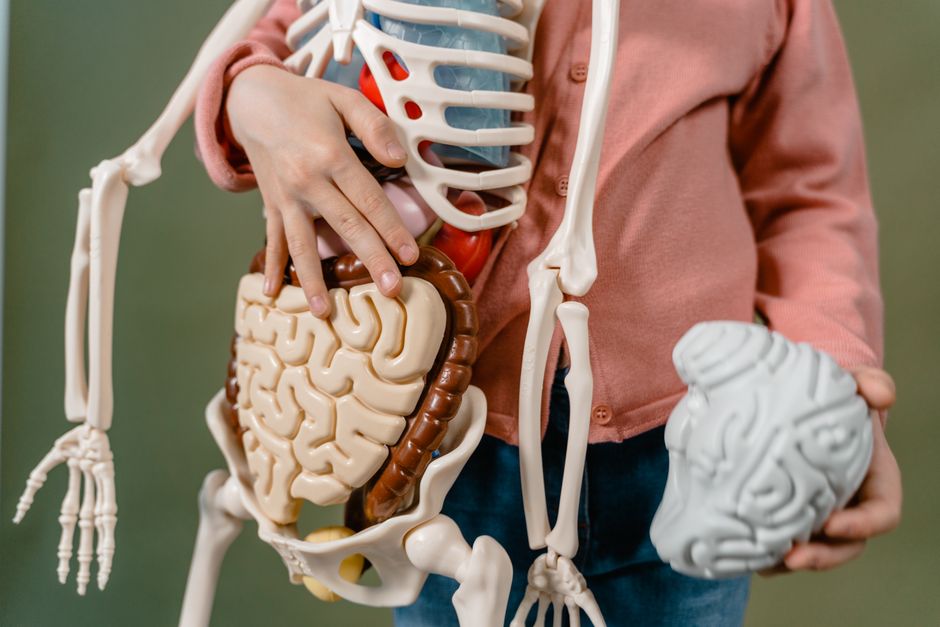
The human digestive tract is a continuous tube that runs from your mouth to your anus. If you could stretch it out straight, it would measure about 30 feet (roughly 9 meters) in a living adult. That length comes mostly from the small intestine, which alone accounts for around 20 feet.
That number surprises most people. It also raises a fair question: if 30 feet of intestine is coiled inside your abdomen, how does it all fit? The answer comes down to structure, muscle tone, and the way the tissue folds and loops. Understanding the length also helps explain why digestion takes the time it does.
How long is the human digestive tract from start to finish?
The full length is about 30 feet, or 9 meters, in a living adult. That measurement runs from the lips to the anus, and it includes every organ the food passes through along the way.
Here is how the length breaks down by section:
- Mouth and pharynx: a few inches
- Esophagus: about 10 inches (25 centimeters)
- Stomach: roughly 10 to 12 inches when relaxed
- Small intestine: about 20 feet (6 meters)
- Large intestine (colon): about 5 feet (1.5 meters)
- Rectum and anal canal: the final few inches
The small intestine does the heavy lifting. It is where most nutrient absorption happens, so its length matters. The colon is shorter but still plays a major role in reclaiming water and forming waste.
Why is the digestive tract shorter in a living person?
This is one of the more interesting details in anatomy. The 30-foot figure applies to a living person. A digestive tract removed during autopsy and measured on a table can stretch to roughly 26 feet or more, and some older estimates ran longer.
The difference comes down to muscle tone. In a living body, the intestinal wall is not limp. Smooth muscle keeps the tube under tension, so it holds a shorter, firmer shape. Once that muscle tone is gone, the tissue relaxes and can be pulled longer.
So the length you carry around is not a fixed number. It shifts with muscle activity, and it is always shorter than what you would measure on a dissecting table.
How does 30 feet of intestine fit inside the body?
The intestine fits because it is tightly coiled and folded, not stretched out. The small intestine loops back and forth in the center of the abdomen, held in place by a fan-shaped sheet of tissue called the mesentery.
The inner surface is also folded. The lining of the small intestine is covered in tiny finger-like projections called villi, and each villus is covered in even smaller projections called microvilli. These folds multiply the surface area for absorption without adding length.
That surface area matters more than the raw length. A tube 20 feet long with a smooth inside would absorb far less than the same tube packed with villi and microvilli. The folding is what makes the small intestine so efficient.





How long does food take to move through the digestive tract?
Total transit time varies widely between people. A commonly cited range is about 24 to 72 hours from swallowing to elimination, but that is a general figure rather than a fixed rule.
Timing by section looks roughly like this:
- Mouth to stomach: seconds to a minute
- Stomach: about 2 to 4 hours, longer after a large or fatty meal
- Small intestine: roughly 3 to 5 hours
- Colon: the longest and most variable stage, often 10 to 30 hours or more
The colon is where timing varies most. Some people move food through in under a day. Others take several days. Both can fall within a normal range.
What you eat, how much fiber and fluid you take in, your activity level, and your individual gut motility all affect the pace. So does medication, stress, and underlying health conditions.
Does body size change the length of the digestive tract?
Height and body size do affect tract length, but not as much as you might expect. A taller person generally has a somewhat longer tract than a shorter person, but the difference is modest compared with the variation between individuals.
Age matters too. The tract grows through childhood and reaches adult proportions in the teenage years. After that, length stays fairly stable. What can change with age is function, not length. Muscle tone in the gut wall can decline, and motility often slows.
Sex is not a major factor in overall length. Differences in organ size between men and women are smaller than the natural variation from one person to the next.
What is the difference between the digestive tract and the digestive system?
The digestive tract is the continuous tube food travels through. The digestive system is the broader set of organs that support digestion, including some that food never enters.
Organs in the digestive system but outside the tract include:
- Liver: produces bile and processes absorbed nutrients
- Gallbladder: stores and releases bile
- Pancreas: releases enzymes and bicarbonate into the small intestine
These organs connect to the tract through ducts. They add substances that break food down, but the food itself never passes through them. That distinction matters when people talk about “gut length” versus “the digestive system” as a whole.
How long is the digestive tract in children?
Children have shorter tracts because their bodies are still growing. Length increases with age and body size, reaching adult proportions by the late teen years.
No clinical guidelines set exact length values for children at specific ages. Measurements vary too much between individuals for a single standard to be useful. What clinicians track in children is growth, feeding tolerance, and symptoms, not tract length.
If a child has ongoing digestive symptoms, length is rarely the issue. A doctor looks at function, diet, and development instead.
Does a longer or shorter tract affect digestion?
Length alone does not predict how well someone digests food. What matters more is the health of the lining, the surface area from villi and microvilli, enzyme production, and how quickly contents move through.
The evidence here is limited when it comes to linking specific tract lengths to specific digestive outcomes. Some research suggests that surgical removal of parts of the intestine reduces absorption capacity, which makes sense given that surface area is lost. That is a different situation from natural variation in length.
For most people, the tract they were born with works well regardless of how it compares to an average number. If digestion is a problem, the cause is usually function, not length.
What can affect how well the digestive tract works?
Function depends on several factors that have nothing to do with total length. These include diet, hydration, physical activity, sleep, stress, and any medical conditions or medications in play.
The gut lining renews itself constantly, which helps it recover from normal wear. Blood flow to the intestines supports that repair. When blood flow drops, as in certain medical emergencies, the gut can be affected quickly.
Common things that can slow or disrupt normal function include:
- Low fiber intake
- Not drinking enough fluids
- Certain medications, including some pain relievers and antidepressants
- Ongoing stress
- Conditions such as irritable bowel syndrome or inflammatory bowel disease
These affect how the tract works, not how long it is. That is an important distinction, because it means most digestive complaints are not about anatomy but about function.
Frequently Asked Questions
How long is the human digestive tract in feet?
It is about 30 feet (9 meters) in a living adult, measured from the mouth to the anus. The small intestine alone makes up roughly 20 feet of that total.
Is the digestive tract longer in a dead body?
Yes, it can measure longer after death because the intestinal muscles lose tone and the tissue relaxes. In a living person, muscle tension keeps the tract shorter and firmer.
How long does food stay in the digestive tract?
A commonly cited range is about 24 to 72 hours from eating to elimination. The colon is the most variable stage and can hold contents for many hours or even days.
Does a longer digestive tract mean better digestion?
No, length alone does not determine how well you digest food. Surface area from villi and microvilli, enzyme activity, and motility matter more than total length.
