
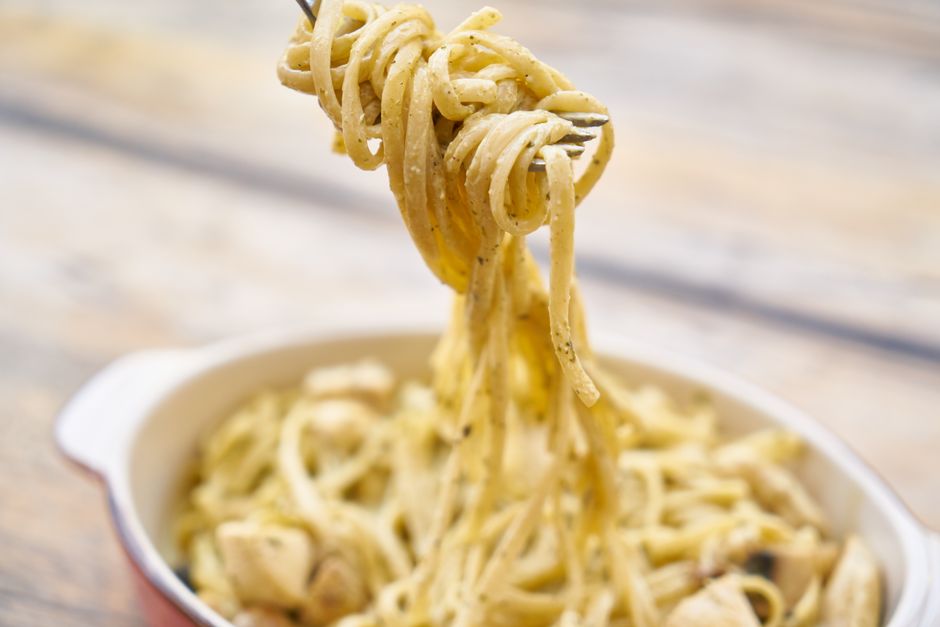
Cooked pasta keeps for about 3 to 5 days in the refrigerator when stored properly. That window applies to plain pasta and pasta mixed with sauce. After day five, the risk of foodborne illness rises enough that throwing it out is the safer choice. The clock starts the day you cook it, not the day you open the sauce jar.
Pasta is a moist, low-acid food, which makes it a friendly environment for bacteria. How you cool it, store it, and reheat it matters more than most people realize.
How Long Is Cooked Pasta Good For in the Fridge?
Three to five days is the standard food safety guidance for cooked pasta stored in the refrigerator. This comes from the same federal food safety framework that covers most cooked leftovers.
The count starts on the day you cook the pasta. If you made it Monday night, eat it by Friday or Saturday at the latest. Day six is not a judgment call worth making.
Two things shorten that window:
- Pasta left out at room temperature for more than 2 hours before refrigerating
- Pasta stored in a shallow container that cooled unevenly, leaving warm pockets
Bacteria multiply fastest between 40°F and 140°F. That range is called the danger zone. Every minute pasta spends cooling on the counter is time in that zone. The 2-hour rule is not conservative advice — it reflects how quickly bacterial populations can grow under those conditions.
One detail that surprises people: pasta that looks and smells fine can still carry enough bacteria to make you sick. Appearance and smell are not reliable safety tests. When in doubt, the date on the container is the better guide.
Does Pasta With Sauce Last as Long as Plain Pasta?
Sauced pasta lasts about the same 3 to 5 days as plain pasta, with a few exceptions worth knowing.
Tomato-based sauces are acidic, which slightly slows bacterial growth. Cream sauces, meat sauces, and dairy-heavy sauces are more perishable. If the pasta has meat sauce or a cream base, aim for the shorter end of that window — 3 days rather than 5.
Seafood pasta is a different situation. Cooked shellfish and fish deteriorate faster than meat or dairy. Most food safety guidance treats seafood leftovers as a 1 to 2 day proposition. Do not stretch it.
Pasta salads made with mayonnaise or oil-based dressings follow the same logic. If the salad sat out at a picnic or buffet for more than 2 hours, discard it regardless of how recently it was made.
Can You Eat Cooked Pasta After 5 Days?
No. Five days is the outer limit, not a suggestion you can round up. After that point, the risk of foodborne illness increases and the pasta offers no nutritional advantage over something fresh.
The bacteria that grow on cooked pasta are not always the kind that produce obvious spoilage. Bacillus cereus is one organism associated with cooked rice and pasta that has been held at improper temperatures. It can cause nausea, vomiting, and diarrhea, typically within a few hours to a day after eating. The pasta may not look or smell off.
This is why the 5-day rule exists as a hard stop rather than a soft guideline. You cannot reliably detect the problem with your senses.
If you are unsure how long the container has been in the fridge, or if it was stored near the back where temperatures fluctuate, err on the side of discarding it.


How Should You Store Cooked Pasta?
Cool it fast, seal it tight, and refrigerate it within 2 hours of cooking. Those three steps do most of the work.
Spread the pasta in a shallow container rather than packing it into a deep bowl. A shallow layer cools faster and more evenly. Once it has stopped steaming, cover it and move it to the refrigerator. Do not wait for it to reach room temperature on the counter — that is exactly the window bacteria need.
An airtight container is better than a bowl covered with plastic wrap or foil. Air exposure dries the pasta out and allows odors and contaminants in. Glass or hard plastic with a tight lid works well.
If you are storing pasta for meal prep, portion it into individual containers before refrigerating. That way you are not repeatedly opening one large container and exposing all of it to room temperature.
Freezing is an option if you want to extend the window. Cooked pasta freezes well for up to 2 months. Sauce and pasta can be frozen together. Thaw in the refrigerator overnight rather than on the counter.
Does Reheating Cooked Pasta Make It Safe?
Reheating kills many bacteria but does not eliminate all food safety risk. Some bacterial toxins are heat-stable and survive reheating.
This is an important point. If pasta has been stored too long and bacteria have produced toxins, heating it to steaming will not make it safe to eat. The bacteria may be dead, but the toxin they left behind is not destroyed by heat.
Reheat pasta to an internal temperature of 165°F. That is the standard threshold for reheating leftovers. A food thermometer is the only reliable way to confirm it. Microwaving until it feels hot is not the same as reaching 165°F throughout.
Reheat only what you plan to eat. Repeated cycles of heating and cooling give bacteria more opportunities to grow. If you have a large batch, portion out what you need and leave the rest in the fridge.
One more thing: pasta that has already been reheated once should not be reheated again. That is not a widely publicized rule, but it follows directly from the temperature cycling logic.
What About Pasta Left Out Overnight?
Throw it away. Pasta left out at room temperature overnight has spent many hours in the danger zone and is not safe to eat, even if it looks fine.
The 2-hour rule is firm for perishable cooked foods. After 2 hours at room temperature, bacteria can reach levels that cause illness. Overnight is well past that threshold.
Some people argue that pasta is not a high-risk food because it is plant-based. That reasoning does not hold. Cooked pasta is moist and contains starch and protein — both of which support bacterial growth. The fact that it is not meat does not make it safe.
If you are ever unsure whether pasta was left out too long, discard it. A stomach illness is not worth the cost of a serving of pasta.
Signs Cooked Pasta Has Gone Bad
Visible mold, a sour or off smell, sliminess, or a change in color are all signs to discard pasta. But the absence of these signs does not mean the pasta is safe.
Slimy texture is one of the more reliable indicators. Cooked pasta that has developed a slick or sticky coating that was not there before should be thrown out. A sour smell is another clear signal.
Mold on pasta is usually visible as fuzzy patches, often green, white, or black. Do not try to salvage pasta by removing the moldy portion. Mold can produce toxins that spread beyond what you can see.
The harder problem is pasta that shows none of these signs but has been stored too long. That is why the date matters more than your nose.
How Long Does Cooked Pasta Last at Room Temperature?
Two hours is the maximum. After that, it should be refrigerated or discarded.
If the room is warm — above 90°F — the window shrinks to 1 hour. This applies to outdoor gatherings, hot kitchens, and cars. The warmer the environment, the faster bacteria multiply.
This rule applies whether the pasta is plain, sauced, or in a salad. There is no version of cooked pasta that is exempt from the 2-hour rule.
Frequently Asked Questions
How long is cooked pasta good for in the fridge?
Cooked pasta is safe to eat for 3 to 5 days when stored in an airtight container in the refrigerator. Pasta with meat or cream sauce should be eaten within 3 days.
Can you eat cooked pasta after 7 days?
No. Seven days is well past the safe storage window for cooked pasta. The risk of foodborne illness is significant by that point, and reheating does not make it safe.
Does reheating pasta kill bacteria?
Reheating kills many bacteria but does not destroy heat-stable toxins they may have produced. Pasta stored too long is not made safe by reheating it to 165°F.
How do you know if cooked pasta has gone bad?
Signs include a sour smell, slimy texture, visible mold, or a change in color. If none of these are present but the pasta has been stored longer than 5 days, discard it anyway.
