
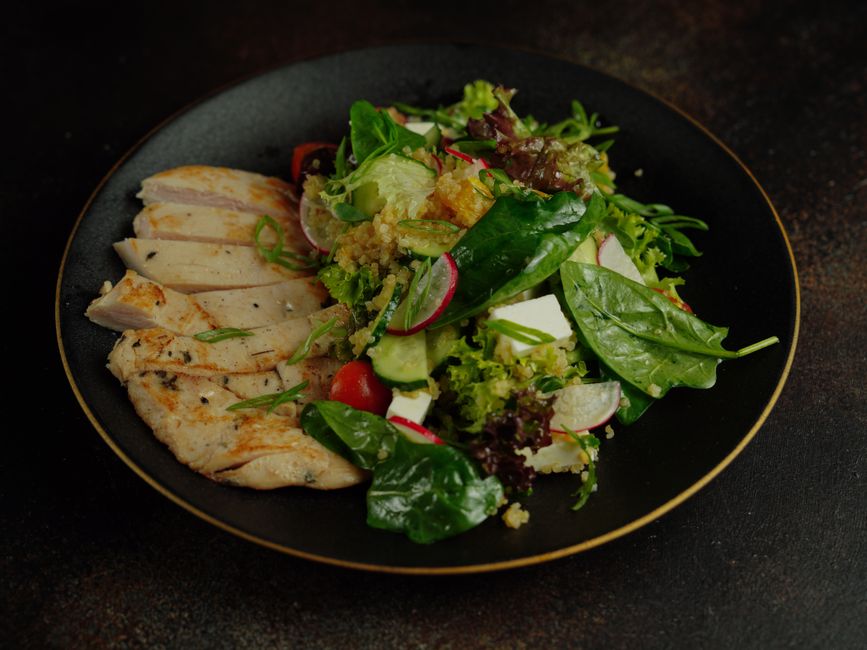
Cooked chicken should not sit out at room temperature for more than two hours. That two-hour limit applies to the total time the food spends between 40°F and 140°F, the range food safety agencies call the “danger zone.” If the room is warmer than 90°F — a hot kitchen, a picnic table in summer — the limit drops to one hour.
Those numbers come from the U.S. Department of Agriculture and the Food and Drug Administration, and they apply to cooked chicken just as they do to other perishable foods. The clock starts the moment the chicken stops being hot or cold, not when you first notice it sitting there.
Why Does Cooked Chicken Have a Time Limit at All?
Cooking kills bacteria. It does not sterilize food forever.
Once chicken is cooked, it is vulnerable again. Bacteria that survive the cooking process, or that land on the meat afterward from hands, utensils, or the air, can multiply rapidly in the warm, moist environment of cooked poultry. The danger zone — 40°F to 140°F — is the temperature range where this growth happens fastest.
The USDA’s two-hour rule is not arbitrary. It reflects how quickly bacterial populations can reach levels that make people sick. At room temperature, common foodborne bacteria can double in number roughly every 20 minutes under ideal conditions. Two hours gives them enough generations to become a genuine health risk.
Some bacteria also produce toxins as they grow. Those toxins are not destroyed by reheating. This is why you cannot simply microwave questionable chicken and assume it is safe. The bacteria may be dead, but what they left behind is not.
What Happens If You Eat Cooked Chicken Left Out Too Long?
Food poisoning from cooked chicken left out too long typically causes nausea, vomiting, stomach cramps, and diarrhea. Symptoms usually appear within a few hours to a day or two, depending on the organism involved.
The most common culprits on cooked poultry are Salmonella, Campylobacter, and Staphylococcus aureus. Staphylococcus is worth noting because it produces a heat-stable toxin — meaning reheating the chicken will not make it safe. The toxin survives high temperatures.
Most healthy adults recover from food poisoning without treatment in a few days. But some people face serious risk. Infants, young children, adults over 65, pregnant women, and anyone with a weakened immune system can develop severe illness, dehydration, or bloodstream infections. For these groups, a bout of food poisoning is not a minor inconvenience.
If you are unsure whether the chicken is safe, throw it out. The cost of replacing a meal is far lower than the cost of a serious illness.
Does the Two-Hour Rule Change in Hot Weather?
Yes. When the temperature is above 90°F, cooked chicken should not sit out for more than one hour.
Heat accelerates bacterial growth. At 90°F and above, the multiplication rate climbs steeply enough that the standard two-hour window is no longer protective. This matters for backyard barbecues, picnics, potlucks, and any outdoor gathering in summer.
The one-hour rule applies to the ambient temperature, not the food temperature. If the air around the chicken is above 90°F, the clock is one hour regardless of how the chicken was cooked or how long it was refrigerated beforehand.





How Can You Tell If Cooked Chicken Has Gone Bad?
You often cannot tell by looking or smelling. This is the part many people get wrong.
Pathogenic bacteria — the kind that make you sick — generally do not change the appearance, smell, or taste of food. Chicken that looks and smells fine can still be unsafe after sitting out too long. Sliminess, off odors, and color changes are signs of spoilage bacteria, which are a different problem. Spoilage tells you food is deteriorating. It does not reliably tell you whether pathogens are present.
Time and temperature are the reliable indicators. If cooked chicken has been in the danger zone for more than two hours — or one hour above 90°F — it should be discarded, no matter how it looks.
How Should You Store and Reheat Cooked Chicken Safely?
Refrigerate cooked chicken within two hours of cooking. Once refrigerated, it keeps for three to four days, according to USDA guidance.
For longer storage, freeze it. Cooked chicken holds quality in the freezer for about two to six months, though it stays safe indefinitely if kept at 0°F or below. Quality declines before safety does.
When reheating, bring the chicken to an internal temperature of 165°F. Use a food thermometer — not visual cues. Reheating to 165°F kills bacteria that may have grown during storage, though as noted earlier, it does not destroy heat-stable toxins.
A few practical points:
- Divide large batches into shallow containers so they cool faster in the fridge.
- Do not stack hot containers tightly — airflow helps cooling.
- Never thaw or reheat chicken by leaving it on the counter.
- Discard reheated leftovers that have themselves been out more than two hours.
What About Chicken in Salads, Casseroles, or Sandwiches?
The two-hour rule applies to any dish containing cooked chicken, not just plain meat.
Chicken salad, chicken casserole, chicken soup, and chicken sandwiches are all perishable. In fact, mixed dishes can be riskier because the chicken is chopped or shredded, creating more surface area for bacteria, and because mayonnaise-based salads are often kept at room temperature at gatherings.
The same clock applies. Two hours at room temperature, one hour above 90°F. After that, the whole dish should be thrown out — not just the chicken pieces.
Does Reheating Make Left-Out Chicken Safe Again?
No. Reheating kills bacteria but does not remove toxins they may have produced.
This is one of the most common misconceptions about food safety. Many people assume that if they heat the chicken back up to a high temperature, it becomes safe to eat. That is not how it works.
Some bacteria, including Staphylococcus aureus and Bacillus cereus, produce toxins that are heat-stable. They survive boiling, baking, and microwaving. If those toxins are present, reheating does nothing to reduce the risk.
The only reliable protection is preventing the bacteria from growing in the first place — which means respecting the time and temperature limits.
How Long Can Chicken Sit Out Cooked — A Quick Reference
| Condition | Maximum Safe Time Out |
|---|---|
| Room temperature below 90°F | 2 hours |
| Room temperature 90°F or above | 1 hour |
| Refrigerator storage after cooking | 3 to 4 days |
| Freezer storage after cooking | 2 to 6 months for best quality |
| Safe reheating temperature | 165°F internal |
These figures come from USDA and FDA food safety guidance. They are not suggestions — they are the thresholds public health agencies use to define when food becomes a meaningful risk.
Frequently Asked Questions
How long can cooked chicken sit out at room temperature?
Cooked chicken can sit out for up to two hours at room temperature below 90°F. After that, it should be discarded.
Is cooked chicken safe after 3 hours on the counter?
No. Three hours exceeds the two-hour limit set by the USDA and FDA, and the chicken should be thrown out. Reheating it will not make it safe.
Can I eat cooked chicken left out overnight?
No. Chicken left out overnight has been in the danger zone far longer than two hours and poses a real risk of foodborne illness. Discard it.
Does reheating kill bacteria in chicken left out too long?
Reheating kills bacteria but does not destroy heat-stable toxins some bacteria produce. Chicken left out too long is not made safe by reheating.
